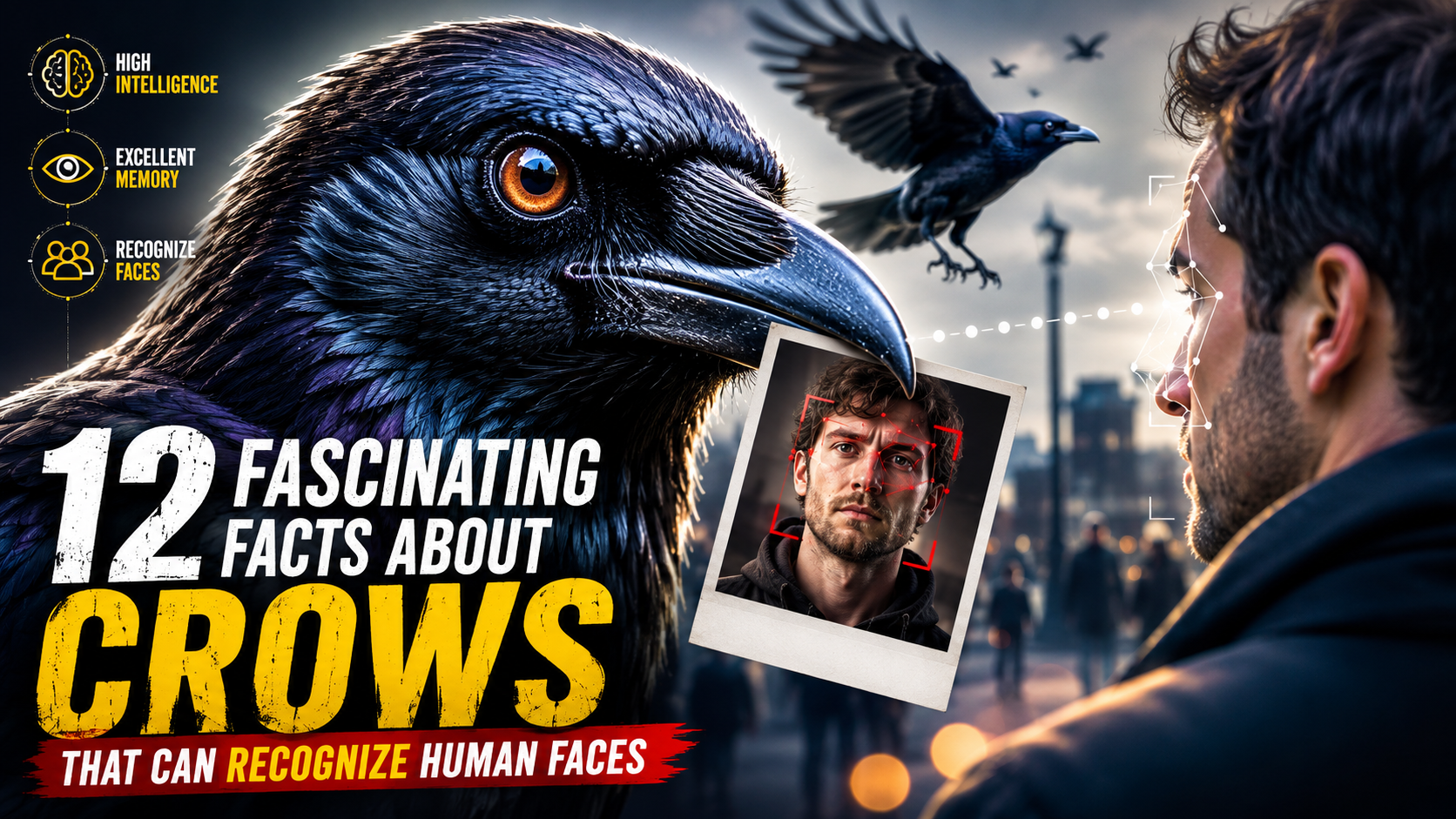
Crows have long been surrounded by myths and legends. In some cultures, they are seen as symbols of wisdom, while in others, they are associated with mystery and intelligence. As scientists continue to study these remarkable birds, one fact has become increasingly clear: crows are among the smartest animals on Earth.
Perhaps the most astonishing discovery is that crows can recognize and remember individual human faces. Far from being simple birds, they possess impressive cognitive abilities that rival those of many mammals. Their capacity to identify people, learn from experiences, and even communicate information to other crows has fascinated researchers around the world.
Here are twelve fascinating facts about crows and their extraordinary ability to recognize human faces.
1. Crows Can Distinguish One Human Face From Another
To a crow, humans do not all look the same.
Research has shown that crows can recognize individual faces and distinguish friendly people from those they perceive as threats. They pay attention to facial features and other visual cues, allowing them to remember specific individuals long after an encounter has occurred.
This ability is far more sophisticated than most people expect from a bird.
2. They Have Remarkably Long Memories
Crows do not quickly forget faces.
Studies suggest that they can remember particular people for years. If a crow has a positive or negative experience with someone, it may retain that memory and respond accordingly during future encounters.
Their long-term memory plays an important role in helping them navigate complex environments.
3. They Can Hold Grudges
One of the most surprising findings about crows is their ability to remember unpleasant experiences.
If a person threatens, startles, or harms a crow, the bird may continue to react cautiously or defensively toward that individual in the future. This behavior has led many researchers to describe crows as animals capable of holding grudges.
Their reactions demonstrate an impressive level of learning and memory.
4. Crows Can Share Information With Other Crows
Perhaps even more remarkable than facial recognition is the fact that crows appear capable of communicating information about people to other members of their group.
Researchers have observed crows warning one another about individuals they perceive as dangerous. Birds that never had direct contact with a person may still react negatively after receiving signals from other crows.
This social learning allows knowledge to spread throughout crow communities.
5. Young Crows Learn From Older Birds
Facial recognition is not always based solely on personal experience.
Young crows often observe the reactions of adults and learn which people should be approached cautiously and which appear harmless. This process resembles cultural learning, where knowledge is passed from one generation to another.
Such learning strategies are rarely associated with birds and highlight the complexity of crow intelligence.
6. Their Brains Are Exceptionally Advanced
Although crow brains are relatively small, they are remarkably efficient.
Scientists have discovered that certain regions of the crow brain perform functions similar to areas associated with advanced cognition in mammals. These structures support problem-solving, memory, and decision-making abilities.
Their neurological capabilities help explain why crows perform so well in cognitive studies.
7. Crows Are Excellent Problem Solvers
Facial recognition is only one example of their intelligence.
Crows have demonstrated an impressive ability to solve puzzles, use tools, and adapt to new situations. Some have learned to manipulate objects, retrieve food through multi-step tasks, and even exploit opportunities in urban environments.
Their problem-solving skills have earned them a reputation as some of the smartest birds on Earth.
8. They Adapt Easily to Human Environments
Crows thrive in both natural habitats and cities.
Their ability to recognize human faces may help explain their success in urban areas. By remembering which people provide food, pose threats, or ignore them completely, crows can make informed decisions that improve their chances of survival.
This adaptability has allowed them to flourish alongside humans.
9. They Recognize More Than Just Faces
Crows do not rely solely on facial features.
They also pay attention to clothing, body language, movement, and behavior. By combining multiple forms of information, they build surprisingly detailed memories about the individuals they encounter.
Their ability to process and remember these details demonstrates sophisticated cognitive flexibility.
10. They Display Signs of Social Intelligence
Crows live within complex social systems that require cooperation and communication.
Recognizing individuals, remembering past interactions, and sharing information are all characteristics associated with advanced social intelligence. These abilities help crows navigate relationships within both their own communities and the environments they share with humans.
Their social complexity continues to intrigue scientists.
11. Their Intelligence Challenges Traditional Assumptions About Birds
For many years, birds were often underestimated when it came to intelligence.
Modern research has dramatically changed that perception. Studies involving crows and other members of the crow family have shown that some birds possess cognitive abilities once thought to be unique to primates and other highly intelligent mammals.
The discovery that crows can recognize human faces is one of many findings reshaping our understanding of animal intelligence.
12. They Remind Us That Wildlife Is More Perceptive Than We Realize
Perhaps the most fascinating lesson from crow research is that wild animals often notice far more than humans assume.
A person walking through a park may not remember seeing a crow, yet the crow may remember that individual’s face for years. These birds constantly observe, learn, and respond to their surroundings in surprisingly sophisticated ways.
Their abilities remind us that intelligence in nature comes in many different forms.
Why Crow Intelligence Matters
The ability to recognize human faces is more than an interesting curiosity. It demonstrates that crows possess advanced memory, social learning, and decision-making skills that help them survive in changing environments.
Studying these birds also broadens our understanding of animal cognition. The more scientists learn about crows, the clearer it becomes that intelligence is not limited to humans or large-brained mammals. Evolution has produced remarkable cognitive abilities across many different branches of the animal kingdom.
A Bird With an Extraordinary Mind
Crows may look like ordinary black birds, but beneath their glossy feathers lies one of nature’s most impressive minds. Their ability to identify people, remember experiences, communicate information, and solve problems places them among the world’s most intelligent animals.
The next time you see a crow perched on a fence or gliding overhead, consider this intriguing possibility: it may be observing you more carefully than you realize—and it might even remember your face long after you’ve walked away.
In many ways, crows serve as a powerful reminder that the natural world is filled with intelligence, complexity, and hidden talents waiting to be discovered.