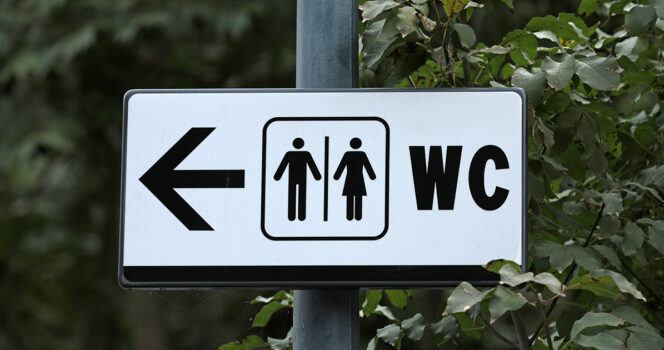
Have you ever walked past a public restroom, noticed the letters “WC” on the door, and wondered what they actually stand for?
You’re certainly not the only one. People around the world often come across this abbreviation and are left scratching their heads. While most of us are familiar with terms like bathroom, restroom, washroom, or even loo, “WC” can seem a little more mysterious.
Interestingly, once you learn its meaning, it may not sound any more logical than the other names we use for the same place.
The Great Bathroom Naming Debate
Back in 2020, a couple named Shelby and Dylan sparked an amusing conversation online when they shared a TikTok video highlighting the different words people use for public toilets in North America.
In the clip, Dylan notices a sign labeled “washroom” and questions the term.
“What exactly are people washing in there?” he jokes. “It’s basically a restroom. The only thing I wash is my hands.”
From behind the camera, Shelby quickly responds with her own observation: “Do people actually rest in a restroom?”
The exchange left Dylan laughing as he admitted neither term made much sense.
Their lighthearted debate quickly attracted attention, with viewers jumping into the comments to defend their preferred terminology.
One person pointed out that the room goes by many names, including bathroom, restroom, washroom, and toilet. Another recalled asking for a washroom during a visit to Disneyland and being directed toward a laundromat instead.
But one comment introduced a term that confused people even more:
“Wait until you hear about water closets.”
What Does WC Mean?
The abbreviation “WC” stands for “water closet,” a term that dates back more than a century.
According to dictionary definitions, a water closet refers either to a room containing a toilet or to the toilet fixture itself along with its related plumbing.
Historically, the various names for bathrooms had more literal meanings. A bathroom was a room designed for bathing. A restroom was a place where people could freshen up, rest briefly, or prepare themselves using sinks and mirrors. Meanwhile, the toilet was often located in a separate area known as the water closet.
Today, these distinctions have largely disappeared. Depending on where you live, the same room may be called a bathroom, washroom, restroom, lavatory, toilet, loo, or WC.
Why Do Public Places Use “WC”?
If you’ve traveled internationally, you’ve probably noticed “WC” signs in airports, hotels, train stations, and restaurants.
The abbreviation has become a widely recognized symbol that transcends language barriers. Because travelers from different countries may use different terms for restrooms, “WC” often serves as a universal label that most people can recognize regardless of their native language.
For this reason, it remains common in many parts of Europe, Asia, and other international destinations.
The Origins of the Water Closet
To understand where the term came from, it helps to look back at the history of indoor plumbing.
Before the late 1800s, indoor toilets were considered a luxury in the United States. Most households relied on outhouses or other outdoor facilities. While some homes contained rooms dedicated to bathing, these spaces usually did not include a toilet.
As indoor plumbing became more common during the late 19th century, toilets were often installed in their own small rooms. These separate spaces became known as water closets.
By the early 1900s, however, homes increasingly combined bathtubs, sinks, and toilets into a single room. This design was more practical, saved space, and simplified plumbing systems.
Although the combined bathroom became standard, the term “water closet” never completely disappeared. Instead, it evolved to describe a small enclosed toilet room located inside a larger bathroom. In some modern homes, a water closet still refers to a private compartment that contains only the toilet, sometimes with a small sink.
Why So Many Different Names?
The language surrounding bathrooms varies widely from country to country.
Americans commonly use “bathroom” or “restroom.” Canadians are well known for using “washroom.” In the United Kingdom, many people say “loo.” Other regions may prefer terms such as “lavatory,” “toilet,” or “WC.”
This variety often sparks lively discussions online.
In one Reddit conversation, users debated why Americans call public facilities “bathrooms” when there is often no bathtub inside.
One commenter humorously replied that Americans could just as easily ask why a “water closet” isn’t actually a closet.
Others pointed out that different cultures simply developed different euphemisms for referring to a room with a toilet. While Americans tend to favor “bathroom” and “restroom,” many other countries use terms like “WC,” “lavatory,” or “loo.”
The discussion became even more interesting when people shared how their own languages describe the room. One user explained that in Russian, the phrase can translate roughly to “room without windows,” even when a window is present. Another noted that in Esperanto, the word means “necessary place.”
Washroom, Restroom, or Bathroom?
The debate over the best name continues.
Many people argue that “washroom” is the most practical term because washing your hands is one of the main activities that takes place there. Others prefer “bathroom” simply because it’s the word they grew up using.
And while “restroom” remains common throughout the United States, critics point out that very little resting actually happens there.
Ultimately, there may never be a perfect term. Every name has its quirks, and each reflects a different piece of history and culture.
Whether you call it a bathroom, washroom, restroom, toilet, loo, lavatory, or WC, everyone is talking about the same essential place.
So next time you spot the letters “WC” on a door, you’ll know they stand for “water closet” — a term that has survived for more than a century, even as our bathrooms have evolved dramatically over time.
What do you call the room that contains a toilet? The answer may depend entirely on where in the world you live.