Few actors have left a mark on American cinema quite like John Wayne. For generations of moviegoers, he embodied the spirit of the Western hero—tough, determined, and guided by a strong sense of right and wrong. Born Marion Robert Morrison, Wayne’s journey from minor film roles to international stardom transformed him into one of the most recognizable faces in entertainment history.
Over a career that stretched across more than five decades, Wayne appeared in nearly 200 films and helped shape the image of the American cowboy on screen. His performances became deeply woven into Hollywood history, making him not only a movie star but also a cultural symbol whose influence extended far beyond the silver screen.
By the late 1970s, Wayne had already secured his place among Hollywood’s greatest legends. Audiences admired him for the larger-than-life characters he portrayed, many of whom represented courage, resilience, and unwavering conviction. Yet away from the cameras, he was fighting a series of serious health issues that had gradually taken a toll on his body.
Throughout his later years, Wayne faced several major medical challenges. He had previously battled cancer and undergone significant medical procedures, including heart-related surgery. Even as his health deteriorated, he remained determined to stay involved in public life whenever possible, demonstrating the same toughness that audiences had long associated with his screen characters.
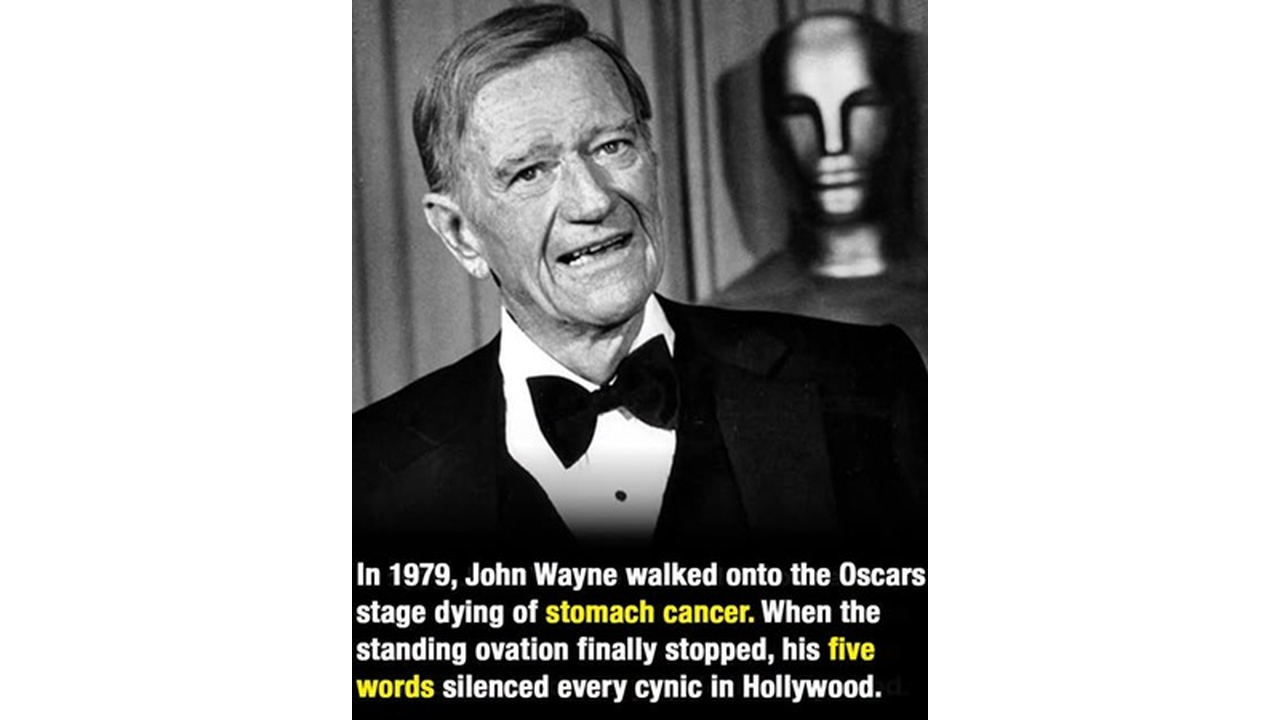
One of the most unforgettable moments of Wayne’s final years took place on April 9, 1979, during the Academy Awards ceremony at the Dorothy Chandler Pavilion in Los Angeles. By then, his declining health was evident, and many people understood the difficulties he had been facing. Nevertheless, he chose to attend the event, creating a moment that would later become one of the most emotional scenes in Oscar history.
Earlier that year, Wayne had undergone major surgery following another serious diagnosis. Combined with his previous battles with illness, the procedure left him visibly weaker than the robust figure movie fans remembered from classics such as Stagecoach and The Searchers. Despite these challenges, he accepted an invitation from his longtime friend Bob Hope to appear at the ceremony and present an award.
As Wayne stepped onto the stage that evening, the reaction from the audience was immediate. The room was filled with some of the most respected figures in the film industry, many of whom had admired him throughout their careers. Within moments, the crowd rose to its feet in a heartfelt standing ovation.
The applause lasted well beyond a typical welcome. It was not simply a tribute to a successful actor—it was recognition of a man whose work had helped define an era of filmmaking. The audience was honoring both his extraordinary career and the determination he had shown in the face of serious illness.
Although Wayne appeared noticeably thinner and more fragile than in previous years, there was still something unmistakably familiar about his presence. His calm confidence and natural authority remained intact. Even in declining health, he projected the same quiet strength that had made him a cinematic icon.
When the applause finally subsided, Wayne addressed the audience with the straightforward honesty for which he was known. He offered a brief message of gratitude, thanking those in attendance for their warm reception. His words were simple but deeply meaningful, reflecting the mutual respect between the actor and the people who had supported him throughout his remarkable career.
During the ceremony, Wayne helped present the award for Best Picture, which was ultimately awarded to The Deer Hunter. While his role during the event was relatively brief, the significance of his appearance was undeniable. Looking back, it would become one of the final major public moments of his life and career.
In the weeks that followed, Wayne’s condition continued to worsen. Though his mind remained active and he stayed close to family and friends, his physical health steadily declined. He continued seeking treatment and explored medical options that were considered innovative at the time. His determination to keep fighting reflected the same persistence that had characterized much of his life.
Even as his health faded, Wayne’s legacy continued to grow. By that point, he had become much more than a successful actor. His influence on American culture was immense, particularly through the Western genre. Films like Stagecoach, The Searchers, and numerous others helped define how Hollywood portrayed frontier life, heroism, and adventure for decades.
His impact also extended into the world of medical research. Following his death, his family played a key role in supporting the establishment of the John Wayne Cancer Institute, an organization dedicated to advancing cancer research and treatment. The institute became an important part of his legacy, ensuring that his name would contribute to helping others long after his film career ended.
John Wayne died on June 11, 1979, at the age of 72. News of his passing resonated throughout Hollywood and across the country. Tributes poured in from fellow actors, filmmakers, political leaders, and fans who had grown up watching his movies. Many reflected not only on his achievements in film but also on the lasting influence he had on American popular culture.
In the years since his death, his appearance at the 1979 Academy Awards has often been remembered as a poignant farewell. For many, it represented a final connection between a beloved star and the audience that had followed his career for decades. Rather than focusing solely on his illness, people often view the moment as a celebration of a life devoted to storytelling and entertainment.
Wayne was laid to rest at Pacific View Memorial Park in Newport Beach, California, overlooking the Pacific Ocean. Initially, details surrounding his gravesite were kept private out of respect for his family. Over time, however, it became a place of reflection for admirers who continue to appreciate his work and his contribution to cinema.
More than forty years after his passing, John Wayne remains one of the most influential figures in film history. His performances helped establish the Western as one of Hollywood’s defining genres, and his image continues to symbolize a significant era in American filmmaking.
His final Academy Awards appearance endures as one of the most memorable moments of his life—a powerful reminder of his resilience, his connection with audiences, and the respect he earned throughout his career. Though decades have passed since that night, the image of Wayne standing before a cheering crowd remains a lasting symbol of a Hollywood legend taking one final bow.
Today, his work continues to be studied, celebrated, and debated by film enthusiasts and historians alike. Whether viewed as a movie star, cultural icon, or cinematic pioneer, John Wayne’s influence remains firmly embedded in the story of American cinema, ensuring that his legacy will endure for generations to come.







