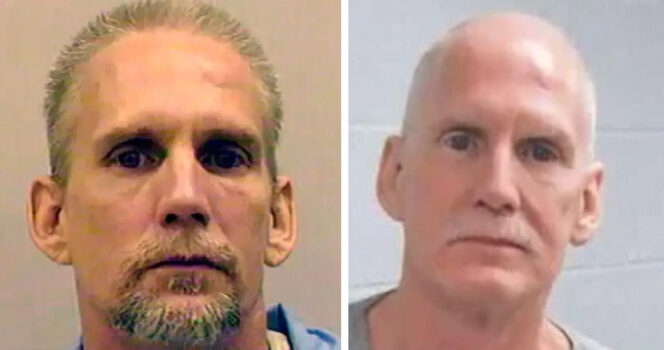
A federal death row inmate whose unusual final meal request once made headlines reportedly experienced severe suffering during his execution, according to findings later detailed in an autopsy.
Wesley Ira Purkey was executed by lethal injection in July 2020 at the age of 68 after spending years on federal death row. He had been sentenced to death in 2004 for the 1998 kidnapping, sexual assault, and murder of 16-year-old Jennifer Long in Kansas City, Missouri.
Jennifer disappeared on January 22 after she failed to arrive at school. Authorities later determined that Purkey approached the teenager outside a grocery store and persuaded her to get into his pickup truck.
Prosecutors said he drove Jennifer to his home, where he sexually assaulted and fatally stabbed her. Despite extensive efforts, her remains have never been found, according to the Death Penalty Information Center.
Purkey was also convicted of murdering 80-year-old Mary Bales, a polio survivor he had met while performing repair work at her house. Investigators said he returned to fix a kitchen faucet before attacking her with a claw hammer. He was later arrested after neighbors reportedly noticed him attempting to burn her body.
As his execution date approached, Purkey drew attention for an unusual request involving his final meal. Reports said he asked for pecan pie and requested that prison staff save part of it for “later,” seemingly overlooking the fact that he would not have another opportunity to eat it.
However, it was the details that emerged after his execution that sparked renewed debate. An autopsy concluded that Purkey developed severe acute pulmonary edema in both lungs after receiving the lethal injection drug pentobarbital. The report also documented a large amount of frothy fluid in his trachea and major airways.
Medical experts say pulmonary edema causes fluid to rapidly accumulate inside the lungs, making it increasingly difficult to breathe. The condition has often been compared to the sensation of drowning.
Dr. Gail Van Norman, a professor of anesthesiology and pain medicine, said the autopsy findings indicated Purkey was likely still alive while the fluid built up in his lungs.
According to her assessment, the evidence supports the view that many prisoners executed with pentobarbital could experience intense pain and distress, including feelings of suffocation and drowning before losing consciousness.
Purkey was executed at the federal penitentiary in Terre Haute, Indiana. Before his death, he addressed Jennifer Long’s family in a final statement, expressing regret for the suffering he had caused.
“I deeply regret the pain and suffering I caused to Jennifer’s family,” he said. He also apologized to his own daughter, saying he regretted the pain his actions had brought to her, and questioned the purpose of what he described as a “sanitized murder.”
Following the execution, Jennifer’s father, William Long, spoke briefly with reporters. Reflecting on the loss of his daughter, he said Purkey’s death marked the end of a long chapter, adding, “He needed to take his last breath. He took my daughter’s last breath.”
The case continues to be cited in broader discussions about capital punishment, with critics pointing to the autopsy findings as evidence that lethal injection may not always result in a painless death, while supporters argue that justice had finally been carried out for Purkey’s victims.







