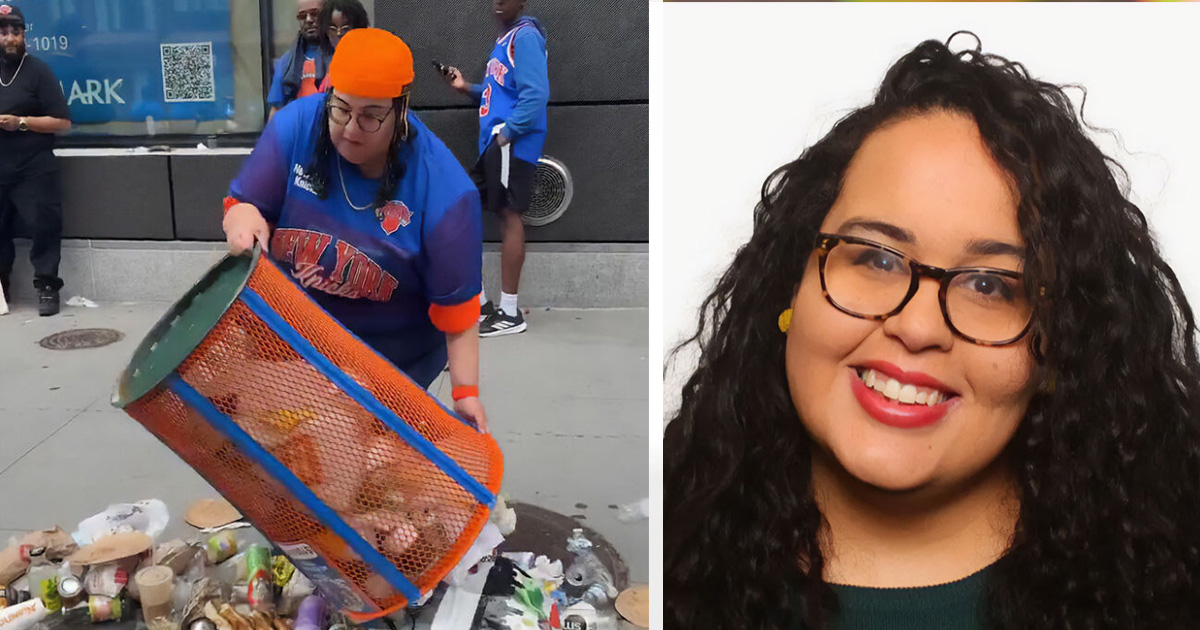
What began as a lighthearted celebration of the New York Knicks’ historic NBA championship quickly turned into a cautionary tale after a parade attendee was caught on camera stealing a city-owned trash can. The incident went viral across social media, and the consequences proved to be far more serious than the woman involved may have expected.
Parade Celebration Takes an Unexpected Turn
New York City was packed with jubilant basketball fans on June 18 as thousands gathered to celebrate the Knicks’ long-awaited NBA championship victory. Streets throughout Manhattan were filled with cheering supporters dressed in the team’s signature blue and orange colors.
Among the sea of fans was 40-year-old Angie Báez, whose actions would soon dominate headlines for reasons unrelated to basketball.
Videos recorded by spectators showed Báez walking up to one of the city’s specially designed Knicks-themed trash cans. Instead of simply posing for a photo with it, she dumped its contents onto the sidewalk before lifting the entire bin and carrying it away.
The unusual scene quickly spread across TikTok, X, Instagram, and other social media platforms, attracting millions of views within hours.
Subway Ride With the Stolen Trash Can Goes Viral
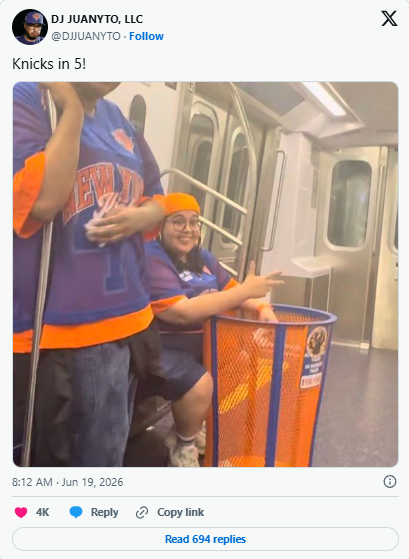
The story gained even more attention after another image surfaced showing Báez riding a New York City subway with the bright blue-and-orange trash can sitting beside her.
For many viewers, the image perfectly captured the bizarre nature of the incident.
While some initially treated it as a humorous moment from the championship celebrations, others pointed out that removing public property and littering city streets were criminal offenses rather than harmless pranks.
Identity of the Woman Revealed
As the videos continued circulating online, media outlets identified the woman as Angie Báez, a senior employee at JPMorgan Chase.
According to reports, Báez served as Executive Director of Community and Industry Engagement within the company’s Card and Connected Commerce division.
She had reportedly built much of her professional career around community outreach, diversity initiatives, and corporate engagement.
Before joining JPMorgan Chase, Báez held a leadership role overseeing diversity, equity, and inclusion efforts at restaurant recommendation platform The Infatuation before the company became part of Chase.
Professional biographies described her as someone dedicated to creating positive community impact and promoting greater inclusion across industries.
Employer Takes Swift Action
As public attention intensified, JPMorgan Chase confirmed that Báez was no longer employed by the company.
Although the bank declined to discuss specific details surrounding the decision, a spokesperson issued a brief statement confirming that her employment had ended.
The dismissal became one of the most talked-about aspects of the story, with many people debating whether losing a high-level corporate position was an appropriate consequence for the viral incident.
City Officials Condemn the Stunt
New York City’s Department of Sanitation also responded publicly after the theft attracted widespread attention.
Officials reminded residents that both littering and stealing city-owned property violate the law and undermine public spaces intended for everyone.
The department also criticized the decision to commit the acts while being recorded on camera, describing the behavior as remarkably poor judgment.
Their statement quickly spread online, becoming almost as widely shared as the original video itself.
Financial Penalties Added to the Consequences
In addition to losing her job, Báez was issued multiple civil penalties.
According to reports, she received:
- A $75 fine for illegally dumping garbage onto a public sidewalk.
- A $100 fine for interfering with sanitation department operations.
Although the financial penalties themselves were relatively modest, many observers noted that the loss of her career likely represented the most significant consequence.
Social Media Reacts
News of Báez’s dismissal generated strong reactions online.
Many users argued that actions have consequences, particularly for professionals representing major organizations.
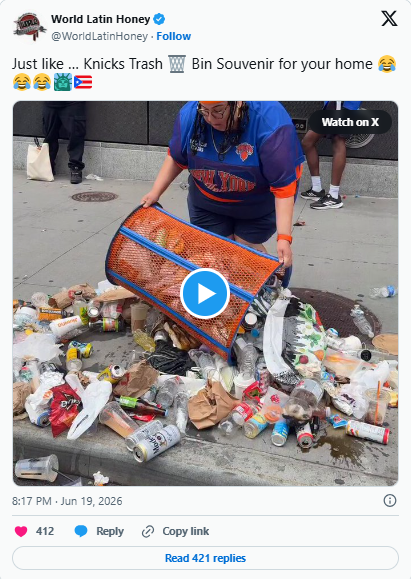
Some commented that the theft appeared unnecessary, noting that a similar decorative trash can could easily have been recreated as a personal keepsake without taking public property.
Others questioned whether losing a career over a single poor decision was excessive, suggesting that social media outrage often leads to disproportionately severe consequences.
The debate highlighted broader conversations about accountability, viral fame, and how online behavior can affect professional lives.
Trash Can Returned to Its Original Home
Fortunately, the missing trash can did not remain missing for long.
The New York City Department of Sanitation later announced that the limited-edition Knicks-themed receptacle had been recovered and returned to its original location.
To celebrate its return, the department posted a photo on social media with the playful caption:
“Home sweet home.”
The image also included a welcome-back message for the restored trash can, adding a touch of humor to an otherwise embarrassing episode.
A Reminder About Viral Decisions
The incident serves as another example of how quickly seemingly impulsive actions can escalate in today’s digital world.
What may have been intended as a humorous souvenir during a championship celebration instead resulted in public criticism, financial penalties, and the loss of a successful professional career.
As smartphones capture nearly every public moment, actions that once might have gone unnoticed can instantly become global headlines—often carrying consequences far beyond what anyone involved anticipated.







