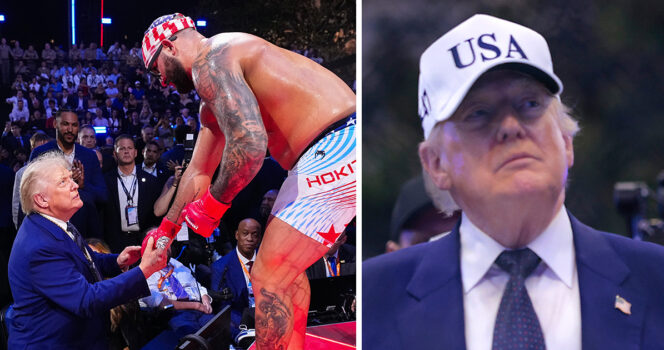
Controversy Erupts After UFC White House Event as Fighter’s Remarks Spark Online DebateWhat unfolded on Sunday night was the kind of spectacle few would have imagined even a few years ago. A UFC event—branded as UFC Freedom 250—took place on the grounds of the White House, staged as part of celebrations marking the 250th anniversary of the United States, alongside President Donald Trump’s 80th birthday.
The event immediately drew global attention, not only for the fights themselves but also for the unusual setting and the political symbolism surrounding it. With high-profile guests, dramatic production design, and an atmosphere that leaned heavily into spectacle, the evening quickly became one of the most talked-about sporting events of the year.
However, alongside the entertainment and fanfare, controversy was never far away.
A Night Overshadowed by Debate
Even before the first fight began, the event had already faced scrutiny. A lawsuit filed days earlier attempted to halt the fights from taking place on White House grounds, raising questions about legality, appropriateness, and the merging of political space with professional combat sports.
Although the legal challenge did not stop the event, it added an early layer of tension that followed the night into every major moment.
Hokit’s Victory Speech Sparks Backlash
One of the most widely discussed incidents occurred after UFC heavyweight Josh Hokit defeated Derrick Lewis. Hokit, who has been gaining attention for his outspoken personality and theatrical presence, took the microphone following his victory.
What began as a typical post-fight celebration quickly escalated when he made a controversial remark that drew immediate reaction both inside the arena and online.
His closing statement included a comment about Michelle Obama that many viewers found offensive and inappropriate, instantly shifting attention away from the fight itself and toward the fallout from his words.
UFC Leadership Responds
UFC president Dana White addressed the situation shortly afterward, describing the remarks as “nasty and false.” His comments reflected the organization’s effort to distance itself from the controversy while acknowledging the attention it was receiving.
Despite the quick response, the incident had already spread widely across social media, where clips of the moment circulated rapidly.
Trump’s Reaction Draws Public Attention
Much of the online discussion soon shifted toward President Donald Trump’s reaction during the moment.
Seated ringside, Trump was seen shortly after Hokit’s remarks removing a chain that the fighter had placed around his neck earlier in the evening. The timing of the gesture quickly became a focal point for speculation.
Some viewers interpreted the action as a subtle response to the fighter’s comments, while others argued it was simply unrelated and coincidental.
Footage appeared to show Trump reacting with a brief smile during the exchange, further fueling differing interpretations of the moment.
Media Coverage Adds More Context
CNN host Kaitlan Collins addressed the incident on air, noting the mixed reactions captured in the footage.
“So as Hokit wraps up his interview and walks away, you can see the president there on the other side of the ring. He can be seen sort of half smiling as there’s a mixture of cheers and boos,” she explained.
Collins also added that CNN had sought clarification regarding Hokit’s comments, but the White House declined to directly respond.
This lack of official comment only intensified public speculation about how the moment was viewed at the highest level.
Social Media Reacts Instantly
As expected, social media quickly became the main arena for interpretation and debate.
Some users believed the timing of Trump removing the chain was directly connected to the controversial remark, suggesting it was a silent form of disapproval. Others strongly disagreed, arguing that the removal was coincidental and likely just part of the natural post-fight interactions.
One user wrote that it was far more likely Trump simply removed the chain because the segment had ended and he no longer needed to wear it.
Another commenter echoed a similar view, saying there was no clear connection between the speech and the gesture, pointing out that the chain was removed immediately after the interaction concluded.
The differing interpretations highlighted how quickly public perception can split when political figures and high-profile sporting events intersect.
Calls for Disciplinary Action
Beyond speculation about Trump’s reaction, some online voices focused their criticism directly on Hokit.
A portion of users called for disciplinary measures from the UFC, arguing that his comments crossed a line. Critics described the remarks as inappropriate and unnecessary, particularly in a celebratory sporting environment.
Others defended the importance of free expression within post-fight interviews, though even among supporters, opinions were divided on whether the comments were appropriate for the moment.
A Blurred Line Between Sport and Spectacle
The UFC Freedom 250 event highlighted the increasingly blurred boundaries between sports, entertainment, and political theater.
By staging fights at such a symbolically significant location, the event guaranteed attention well beyond the combat itself. Every gesture, reaction, and comment became part of a larger narrative that extended far outside the octagon.
What might once have been a routine post-fight interview instead became a global talking point within minutes.
The Power of a Single Moment
In modern sports media, isolated moments can rapidly define entire events. Hokit’s post-fight remarks, combined with the visible reactions of those nearby, demonstrated how quickly narratives form and spread.
Whether intentional or not, every detail—from spoken words to small physical gestures—was analyzed, interpreted, and debated by audiences worldwide.
Final Thoughts
The UFC Freedom 250 event will likely be remembered less for the fights themselves and more for the controversy that unfolded around them.
Between legal challenges, political symbolism, and viral post-fight moments, the evening became a case study in how modern sports exist at the intersection of entertainment, politics, and digital scrutiny.
As debates continue online, one thing remains clear: in today’s media landscape, no moment is ever just a moment—it is content, interpretation, and controversy all at once.







