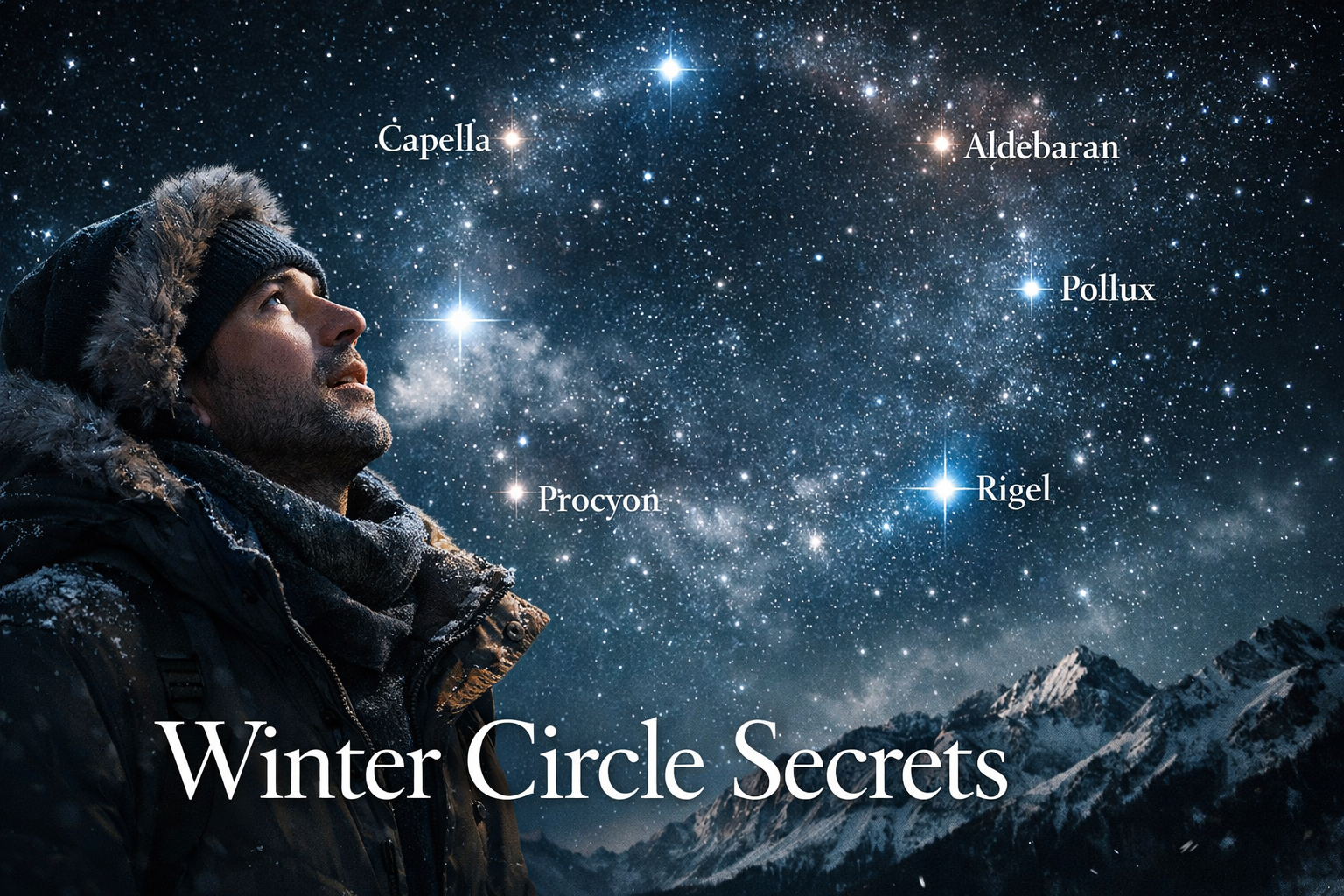
When winter arrives in the Northern Hemisphere, the night sky transforms into one of the most spectacular celestial displays of the year. Among the countless stars shining overhead, a remarkable pattern known as the Winter Circle captures the attention of astronomers, stargazers, and casual skywatchers alike. This enormous celestial formation is made up of some of the brightest stars visible from Earth, creating a giant ring that dominates winter evenings.
But the Winter Circle is more than just an attractive arrangement of stars. Each stellar beacon within this cosmic shape holds incredible stories—ranging from massive supergiants nearing the ends of their lives to stars that guide our understanding of the universe. Hidden among them are mysteries involving stellar evolution, ancient mythology, and the future fate of entire solar systems.
Let’s explore ten of the brightest stars associated with the Winter Circle and uncover the secrets that make them some of the most fascinating objects in the night sky.
What Is the Winter Circle?
The Winter Circle, sometimes called the Winter Hexagon, is a large asterism visible during winter months in the Northern Hemisphere. Unlike official constellations, an asterism is a recognizable pattern formed by stars that may belong to different constellations.
The Winter Circle is typically outlined by six prominent stars:
- Sirius
- Procyon
- Pollux
- Capella
- Aldebaran
- Rigel
Many observers also include Betelgeuse, creating an even more impressive shape that highlights the grandeur of the winter sky.
These stars belong to several constellations, including Orion, Taurus, Gemini, Canis Major, Canis Minor, and Auriga. Together, they form one of the easiest and most rewarding celestial landmarks to identify.
1. Sirius: The Dazzling Dog Star
Sirius is the brightest star visible in Earth’s night sky and serves as the shining jewel of the Winter Circle. Located in the constellation Canis Major, it outshines nearly every other star we can see without a telescope.
Despite appearing as a single point of light, Sirius is actually a binary star system. Its companion, Sirius B, is a white dwarf—the dense remnant of a once-larger star.
Hidden Secret
One of the most fascinating aspects of Sirius is its companion star. Sirius B packs nearly the Sun’s mass into a body roughly the size of Earth. A teaspoon of its material would weigh tons on our planet. This makes Sirius an excellent example of the strange and extreme outcomes of stellar evolution.
2. Procyon: The Little Dog’s Bright Companion
Procyon, found in the constellation Canis Minor, is often overshadowed by Sirius, yet it remains one of the brightest stars in the sky.
Its name means “before the dog,” referring to the fact that it rises shortly before Sirius from many locations.
Hidden Secret
Like Sirius, Procyon is also part of a binary system. Its companion is another white dwarf, providing astronomers with valuable clues about how stars age and die. Observations of Procyon help scientists test theories about stellar lifecycles and internal structure.
3. Pollux: The Giant Twin
Pollux is the brighter of the famous twin stars in Gemini. Its warm orange glow makes it stand out among neighboring stars.
Unlike many stars visible in the Winter Circle, Pollux has already evolved beyond the main phase of its life and expanded into a giant star.
Hidden Secret
Pollux hosts at least one confirmed exoplanet. This discovery demonstrated that planets can survive even after their parent stars begin evolving into giants. Studying Pollux and its planetary system offers insight into what may eventually happen to our own solar system billions of years from now.
4. Castor: The Hidden Multiple-Star System
Although Castor is not always counted as one of the Winter Circle’s main corner stars, it sits close to Pollux and is one of Gemini’s most famous celestial objects.
To the naked eye, Castor appears as a single bright star.
Hidden Secret
Castor is actually a complex system containing six stars organized into three binary pairs. This makes it one of the most intriguing stellar families visible in the night sky. Through telescopes, astronomers can study the gravitational interactions among these stars and better understand how multiple-star systems form.
5. Capella: The Golden Beacon
Capella shines brilliantly from the constellation Auriga and appears as a golden-yellow star high above the winter horizon.
It has been an important navigational star for centuries and remains a favorite target for amateur astronomers.
Hidden Secret
Capella is not a single star but a system containing multiple stars. The two primary stars are giant suns that orbit each other closely. Both have exhausted much of their hydrogen fuel and are entering later stages of stellar evolution.
Scientists use Capella as a natural laboratory for studying how stars change as they age.
6. Aldebaran: The Fiery Eye of the Bull
Aldebaran marks the eye of Taurus the Bull and is instantly recognizable because of its reddish-orange color.
Its appearance near the famous Pleiades star cluster makes it one of the most striking sights in the winter sky.
Hidden Secret
Although Aldebaran appears to belong to the nearby Hyades star cluster, it is actually much closer to Earth. This alignment is merely a line-of-sight coincidence. The star’s distinctive color comes from its status as a red giant, indicating that it has already exhausted much of the hydrogen in its core.
7. Rigel: Orion’s Brilliant Blue Giant
Rigel forms Orion’s left foot and ranks among the most luminous stars visible from Earth.
Its intense blue-white light signals extremely high surface temperatures.
Hidden Secret
Rigel is a massive supergiant destined for a dramatic ending. Astronomers believe it will eventually explode as a supernova, releasing an enormous amount of energy into space. Such an explosion would briefly rival the brightness of an entire galaxy.
Studying Rigel helps researchers understand the life cycles of massive stars and the processes that create many of the heavier elements found throughout the universe.
8. Betelgeuse: The Star That Could Explode
Few stars have captured public attention quite like Betelgeuse. Located in Orion’s shoulder, this red supergiant is one of the largest stars visible to the naked eye.
If placed at the center of our solar system, Betelgeuse would extend far beyond the orbit of Mars.
Hidden Secret
Betelgeuse has experienced unusual dimming events that sparked worldwide speculation about an imminent supernova explosion. While astronomers now believe the dimming was caused by dust and surface activity, the star remains near the end of its life.
One day, it will explode in a spectacular supernova visible even during daylight. Fortunately, it is far enough away that Earth would remain safe.
9. Bellatrix: Orion’s Warrior Star
Bellatrix, another prominent star in Orion, has been known since ancient times as the “Female Warrior.”
Though not as bright as Rigel or Betelgeuse, it contributes significantly to Orion’s unmistakable shape.
Hidden Secret
Bellatrix is a hot blue giant star rotating at an astonishing speed. Rapid rotation influences everything from its shape to its internal dynamics. Astronomers study stars like Bellatrix to understand how rotation affects stellar evolution and lifespan.
10. Alnath: The Star Between Two Constellations
Alnath sits at the border between Taurus and Auriga and often receives less attention than other bright winter stars.
Yet its position makes it an important marker in the night sky.
Hidden Secret
Alnath is a powerful blue giant producing immense amounts of ultraviolet radiation. Its characteristics offer valuable information about how massive stars influence their surrounding environments, including nearby gas clouds where future stars may form.
The Hidden Science of the Winter Circle
The stars of the Winter Circle may appear close together from our perspective on Earth, but they are actually separated by vast distances.
For example:
- Sirius lies about 8.6 light-years away.
- Procyon is approximately 11.5 light-years distant.
- Aldebaran sits around 65 light-years away.
- Rigel is hundreds of light-years from Earth.
- Betelgeuse is located even farther away.
This means the Winter Circle is not a physical structure. It is simply a pattern created by our viewpoint within the Milky Way.
The arrangement reminds us that the universe is three-dimensional and often far more complex than appearances suggest.
Ancient Myths Behind the Stars
Long before telescopes existed, civilizations around the world created stories inspired by these brilliant stars.
The Greeks associated many Winter Circle stars with legendary figures:
- Orion represented a mighty hunter.
- Taurus symbolized a powerful bull.
- Gemini represented the twins Castor and Pollux.
- Canis Major and Canis Minor depicted Orion’s loyal hunting dogs.
Ancient Egyptians paid special attention to Sirius because its annual rising coincided with the flooding of the Nile River, a critical event for agriculture and survival.
These myths demonstrate humanity’s enduring connection with the night sky and our desire to understand the cosmos.
Why the Winter Circle Is Perfect for Stargazing
The Winter Circle remains one of the easiest celestial patterns for beginners to identify.
Several factors make it ideal for observation:
- It contains exceptionally bright stars.
- The stars are spread across a large area of sky.
- Most are visible even from moderately light-polluted locations.
- It helps observers locate major constellations quickly.
A clear winter evening often provides excellent viewing conditions because colder air tends to contain less atmospheric moisture and haze.
Looking Beyond the Circle
Once you’ve identified the Winter Circle, many other celestial treasures become easier to find.
Within and around the formation, observers can discover:
- The Orion Nebula, a vast stellar nursery.
- The Pleiades star cluster.
- The Hyades cluster.
- Numerous double stars and variable stars.
- Bright planets that occasionally pass through the region.
A simple pair of binoculars can reveal details that are invisible to the naked eye, making winter one of the best seasons for exploring the heavens.
Final Thoughts
The Winter Circle is far more than a beautiful arrangement of bright stars. It serves as a gateway to understanding the universe, showcasing stellar giants, dying suns, multiple-star systems, and future supernova candidates. Each star within the circle tells a unique story about cosmic evolution, extreme physics, and humanity’s long-standing fascination with the night sky.
Whether you’re a seasoned astronomer or someone stepping outside on a cold winter evening for a quick look upward, the Winter Circle offers an unforgettable reminder of the wonders waiting above us. Hidden within its shining stars are clues about the past, present, and future of our universe—proof that even the most familiar points of light still hold extraordinary secrets.







