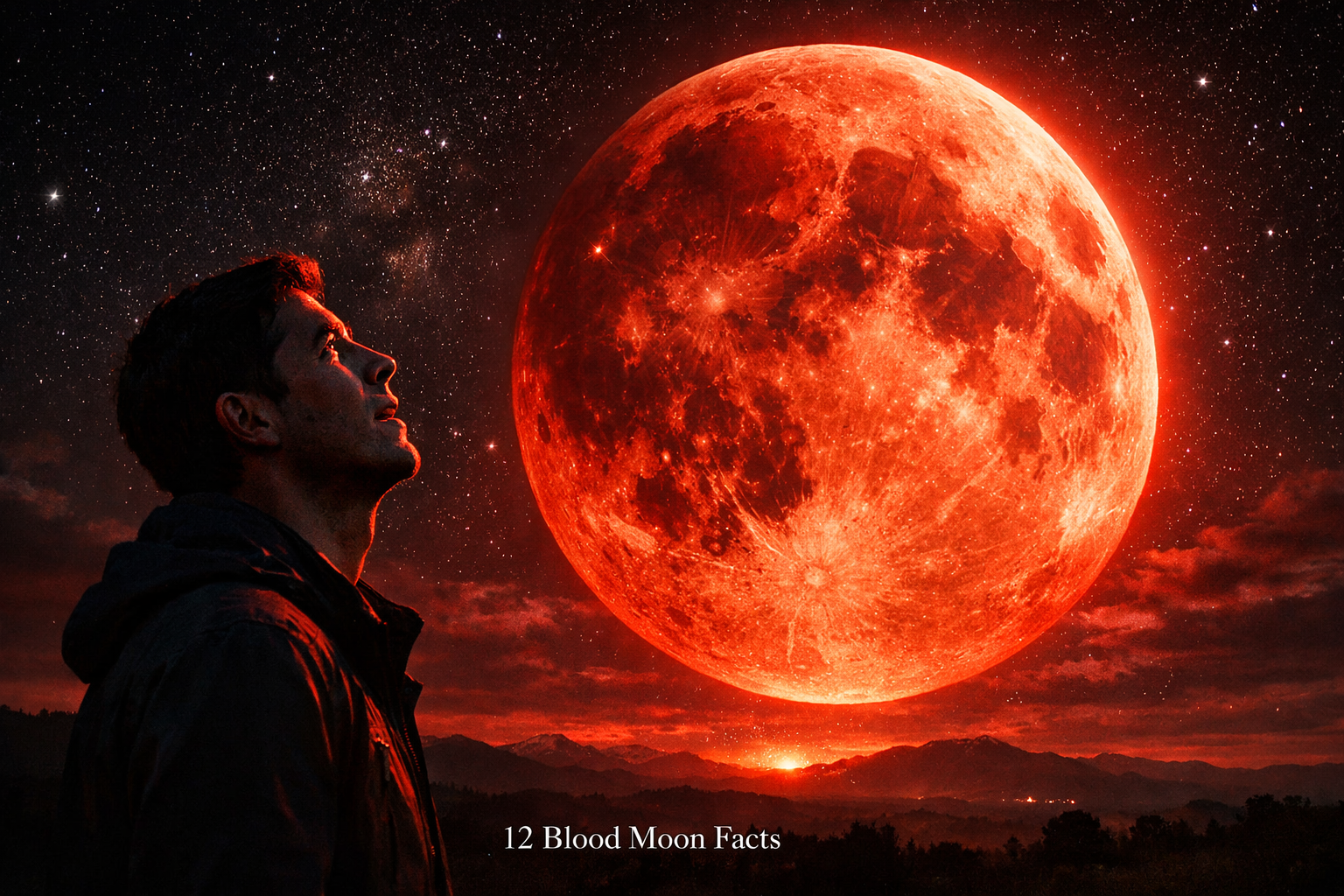
Few celestial events capture public attention quite like a Blood Moon. When the Moon takes on a striking reddish hue and glows ominously against the night sky, people everywhere stop to look up. Throughout history, this rare phenomenon has inspired myths, scientific discoveries, cultural traditions, and endless curiosity.
Unlike ordinary full moons, a Blood Moon transforms the familiar lunar surface into something mysterious and dramatic. Its deep red color often sparks questions about what causes it, how often it occurs, and whether there is any special significance behind it.
While ancient civilizations viewed Blood Moons as supernatural signs, modern science has revealed the fascinating astronomical processes responsible for this breathtaking event. Yet despite our growing understanding, Blood Moons continue to amaze both astronomers and casual skywatchers alike.
Here are 12 intriguing facts about Blood Moons that help explain why they remain one of the most talked-about events in the night sky.
1. A Blood Moon Happens During a Total Lunar Eclipse
One of the biggest misconceptions is that a Blood Moon is a separate astronomical event. In reality, a Blood Moon occurs during a total lunar eclipse.
A lunar eclipse takes place when Earth moves directly between the Sun and the Moon. As a result, Earth’s shadow falls across the Moon’s surface. During a total lunar eclipse, the Moon becomes fully immersed in Earth’s darkest shadow, known as the umbra.
Instead of disappearing completely, the Moon turns shades of red, orange, or copper, creating the phenomenon we call a Blood Moon.
This remarkable alignment requires the Sun, Earth, and Moon to line up almost perfectly, making total lunar eclipses relatively uncommon.
2. Earth’s Atmosphere Creates the Red Color
The Moon does not actually change color on its own. The reddish appearance comes from sunlight passing through Earth’s atmosphere.
As sunlight travels through the atmosphere, shorter wavelengths such as blue and violet scatter in different directions. Longer wavelengths, particularly red and orange light, continue through the atmosphere and are bent toward Earth’s shadow.
This filtered light reaches the Moon and bathes it in a reddish glow.
The process is similar to what creates colorful sunrises and sunsets on Earth. During a Blood Moon, countless sunsets and sunrises occurring around the edge of Earth combine to illuminate the Moon with warm red tones.
3. Every Blood Moon Looks Different
No two Blood Moons appear exactly the same.
Some eclipses produce a bright orange Moon, while others create a deep crimson or dark brick-red color. The appearance depends largely on conditions within Earth’s atmosphere at the time of the eclipse.
Factors that can influence the Moon’s color include:
- Dust particles
- Air pollution
- Volcanic ash
- Cloud cover
- Atmospheric moisture
Major volcanic eruptions can dramatically darken future Blood Moons by injecting large amounts of particles into the atmosphere.
Because atmospheric conditions are constantly changing, every eclipse creates a unique visual experience.
4. Ancient Cultures Feared Blood Moons
Long before scientists understood eclipses, Blood Moons often caused fear and confusion.
Many ancient civilizations viewed the sudden reddening of the Moon as a warning from the gods or a sign of impending disaster. In some cultures, people believed a celestial creature was attacking or swallowing the Moon.
To ward off perceived danger, communities often performed rituals, beat drums, or made loud noises in hopes of driving away whatever force was responsible.
These interpretations varied from one culture to another, but the dramatic appearance of a Blood Moon almost always carried special significance.
5. Blood Moons Are Completely Safe to Observe
Unlike solar eclipses, Blood Moons can be viewed safely without special eye protection.
Looking directly at a solar eclipse without proper filters can damage eyesight because of the Sun’s intense brightness. A lunar eclipse, however, poses no such risk.
You can enjoy a Blood Moon with:
- The naked eye
- Binoculars
- Small telescopes
- Professional astronomical equipment
In fact, many people find that binoculars reveal impressive details and color variations across the Moon’s surface during an eclipse.
6. The Entire Night Side of Earth Can Watch
One of the most appealing aspects of a Blood Moon is its accessibility.
During a solar eclipse, only a narrow path on Earth experiences totality. A Blood Moon, however, can be viewed from anywhere on the night side of the planet where the Moon is above the horizon.
This means millions of people can witness the same event simultaneously across multiple continents.
As a result, Blood Moons often become global events, bringing together skywatchers from different countries and cultures.
7. The Moon Doesn’t Always Turn Bright Red
The term “Blood Moon” can create the expectation of a vivid crimson Moon, but the reality is often more subtle.
Depending on atmospheric conditions, the Moon may appear:
- Orange
- Rust-colored
- Copper-toned
- Dark red
- Brownish-red
Some eclipses produce surprisingly dark Moons that are difficult to see, while others create spectacular glowing red discs that stand out dramatically against the night sky.
The variability is one reason eclipse enthusiasts eagerly anticipate every event.
8. Blood Moons Can Last for Hours
Unlike many astronomical phenomena that occur quickly, a Blood Moon unfolds gradually.
The complete eclipse process often takes several hours from beginning to end.
The sequence typically includes:
- The Moon entering Earth’s outer shadow.
- Partial shadow coverage.
- Total eclipse and Blood Moon phase.
- Gradual return to full brightness.
The total eclipse stage alone can last more than an hour under ideal conditions.
This extended duration gives observers plenty of time to enjoy and photograph the event.
9. Blood Moons Have Inspired Religious and Cultural Interpretations
Throughout history, Blood Moons have played important roles in religious traditions and folklore.
Various cultures interpreted them as:
- Messages from divine beings
- Warnings of significant change
- Symbols of transformation
- Omens related to harvests or weather
Even in modern times, Blood Moons occasionally become the focus of speculation regarding prophecy or major world events.
However, astronomers emphasize that Blood Moons are natural and predictable celestial occurrences governed by the laws of physics.
Their mystery may inspire imagination, but their cause is entirely scientific.
10. Blood Moons Help Scientists Study Earth’s Atmosphere
While Blood Moons are beautiful to observe, they also provide valuable scientific opportunities.
Researchers analyze the light reaching the Moon during an eclipse to gain insights into Earth’s atmosphere.
By studying how sunlight is filtered and refracted, scientists can learn about:
- Atmospheric composition
- Dust levels
- Aerosol concentrations
- Climate-related changes
In some ways, a lunar eclipse allows researchers to examine Earth as if it were a distant planet.
This information even contributes to the search for potentially habitable worlds beyond our solar system.
11. A Series of Blood Moons Is Called a Tetrad
A single Blood Moon is exciting enough, but occasionally nature provides a sequence of them.
When four total lunar eclipses occur consecutively without any partial eclipses in between, the series is known as a tetrad.
Tetrads are relatively uncommon and often generate significant public interest.
Because lunar eclipses follow predictable orbital cycles, astronomers can calculate tetrads decades or even centuries in advance.
The rarity of these sequences has contributed to numerous cultural interpretations and public fascination over the years.
12. Blood Moons Remind Us of Our Place in the Universe
Perhaps the most remarkable aspect of a Blood Moon is the perspective it offers.
The event is a vivid reminder that Earth, the Moon, and the Sun are part of a dynamic cosmic system. Watching Earth’s shadow slowly move across the lunar surface allows us to witness celestial mechanics in action.
For a brief period, the sky reveals a larger story—one involving planetary motion, gravity, sunlight, and the vast scale of space itself.
The sight of a glowing red Moon often inspires a sense of wonder that transcends science, culture, and geography. It encourages people to pause, look upward, and appreciate the intricate workings of the universe.
Why Blood Moons Continue to Fascinate Humanity
Despite advances in astronomy and space exploration, Blood Moons have never lost their appeal.
Part of their enduring popularity comes from their rarity. Unlike the regular monthly full moon, a Blood Moon feels special because it requires a precise alignment of celestial bodies.
Another reason is its dramatic visual impact. The Moon’s transformation from bright silver to deep red creates an unforgettable spectacle that photographs rarely capture fully.
Finally, Blood Moons connect modern observers with generations of people who stood beneath the same sky and wondered about the same phenomenon. Ancient myths, scientific discoveries, and personal experiences all converge during a total lunar eclipse.
Tips for Watching the Next Blood Moon
If you want to enjoy the next Blood Moon to the fullest, a little preparation can enhance the experience.
Consider these simple tips:
- Find a location with minimal light pollution.
- Check weather forecasts in advance.
- Bring binoculars for a closer view.
- Allow your eyes to adjust to the darkness.
- Arrive early to watch the eclipse progression.
- Use a tripod if you plan to photograph the event.
Even from urban areas, a Blood Moon can be an impressive sight, but darker skies often reveal richer colors and greater detail.
Final Thoughts
A Blood Moon is far more than a beautiful astronomical event. It is a stunning demonstration of how sunlight, Earth’s atmosphere, and orbital mechanics work together to create one of nature’s most memorable spectacles. From ancient legends and cultural traditions to modern scientific research, Blood Moons have inspired awe for thousands of years.
Whether you’re an experienced astronomer or someone seeing one for the first time, witnessing a Blood Moon is an unforgettable experience. Its crimson glow serves as a reminder that even familiar objects in the night sky can still surprise us, spark our curiosity, and deepen our appreciation for the wonders of the universe.







