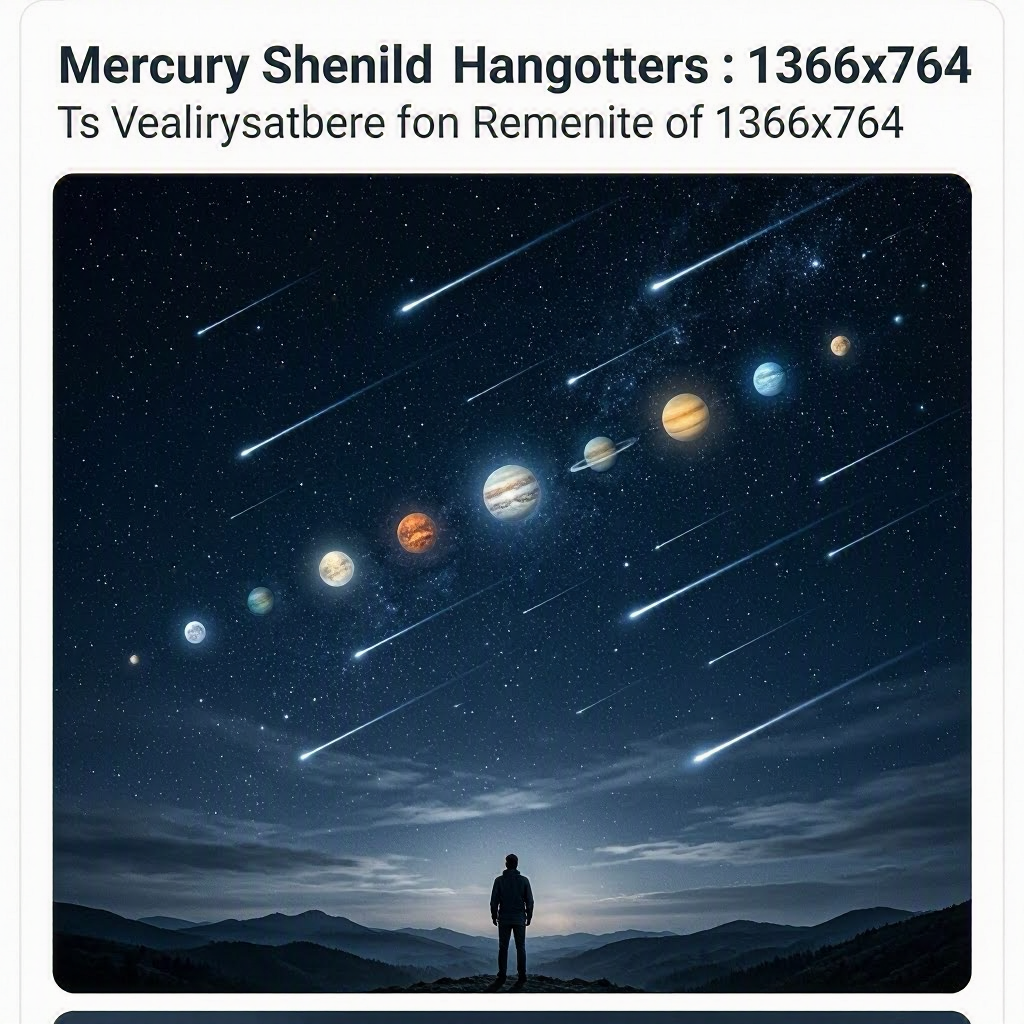
August is shaping up to be an exciting month for skywatchers. Between a rare six-planet alignment and one of the year’s most spectacular meteor showers, the night sky will offer a combination of celestial events that few people get the chance to witness in a single month.
While meteor showers and planetary gatherings occur separately from time to time, seeing both phenomena share the spotlight makes August especially memorable for astronomy enthusiasts. Whether you’re a seasoned stargazer or simply someone who enjoys looking up on a clear night, this month provides an excellent opportunity to experience the beauty and complexity of our solar system.
Here are 10 fascinating facts about August’s rare six-planet alignment and meteor shower that make these events worth watching.
1. Six Planets Will Appear Along the Same Path in the Sky
One of the highlights of August is the appearance of six planets seemingly lined up across the sky.
Although the planets are not actually arranged in a straight line through space, they appear clustered along an imaginary path known as the ecliptic—the plane in which most planets orbit the Sun. From Earth’s perspective, this creates the impression of a remarkable planetary alignment.
Such gatherings are uncommon enough to attract widespread attention among skywatchers.
2. The Planets Are Separated by Millions of Miles
The term “planetary alignment” can be misleading.
While the planets may appear close together in the sky, they remain separated by enormous distances in space. Some are hundreds of millions or even billions of miles apart. The alignment is largely a visual effect caused by our viewing angle from Earth.
Even so, seeing multiple planets sharing the same region of the sky is an impressive sight.
3. Several Planets May Be Visible Without a Telescope
One reason planetary alignments generate excitement is their accessibility.
Depending on local viewing conditions and the exact timing, several planets can often be seen with the naked eye. The brightest among them stand out as steady points of light that do not twinkle like stars.
This allows casual observers to participate without expensive equipment.
4. Binoculars Can Dramatically Improve the View
While some planets are visible without assistance, binoculars can enhance the experience considerably.
They help reveal fainter planets and provide a clearer view of the celestial arrangement. A small telescope can go even further, allowing observers to see details such as the rings of Saturn or the moons of Jupiter.
Even basic optical equipment can transform a casual observation into a memorable experience.
5. The Perseid Meteor Shower Peaks in August
At the same time skywatchers are searching for planets, they can also enjoy one of the year’s most reliable meteor showers.
The Perseids occur when Earth passes through debris left behind by Comet Swift–Tuttle. Tiny particles from the comet enter Earth’s atmosphere at tremendous speeds, creating bright streaks of light commonly called shooting stars.
The Perseids are famous for their high activity rates and brilliant meteors.
6. Some Meteors Are Older Than Human Civilization
The particles responsible for the Perseid meteor shower have been drifting through space for centuries and, in some cases, much longer.
Many of these fragments were shed by Comet Swift–Tuttle during previous passages through the inner solar system. When they finally encounter Earth, they create brief flashes that last only seconds but represent material that has traveled millions of miles through space.
Each meteor is a tiny piece of cosmic history.
7. Fireballs Are One of the Shower’s Greatest Attractions
The Perseids are particularly known for producing bright meteors called fireballs.
These exceptionally luminous meteors can outshine nearby stars and planets, leaving glowing trails that persist for several seconds. Some are bright enough to illuminate the surrounding landscape momentarily.
For many observers, spotting a fireball becomes the highlight of the night.
8. The Best Viewing Time Is Before Dawn
Although meteors can appear at any time during the night, the hours before sunrise usually provide the most active viewing period.
At that time, the side of Earth facing the direction of its orbital motion encounters more incoming debris particles. This increases the number of meteors visible in the sky.
The same early-morning hours often provide favorable conditions for observing planetary alignments as well.
9. Dark Skies Make a Huge Difference
Light pollution is one of the biggest obstacles to observing celestial events.
City lights can wash out fainter meteors and make some planets more difficult to locate. Traveling even a short distance away from urban areas can dramatically improve visibility.
Under truly dark skies, observers may see far more meteors and enjoy a much richer view of the planetary lineup.
10. These Events Offer a Rare Reminder of Our Place in the Universe
Perhaps the most compelling aspect of August’s celestial display is the perspective it provides.
A six-planet alignment highlights the scale and structure of our solar system, while the Perseid meteor shower reminds us that Earth is constantly moving through streams of ancient cosmic debris. Together, these events reveal a universe that is dynamic, interconnected, and far more active than it appears from day to day.
For a few nights, anyone willing to step outside and look up can witness that cosmic story unfolding overhead.
Why August’s Sky Show Is Worth Watching
The combination of a six-planet alignment and the Perseid meteor shower makes August one of the most rewarding months for stargazing. Whether you’re observing from a backyard, a campsite, or a remote dark-sky location, you’ll have the opportunity to witness two extraordinary celestial events at the same time.
You don’t need advanced knowledge of astronomy to enjoy the experience. A clear sky, a little patience, and a willingness to look upward are often all that’s required.
As planets gather along the ecliptic and meteors streak across the darkness, August offers a rare chance to see multiple wonders of the solar system in a single glance. It’s a reminder that some of the most spectacular shows on Earth don’t happen on a stage—they happen in the sky above us.







