For centuries, humans wondered whether planets existed beyond our solar system. Philosophers, astronomers, and dreamers imagined distant worlds orbiting faraway stars, but for most of history, there was no way to prove they were real. That changed in the late 20th century when scientists began discovering exoplanets—planets that orbit stars outside our solar system.
Finding these worlds was a remarkable achievement, but actually seeing them presented an even greater challenge. Stars are incredibly bright, while planets are comparatively dim. Trying to photograph a planet next to its host star is often compared to spotting a firefly next to a powerful searchlight from thousands of miles away.
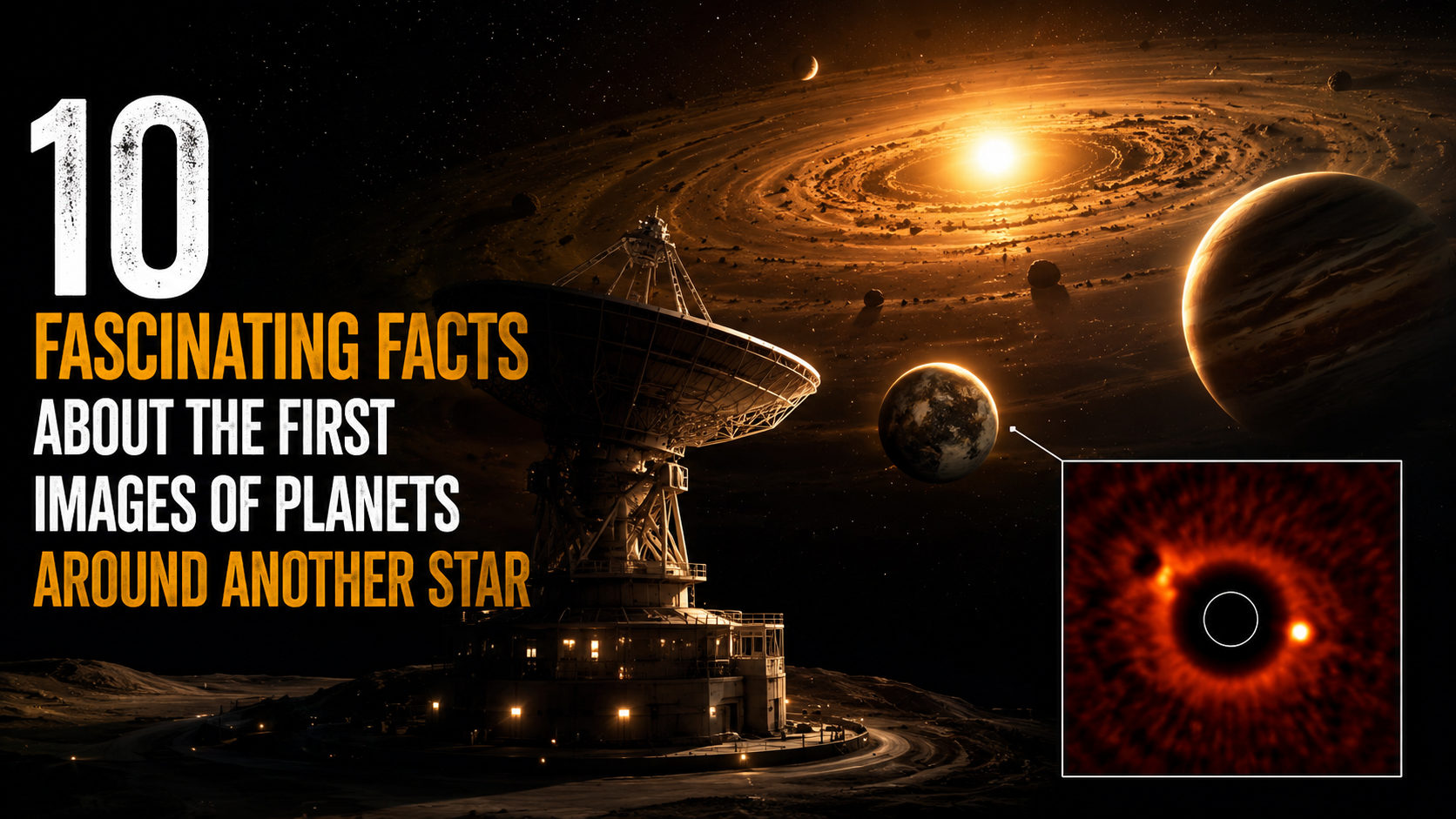
Despite these difficulties, astronomers eventually achieved what once seemed impossible: capturing direct images of planets orbiting another star. These groundbreaking photographs opened a new chapter in the search for worlds beyond our own and provided an entirely new way to study distant planetary systems.
Here are 10 fascinating facts about the first images of planets around another star and why they transformed modern astronomy.
1. Most Exoplanets Were Found Before They Were Seen
Long before astronomers captured direct images of exoplanets, they had already discovered hundreds of them using indirect methods.
Scientists often detected planets by observing how a star’s light changed when a planet passed in front of it or by measuring tiny movements caused by a planet’s gravitational pull. These techniques revealed the existence of distant worlds without actually photographing them.
Direct imaging represented a major leap forward because it allowed astronomers to observe the planets themselves rather than simply infer their presence.
2. Photographing Exoplanets Is Extremely Difficult
One reason direct images took so long to achieve is that stars vastly outshine their planets.
A planet reflects or emits only a tiny fraction of the light produced by its host star. From Earth, the star’s brightness can overwhelm telescopes and obscure nearby planets.
Astronomers had to develop sophisticated instruments capable of blocking starlight and enhancing faint planetary signals. Without these technological advances, direct imaging would remain nearly impossible.
3. The First Famous Multi-Planet Images Came From HR 8799
A major breakthrough occurred when astronomers captured images of several planets orbiting the star HR 8799.
The images revealed multiple massive planets circling the star, marking one of the first times scientists directly observed an entire planetary system beyond our own. The discovery provided dramatic visual evidence that other stars could host complex systems of planets.
The achievement quickly became one of the most celebrated milestones in exoplanet research.
4. The Planets Were Much Larger Than Earth
The first directly imaged exoplanets were not Earth-like worlds.
Instead, they were enormous gas giants several times more massive than Jupiter. Their large size made them easier to detect because they emitted more infrared radiation and were located relatively far from their host stars.
Smaller rocky planets similar to Earth remain far more difficult to image directly due to their size and lower brightness.
5. Infrared Light Played a Key Role
Many of the first successful exoplanet images were captured using infrared observations rather than visible light.
Young giant planets retain heat from their formation and glow more brightly in infrared wavelengths. By observing these wavelengths, astronomers could detect planets that would otherwise remain hidden.
Infrared imaging became one of the most powerful tools for studying young planetary systems and continues to play a major role in exoplanet research today.
6. Special Devices Helped Block Starlight
To capture the first images of exoplanets, astronomers relied on instruments called coronagraphs and advanced image-processing techniques.
A coronagraph blocks much of a star’s direct light, allowing nearby objects to become visible. Additional computer processing helps remove remaining glare and reveal faint planetary signals.
These innovations dramatically improved astronomers’ ability to distinguish planets from the overwhelming brightness of their stars.
7. The Images Revealed Young Planetary Systems
Many of the first directly imaged planets were relatively young by astronomical standards.
Young planets are often easier to observe because they still radiate heat left over from their formation. This makes them brighter in infrared light than older, cooler planets.
Studying these young worlds has helped scientists learn more about how planetary systems develop and evolve over time.
8. Direct Images Provide More Than Just Pictures
The significance of direct imaging goes far beyond producing impressive photographs.
By analyzing the light from directly observed planets, astronomers can estimate their temperatures, compositions, atmospheric properties, and orbital characteristics.
This information allows researchers to study distant worlds in ways that were previously impossible. Direct imaging transformed exoplanets from invisible objects into subjects of detailed scientific investigation.
9. The Discoveries Changed How We View Planetary Systems
Before exoplanet discoveries, our solar system served as the primary model for understanding planets.
Direct images revealed that other planetary systems can be very different from our own. Some contain giant planets orbiting at great distances from their stars, while others display unusual orbital arrangements that challenge existing theories.
These findings forced scientists to rethink assumptions about how planets form and how common different types of planetary systems may be throughout the galaxy.
10. The First Images Opened the Door to Future Exploration
The earliest direct images were only the beginning.
Advances in telescope technology continue to improve astronomers’ ability to detect and study distant worlds. Modern observatories are capable of imaging increasingly smaller and fainter planets, and future missions may eventually capture detailed observations of Earth-sized worlds.
Many scientists hope that upcoming instruments will provide the clearest views yet of potentially habitable planets orbiting nearby stars.
The first images proved that direct observation was possible and paved the way for a new era of discovery.
Why Direct Imaging Matters
Direct imaging is important because it complements other exoplanet detection methods.
While techniques such as the transit method and radial velocity measurements can reveal a planet’s size, mass, or orbit, direct imaging allows scientists to study the planet’s actual light. This provides unique information about its atmosphere, temperature, weather patterns, and composition.
The ability to observe planets directly brings researchers closer to understanding what these distant worlds are truly like.
The Search for Habitable Worlds
One of the ultimate goals of exoplanet research is identifying planets that might support life.
Although the first directly imaged planets were giant gas worlds unlikely to host life as we know it, the technologies developed for those discoveries continue to improve. Future telescopes may be capable of analyzing the atmospheres of smaller rocky planets and searching for potential biosignatures—chemical indicators that could suggest biological activity.
Such discoveries would represent one of the most significant scientific achievements in human history.
How Technology Made It Possible
The success of direct imaging depended on decades of technological innovation.
Advancements that contributed to these discoveries include:
- Adaptive optics systems that correct atmospheric distortion.
- Powerful infrared detectors.
- High-precision coronagraphs.
- Advanced image-processing algorithms.
- Larger and more sophisticated telescopes.
Each improvement increased astronomers’ ability to separate faint planetary light from overwhelming stellar brightness.
Without these breakthroughs, direct imaging would remain beyond reach.
Looking Toward the Future
The future of exoplanet imaging is incredibly exciting.
New observatories, including next-generation ground-based telescopes and space missions, are expected to provide even more detailed observations of distant worlds. Researchers hope to study planetary atmospheres with unprecedented precision and perhaps identify planets that resemble Earth in size and environmental conditions.
As technology continues to advance, the dream of directly observing potentially habitable worlds grows increasingly realistic.
What began with a handful of faint images may eventually lead to detailed studies of planets capable of supporting life.
Final Thoughts
The first images of planets orbiting another star marked a turning point in astronomy. For the first time, humanity could directly observe worlds beyond the solar system, transforming exoplanets from theoretical possibilities into visible realities.
These groundbreaking observations demonstrated the power of scientific innovation and expanded our understanding of the universe. They revealed new planetary systems, challenged existing theories, and laid the foundation for future discoveries.
Today, every new exoplanet image builds upon that historic achievement. As telescopes become more powerful and techniques become more refined, we move closer to answering some of humanity’s oldest questions: How common are planets like Earth? Are we alone in the universe? And what other wonders await among the stars?
The first images did more than capture distant planets—they opened a window into an entirely new frontier of exploration.