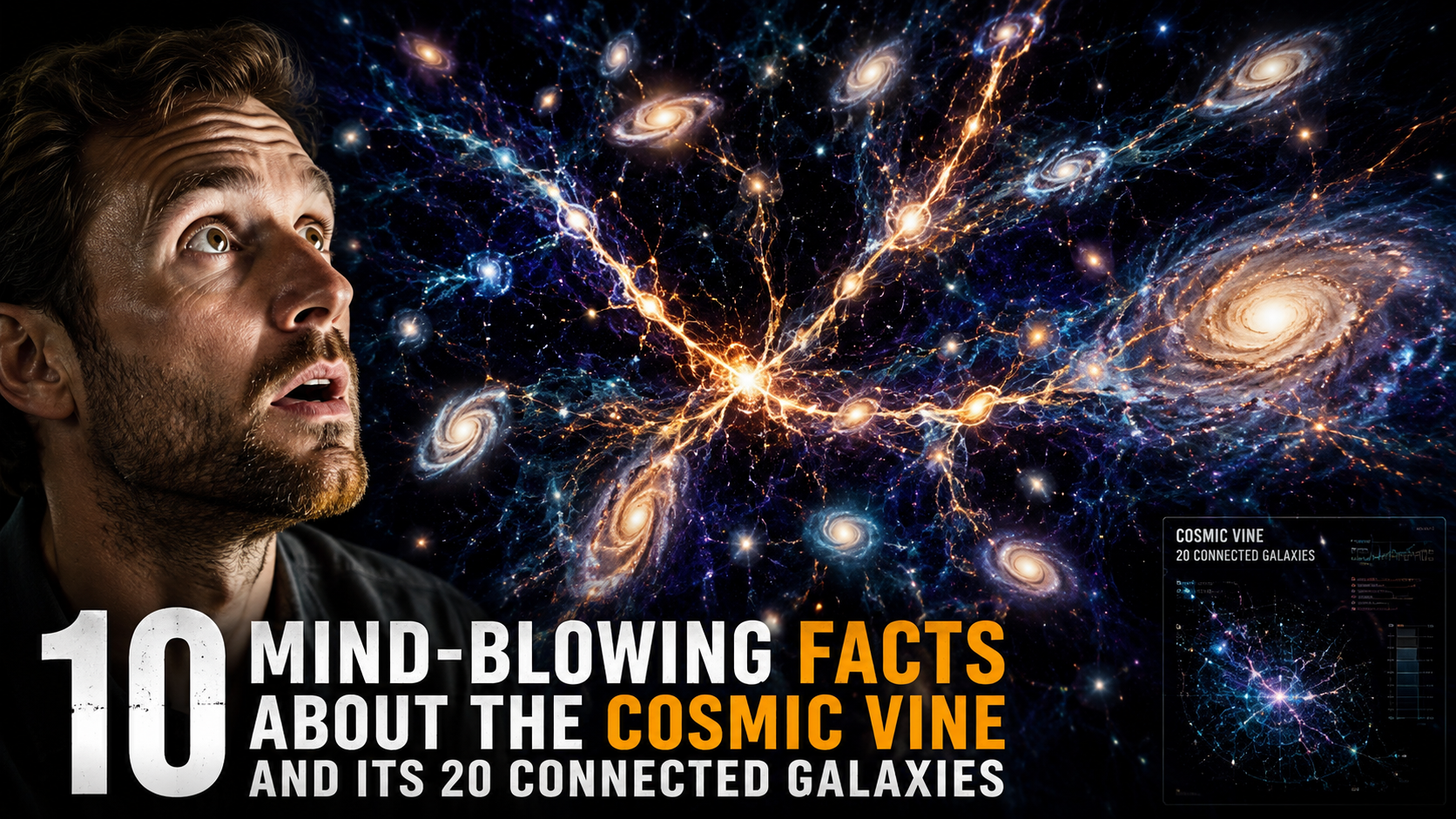
The universe is filled with structures so vast that they challenge our understanding of size and distance. While many people are familiar with stars, planets, and individual galaxies, the cosmos also contains enormous networks of galaxies linked together by gravity and invisible matter. One of the most intriguing recent discoveries is the Cosmic Vine, a gigantic filament-like structure made up of approximately 20 interconnected galaxies.
Stretching across an immense region of space, the Cosmic Vine offers scientists a rare opportunity to study how galaxies gather into larger structures and how the universe evolved over billions of years. Its discovery is another reminder that the cosmos is far more intricate and interconnected than it may appear.
Here are ten mind-blowing facts about the Cosmic Vine and its 20 connected galaxies.
1. It Is a Giant Cosmic Filament
The Cosmic Vine is not a single galaxy or a compact cluster of galaxies.
Instead, it is a long, thread-like structure known as a galactic filament. Filaments are among the largest known structures in the universe and form part of the vast network often called the cosmic web.
These enormous strands connect galaxies and galaxy groups across immense distances, creating a universe that resembles a giant three-dimensional web.
2. It Contains Around 20 Interconnected Galaxies
At the heart of the Cosmic Vine are approximately twenty galaxies that appear to be physically associated with one another.
These galaxies are not randomly scattered through space. Their arrangement suggests that they belong to a larger, organized structure shaped by gravity and the distribution of matter in the universe.
Studying such systems helps astronomers understand how galaxies evolve within their larger cosmic environments.
3. The Galaxies Are Separated by Enormous Distances
Although the galaxies in the Cosmic Vine are considered connected, they are still extraordinarily far apart.
The distances between individual galaxies can span millions of light-years. If humanity could somehow travel at the speed of today’s fastest spacecraft, reaching even the nearest neighboring galaxy would take an almost unimaginable amount of time.
The discovery reminds us that even “connected” objects in the universe are separated by vast expanses of space.
4. It Is Part of the Cosmic Web
Modern astronomy suggests that matter in the universe is not evenly distributed.
Instead, galaxies tend to gather along enormous filaments and nodes that form the cosmic web. Between these structures lie gigantic voids containing relatively little matter.
The Cosmic Vine provides another striking example of this large-scale architecture and helps scientists investigate how these vast patterns emerged after the Big Bang.
5. Gravity Plays a Major Role in Its Formation
Gravity is the fundamental force responsible for building structures such as the Cosmic Vine.
Over billions of years, slight variations in matter density allowed gravity to gradually pull material together. These regions eventually developed into galaxies, clusters, and the immense filaments connecting them.
The Cosmic Vine represents the outcome of processes that have been unfolding since the universe was very young.
6. It Offers a Window Into the Early Universe
Observing distant objects is like looking backward in time because light requires enormous periods to travel across space.
The galaxies within the Cosmic Vine allow astronomers to examine conditions that existed billions of years ago. By studying these galaxies, scientists gain valuable information about how matter assembled and how galactic structures evolved during earlier stages of cosmic history.
Every observation acts like a glimpse into the universe’s distant past.
7. It Challenges Our Sense of Scale
The dimensions of structures like the Cosmic Vine are difficult for the human mind to comprehend.
Human civilization occupies only a tiny planet orbiting an ordinary star in one galaxy among hundreds of billions. Yet the Cosmic Vine spans distances that make individual galaxies seem almost insignificant.
Discoveries like this continually expand our understanding of how immense the universe truly is.
8. Invisible Matter May Help Hold It Together
Scientists believe that dark matter plays a crucial role in shaping large-scale cosmic structures.
Although dark matter cannot be seen directly, its gravitational influence appears to guide the formation of galaxies and the giant filaments linking them together.
The Cosmic Vine may owe much of its existence to this mysterious form of matter, which is thought to account for most of the matter in the universe.
9. Discoveries Like This Improve Computer Models of the Universe
Astronomers use sophisticated simulations to recreate how the universe evolved over billions of years.
The discovery of structures like the Cosmic Vine provides real-world observations that can be compared with these models. When simulations and observations agree, scientists gain greater confidence in their understanding of cosmic evolution.
Each newly discovered filament becomes another piece of the puzzle describing how the universe developed.
10. It Reminds Us That the Universe Is More Connected Than We Once Imagined
Perhaps the most fascinating aspect of the Cosmic Vine is what it reveals about the nature of the cosmos.
Galaxies may seem like isolated islands of stars, but large-scale observations tell a different story. Across immense distances, galaxies often form part of larger patterns and networks shaped by gravity and the distribution of matter.
The Cosmic Vine is a powerful reminder that the universe is not a random collection of objects. Instead, it is an intricate and interconnected cosmic tapestry stretching across incomprehensible distances.
Final Thoughts
The Cosmic Vine and its 20 connected galaxies offer a remarkable glimpse into the universe’s large-scale structure. As a giant galactic filament woven into the cosmic web, it helps astronomers understand how gravity, dark matter, and cosmic evolution have shaped the universe over billions of years.
Perhaps most importantly, discoveries like the Cosmic Vine inspire a sense of wonder. They reveal that even after centuries of astronomical exploration, the universe continues to surprise us with structures so vast and beautiful that they challenge the limits of human imagination and remind us how much remains to be discovered.







