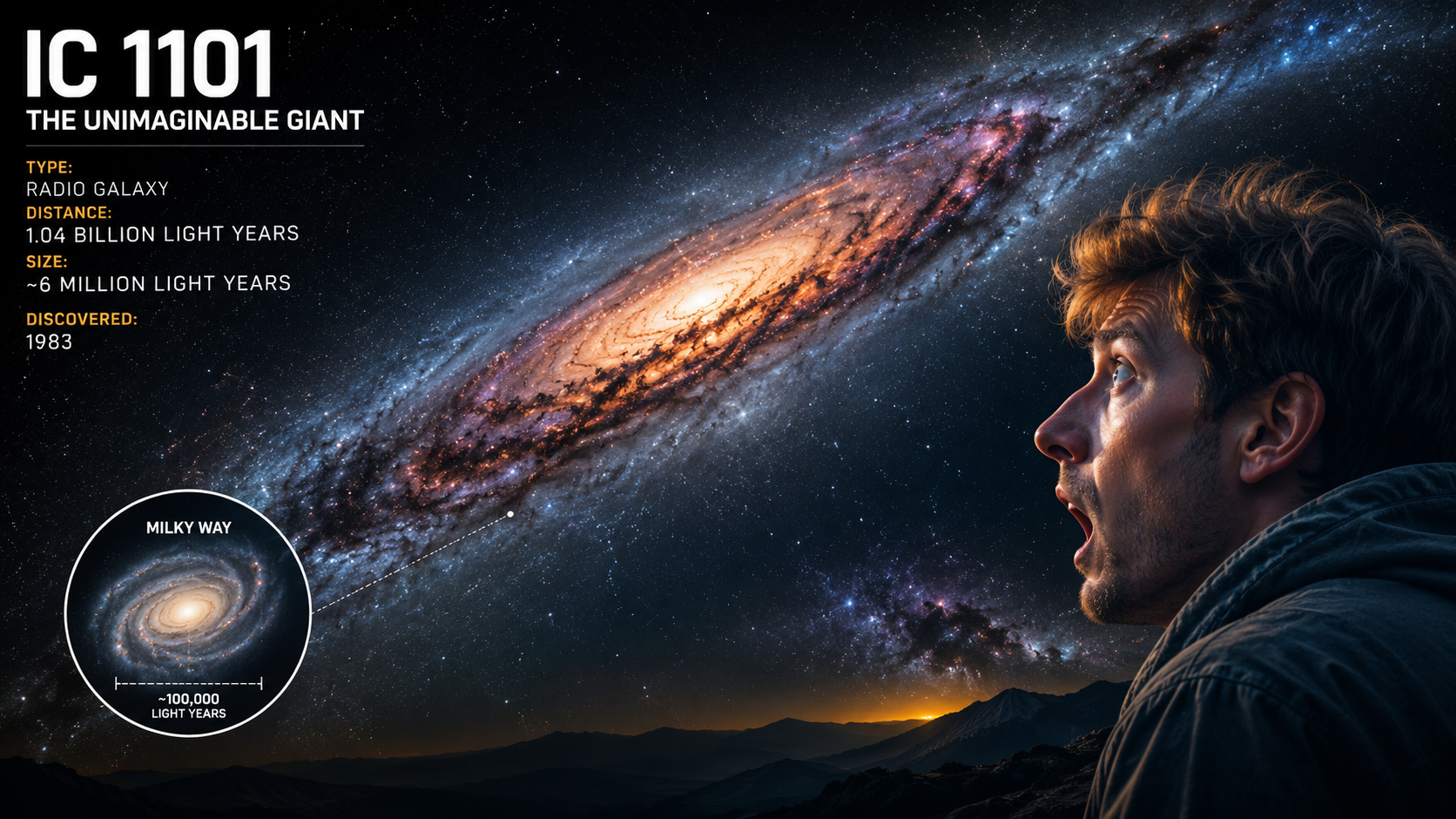
The universe is filled with objects so large that they seem almost impossible to comprehend. Planets appear huge compared to our everyday world, stars dwarf planets, and galaxies make even stars seem insignificant. Yet among the countless galaxies scattered throughout the cosmos, a few stand out because of their truly staggering dimensions. One of the most extraordinary is IC 1101, a galaxy so immense that it challenges our understanding of size itself.
Located far beyond our Milky Way, IC 1101 is one of the largest galaxies ever discovered. Its incredible scale offers a powerful reminder that the universe operates on levels that stretch far beyond ordinary human imagination.
Here are twelve things most people don’t realize about the enormous size of IC 1101.
1. It Is One of the Largest Known Galaxies
IC 1101 belongs to an elite category of truly gigantic galaxies.
Astronomers classify it as a supergiant elliptical galaxy, and it ranks among the largest galaxies ever identified. While many galaxies are vast by human standards, IC 1101 occupies an entirely different level of scale.
Simply understanding its dimensions requires comparisons that go far beyond everyday experience.
2. It Dwarfs the Milky Way
Our Milky Way feels unimaginably large. It stretches roughly 100,000 light-years across and contains hundreds of billions of stars.
Yet IC 1101 makes our home galaxy look relatively modest.
Scientists estimate that IC 1101 spans approximately 4 million light-years in diameter, making it around 40 times wider than the Milky Way. If the Milky Way were enlarged to the size of a dinner plate, IC 1101 would resemble an enormous tabletop.
The comparison highlights just how extraordinary this galaxy truly is.
3. It May Contain Trillions of Stars
The Milky Way contains an estimated 100 to 400 billion stars.
IC 1101 likely contains many times that number. Estimates suggest it may host well over 100 trillion stars, making it one of the most densely populated stellar systems ever observed.
Numbers on this scale are almost impossible to visualize. Even if someone counted one star every second, it would take millions of years to count them all.
4. Its Light Has Traveled for Hundreds of Millions of Years
IC 1101 lies approximately one billion light-years from Earth.
That means the light reaching our telescopes today left the galaxy around one billion years ago. At that time, complex life on Earth was still in its early stages of development.
Looking at IC 1101 is like opening a window into an incredibly distant chapter of cosmic history.
5. It Sits at the Center of a Massive Galaxy Cluster
IC 1101 is not isolated in space.
The galaxy occupies the central region of the Abell 2029 galaxy cluster, an enormous collection of galaxies bound together by gravity.
Central galaxies in clusters often become extraordinarily large because they repeatedly interact with and absorb smaller neighboring galaxies over immense periods of time.
Its location helps explain how it reached such colossal proportions.
6. It Probably Grew by Consuming Other Galaxies
Galaxies are not static islands floating peacefully through space.
Over billions of years, gravity causes galaxies to collide and merge. Larger galaxies frequently absorb smaller ones, steadily increasing in size and mass.
Astronomers believe IC 1101 achieved its enormous dimensions through countless mergers and galactic encounters, essentially growing by incorporating many smaller galaxies into itself.
In a sense, it is a cosmic giant built from the remnants of numerous former galaxies.
7. Its Central Black Hole Could Be Incredibly Massive
At the centers of large galaxies reside supermassive black holes.
Given IC 1101’s extraordinary size, astronomers suspect that its central black hole may also be exceptionally massive. Although determining its exact mass remains challenging, it could rank among the most enormous black holes associated with any known galaxy.
The idea that an already gigantic galaxy may also harbor one of the universe’s most extreme black holes adds another layer to its fascination.
8. Its Scale Challenges Human Imagination
The distances involved within IC 1101 are difficult to comprehend.
Even traveling at the speed of light, crossing the galaxy from one side to the other would require approximately four million years.
For comparison, human civilization spans only a tiny fraction of that time. Entire species have appeared and vanished on Earth in periods far shorter than the time needed for light to traverse this galactic giant.
9. Most of the Galaxy Is Empty Space
Despite containing an immense number of stars, IC 1101 is still dominated by emptiness.
Stars are separated by enormous distances, and the spaces between them vastly outweigh the stars themselves in terms of volume.
This means that even one of the largest galaxies ever discovered is composed mostly of nearly empty regions stretching across millions of light-years.
The universe continually reminds us that size does not necessarily imply density.
10. It Helps Scientists Understand Galaxy Evolution
Extreme objects often serve as natural laboratories for scientific research.
By studying IC 1101, astronomers gain valuable insights into how galaxies form, grow, and interact over billions of years.
Because the galaxy represents one of the most massive examples of its kind, it provides important clues about the processes capable of producing structures of extraordinary scale.
11. There May Be Even Larger Galaxies Waiting to Be Found
Astronomy is filled with surprises.
As telescopes become more powerful and observations reach deeper into space, scientists continue discovering previously unknown galaxies and cosmic structures.
Although IC 1101 ranks among the largest galaxies currently known, future observations may reveal even bigger systems hidden in the vastness of the universe.
The possibility that objects even larger than IC 1101 exist demonstrates how much remains unexplored.
12. It Puts Humanity’s Place in Perspective
Perhaps the most mind-blowing fact about IC 1101 is what it reveals about our place in the cosmos.
Earth is tiny compared with the Sun. The Sun is insignificant compared with the Milky Way. And the Milky Way itself appears small next to IC 1101.
This colossal galaxy contains staggering numbers of stars spread across millions of light-years, yet it is merely one galaxy among countless others in the observable universe.
Its existence reminds us that the cosmos is vastly larger and more extraordinary than our minds naturally imagine.
Final Thoughts
IC 1101 is not simply a large galaxy—it is a cosmic giant that stretches the limits of human comprehension. Its immense diameter, enormous population of stars, and extraordinary history of growth make it one of the most fascinating structures ever discovered.
By studying galaxies like IC 1101, astronomers gain a deeper appreciation of the universe’s immense scale and complexity. More importantly, these discoveries inspire a sense of wonder. They remind us that despite all we have learned about the cosmos, there are still objects so enormous and mysterious that they continue to challenge our imagination and expand our understanding of reality.







