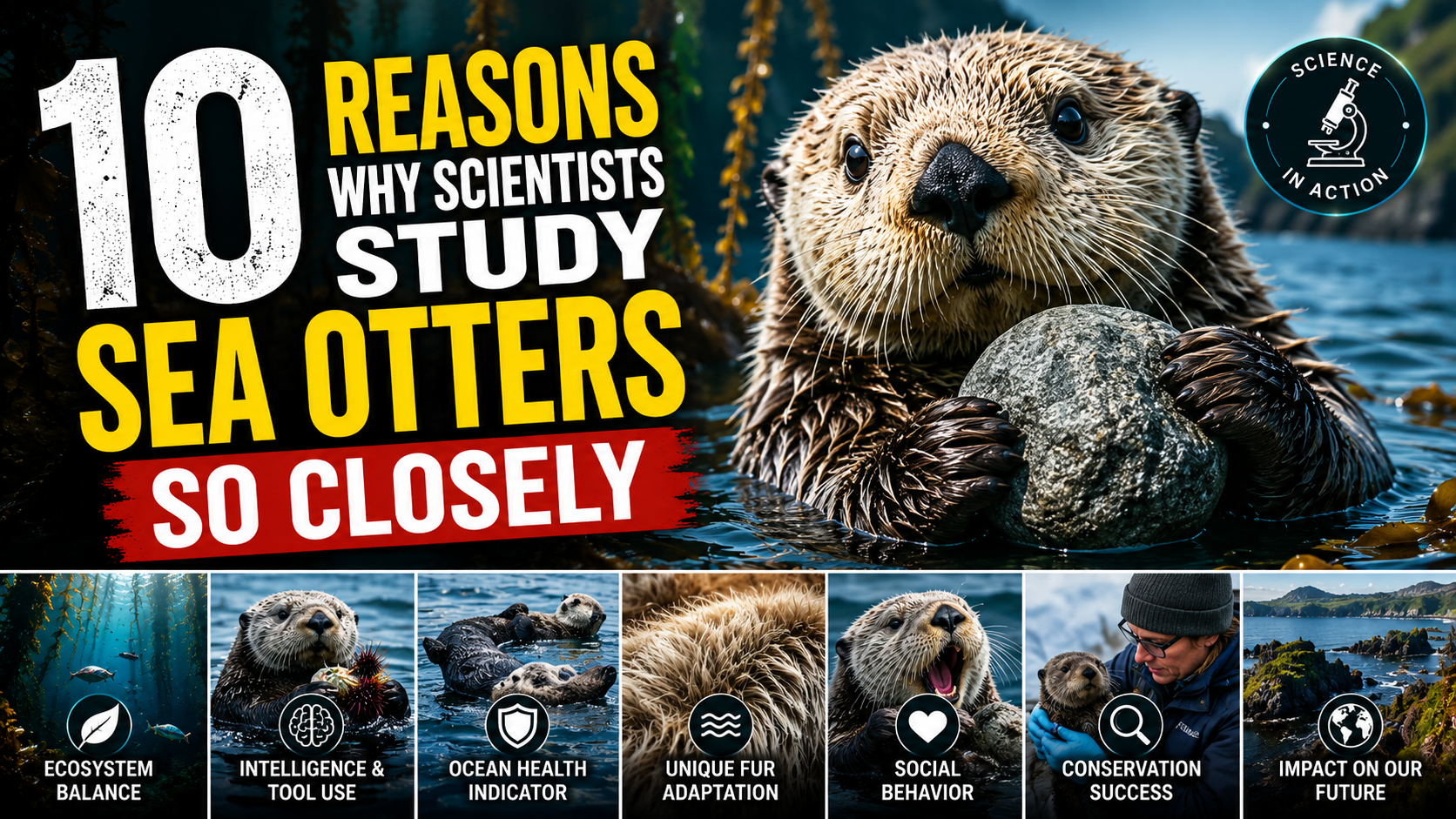
Sea otters are among the most beloved animals in the ocean. With their playful behavior, expressive faces, and habit of floating on their backs while holding hands, they have captured the attention of people around the world. But beyond their charm lies something even more fascinating: sea otters play a surprisingly important role in marine ecosystems and offer valuable insights into animal behavior, evolution, and environmental health.
Scientists have spent decades studying these remarkable marine mammals, and the more researchers learn about them, the more interesting they become. From their unusual use of tools to their influence on entire coastal ecosystems, sea otters are far more than cute ocean residents.
In fact, many marine biologists consider them one of the most important species for understanding how ocean environments function.
So why do scientists pay such close attention to sea otters? Here are ten compelling reasons.
1. Sea Otters Are One of the Few Animals That Regularly Use Tools
Tool use was once considered a trait unique to humans. Over time, researchers discovered that several animal species also use tools, including chimpanzees, crows, dolphins, and sea otters.
Sea otters are particularly famous for carrying rocks that help them break open shellfish such as clams, mussels, and sea urchins. Many otters keep favorite stones tucked into loose skin folds beneath their forearms, essentially carrying a personal toolkit wherever they go.
Scientists study this behavior because it provides insight into animal intelligence, learning, memory, and problem-solving abilities.
The fact that sea otters consistently use tools in the wild makes them one of the most intriguing examples of advanced animal behavior.
2. They Help Keep Ocean Ecosystems Healthy
One of the biggest reasons researchers study sea otters is their enormous ecological impact.
Sea otters are considered a “keystone species,” meaning their presence influences many other organisms within an ecosystem.
One of their favorite foods is the sea urchin. Without predators, sea urchin populations can grow rapidly and consume vast amounts of kelp.
When sea otters keep urchin numbers under control, kelp forests are able to thrive.
Healthy kelp forests provide habitat, food, and protection for countless marine species. In many ways, sea otters help maintain balance throughout coastal ecosystems.
Studying otters helps scientists better understand these interconnected environmental relationships.
3. They Offer Clues About Ocean Health
Sea otters spend much of their lives in coastal waters and are closely connected to their environment.
Because they are sensitive to pollution, habitat changes, disease outbreaks, and shifts in food availability, they often serve as indicators of ecosystem health.
When scientists observe changes in sea otter populations, those changes can signal larger environmental problems.
For example, declines in otter numbers may point to pollution issues, harmful algal blooms, food shortages, or disease outbreaks affecting the marine environment.
Monitoring sea otters allows researchers to identify emerging threats before they become even more serious.
4. Their Thick Fur Is a Biological Wonder
Most marine mammals rely on layers of blubber to stay warm in cold water.
Sea otters are different.
Instead of thick fat deposits, they depend on extraordinarily dense fur for insulation. In fact, sea otters have some of the densest fur of any animal on Earth.
A single square inch of fur can contain hundreds of thousands of hairs.
Researchers study this unique adaptation to understand how animals survive in harsh environments and maintain body temperature under challenging conditions.
Their fur also highlights the importance of conservation, as historical hunting for pelts nearly drove sea otters to extinction in many regions.
5. They Have Remarkably High Metabolic Demands
Sea otters burn energy at an astonishing rate.
To maintain body temperature in cold ocean waters, they must consume a significant amount of food every day—often around 20 to 30 percent of their body weight.
This makes them excellent subjects for studying metabolism, energy use, and feeding behavior.
Scientists are interested in understanding how otters meet these demanding energy requirements and how changes in food availability affect their survival.
Their dietary needs also reveal important information about the health of marine food webs.
6. Sea Otters Display Complex Social Behaviors
Although often seen floating alone, sea otters exhibit a wide range of social behaviors.
They communicate through vocalizations, body language, scent marking, and physical interactions.
Groups of otters sometimes gather in large floating communities known as rafts.
Researchers study these social dynamics to better understand cooperation, communication, territorial behavior, parenting, and group organization in marine mammals.
Social behavior plays an important role in survival, reproduction, and resource sharing, making sea otters valuable subjects for behavioral science.
7. They Teach Scientists About Animal Learning
Not every sea otter uses tools in exactly the same way.
Researchers have discovered that some behaviors appear to be learned and passed between individuals rather than being purely instinctive.
Young otters spend significant time observing their mothers and practicing important survival skills.
Scientists find this especially interesting because it suggests the presence of cultural transmission—a process in which knowledge spreads through social learning.
Studying how sea otters acquire and share behaviors helps researchers understand the evolution of learning and intelligence in animals.
8. Their Recovery Is a Conservation Success Story
By the early 20th century, sea otter populations had been devastated by extensive hunting.
In many areas, they disappeared entirely.
Thanks to conservation efforts, legal protections, habitat management, and recovery programs, several sea otter populations have rebounded significantly.
Scientists closely monitor these recovery efforts because they provide valuable lessons for wildlife conservation worldwide.
The sea otter story demonstrates how targeted conservation actions can help endangered species recover when adequate protections are implemented.
However, challenges remain, making continued research essential.
9. They Influence Carbon Storage in Coastal Waters
One of the most surprising discoveries involving sea otters relates to climate science.
Healthy kelp forests absorb carbon dioxide from the atmosphere and store carbon within plant tissues.
Because sea otters help protect kelp forests by controlling sea urchin populations, they indirectly support carbon storage in coastal ecosystems.
This relationship has attracted growing attention from scientists studying climate change and natural carbon sequestration.
While sea otters alone cannot solve climate challenges, their ecological role highlights how wildlife and environmental systems are often connected in unexpected ways.
10. They Continue to Surprise Researchers
Perhaps the biggest reason scientists study sea otters is that they continue revealing new mysteries.
Every year, researchers uncover additional information about otter behavior, ecology, genetics, health, and environmental interactions.
New technologies such as satellite tracking, underwater monitoring systems, drone surveys, and genetic analysis allow scientists to study otters in greater detail than ever before.
Each discovery raises new questions and deepens our understanding of marine life.
Sea otters remind researchers that even well-known animals can still hold surprising secrets.
Why Sea Otters Matter Beyond Science
The significance of sea otters extends far beyond academic research.
Their presence influences fisheries, coastal habitats, biodiversity, and ecosystem stability. They help maintain healthy marine environments that support numerous species and provide benefits to human communities.
In addition, sea otters inspire public interest in conservation. Their popularity helps raise awareness about ocean protection and the importance of preserving marine ecosystems.
Many people first become interested in ocean conservation because of charismatic animals like sea otters.
In this way, they serve as ambassadors for the broader marine world.
The Challenges Sea Otters Still Face
Despite recovery efforts, sea otters continue to encounter threats.
Some of the most significant challenges include:
- Oil spills
- Coastal pollution
- Habitat degradation
- Disease
- Entanglement in fishing gear
- Climate-related environmental changes
Because otters depend heavily on healthy coastal ecosystems, environmental disturbances can have serious consequences.
Ongoing research helps scientists identify risks and develop strategies to protect populations for future generations.
What Sea Otters Teach Us About Nature
Sea otters demonstrate that even relatively small animals can have enormous ecological influence.
Their role as predators affects entire ecosystems. Their behavior provides clues about intelligence and learning. Their conservation story offers hope for wildlife recovery efforts.
Perhaps most importantly, sea otters illustrate how interconnected nature truly is.
A single species feeding on sea urchins can influence kelp forests, fish populations, biodiversity levels, and even carbon storage.
This interconnectedness is one of the most important lessons modern ecology has revealed.
Final Thoughts
Sea otters may be famous for their playful personalities and adorable appearance, but scientists value them for much deeper reasons. They are intelligent tool users, ecosystem engineers, environmental indicators, and conservation success stories all at once.
Their influence reaches far beyond the shoreline, touching everything from marine biodiversity to climate-related research. Every new study adds another piece to the puzzle of how oceans function and how wildlife shapes the world around us.
As researchers continue to learn more about these remarkable animals, sea otters remain a powerful reminder that some of nature’s most important species are also among its most fascinating. Their story is not just about one marine mammal—it’s about understanding the delicate balance that keeps entire ecosystems thriving.







