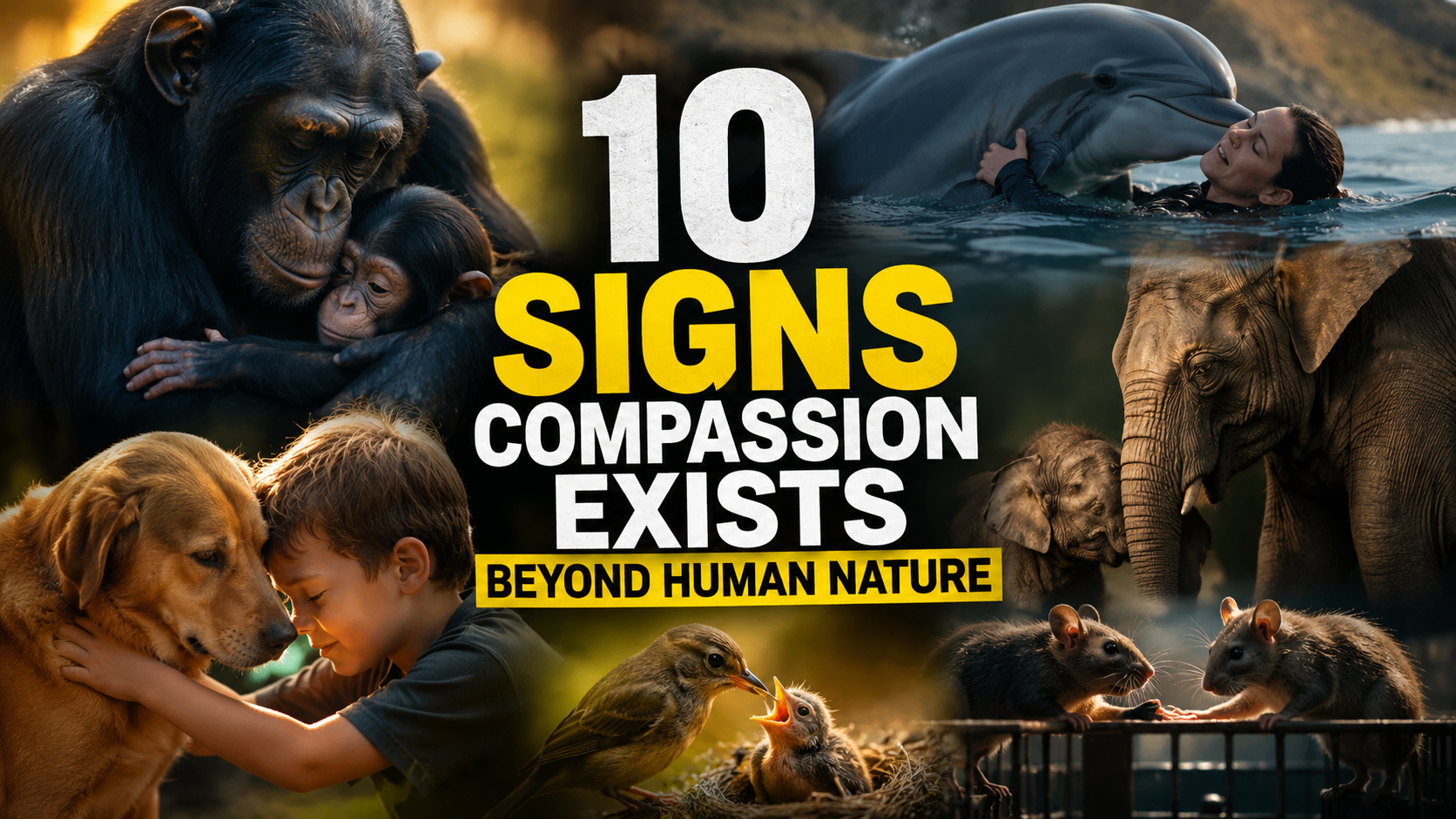
Compassion is often treated as one of humanity’s defining qualities. We celebrate kindness, empathy, and selfless acts as proof of our moral growth and emotional depth. But what if compassion is not uniquely human? Across the natural world, countless behaviors suggest that empathy, protection, and care may exist far beyond our species.
From elephants mourning their dead to dolphins rescuing swimmers, animals repeatedly display actions that seem motivated by concern for others. While scientists continue debating how closely animal emotions resemble human emotions, research increasingly shows that many species are capable of complex social awareness and cooperative behavior.
These examples do not prove that animals think exactly like humans. But they do challenge the idea that compassion belongs only to us. Here are ten powerful signs that kindness and care may be woven more deeply into life on Earth than we once believed.
1. Elephants Mourn Their Dead
Elephants are famous for their intelligence, but their social behavior is even more remarkable. When a member of the herd dies, elephants often pause, touch the body gently with their trunks, and remain nearby for long periods. In some cases, they return to the site of a death months later.
Researchers have observed elephants showing signs of distress, reduced appetite, and unusual quietness after losing companions. These behaviors resemble mourning rituals and suggest a deep emotional bond within elephant families.
The key sign of compassion here is not just sadness — it is the attention and care directed toward the deceased and grieving herd members. Their response goes beyond instinctive survival behavior and reflects strong social empathy.
2. Dolphins Rescue Injured Animals and Humans
Dolphins are highly social mammals known for cooperation within pods. But they have also been documented helping animals outside their immediate group, including humans. Reports describe dolphins supporting injured companions at the surface so they can breathe, and in rare cases, guiding stranded swimmers toward safety.
One famous pattern is “epimeletic behavior,” where dolphins stay beside sick or wounded individuals for extended periods, even when it slows the pod down or increases risk. This kind of assistance appears intentional and sustained.
Such behavior suggests that dolphins recognize distress in others and respond with protective action — a core element of compassionate behavior.
3. Primates Comfort Distressed Companions
Chimpanzees, bonobos, and other primates frequently comfort group members after conflicts or frightening events. They may embrace, groom, or sit quietly beside a distressed individual. These comforting gestures often reduce stress levels and help restore social harmony.
Bonobos are especially known for peaceful conflict resolution and affectionate social bonds. Studies show they respond strongly to the emotional states of others, sometimes helping unrelated individuals who appear upset.
Because primates are evolutionarily close to humans, these behaviors provide some of the clearest evidence that empathy and social care are not uniquely human traits.
4. Rats Free Trapped Companions
In laboratory experiments, rats have repeatedly shown willingness to help trapped cage mates. When given the opportunity, free rats learn how to open restraining devices to release another rat, even without direct rewards.
More strikingly, rats sometimes choose to help another rat before accessing food, suggesting that social motivation can outweigh immediate self-interest. Researchers interpret this as evidence of emotional contagion and helping behavior.
Although we should avoid projecting human emotions too directly onto animals, these experiments reveal that even small mammals can respond to another’s distress in meaningful ways.
5. Birds Share Food With Vulnerable Members
Many bird species engage in cooperative feeding. Ravens, crows, parrots, and some songbirds have been observed sharing food with mates, offspring, elderly birds, or injured companions.
Corvids — the family that includes crows and ravens — are especially impressive. They remember individual birds, form long-term social bonds, and sometimes bring food to companions who are unable to forage effectively.
Food sharing is costly because it reduces the giver’s own resources. When animals consistently share despite that cost, it points to social concern and relationship maintenance rather than simple survival instinct.
6. Dogs Respond to Human Emotions
Dogs have evolved alongside humans for thousands of years, and their sensitivity to our emotions is extraordinary. Studies show that dogs can distinguish between happy, angry, and sad facial expressions and vocal tones. Many owners have witnessed dogs approaching, licking, or leaning against people who are crying or distressed.
Importantly, dogs often adjust their behavior based on a person’s emotional state. A playful dog may become calm and attentive when someone is upset. This responsiveness suggests a form of cross-species empathy.
Their behavior demonstrates that compassionate responses can emerge not only within a species but also across species boundaries.
7. Whales Protect One Another From Danger
Humpback whales and other cetaceans have been seen intervening when predators threaten calves or weaker individuals. Groups may form protective circles around vulnerable whales, using their bodies and tails to fend off attackers such as orcas.
There are also documented cases of humpback whales approaching seals or sea lions during orca attacks and positioning themselves between predator and prey. Scientists still debate the exact motivation, but the repeated pattern of protective intervention is striking.
These actions involve risk and energy expenditure, indicating that social protection can be powerful enough to override pure self-preservation.
8. Animals Adopt Orphans
Adoption is not limited to humans. Lions, gorillas, dogs, cats, and many other species have been observed caring for orphaned young that are not their biological offspring. In some primate groups, unrelated adults help feed, groom, and protect orphaned infants.
This behavior can be difficult to explain purely through genetics, especially when the adopter is not closely related to the orphan. Social bonding, emotional attachment, and group stability likely play important roles.
Taking responsibility for a vulnerable young animal reflects a level of caregiving that closely resembles what we call compassion in human societies.
9. Social Animals Risk Themselves for the Group
Meerkats, prairie dogs, bees, and many other social animals routinely take risks to protect their communities. Sentinel meerkats stand guard and sound alarms when predators approach, exposing themselves first. Prairie dogs issue warning calls that attract attention to the caller. Worker bees defend the hive even though stinging can cost them their lives.
While some of these behaviors are shaped by evolution and kin selection, they still reveal a fundamental pattern: individuals act in ways that benefit others at personal cost. Compassion in nature does not always look sentimental; sometimes it appears as courageous protection and sacrifice.
10. Animals Form Deep, Lasting Bonds
Compassion grows most naturally where relationships matter. Across many species, individuals form long-term social bonds marked by loyalty, cooperation, and emotional support. Wolves care for injured pack members. Horses develop strong friendships and show stress when separated. Penguins reunite with mates through distinctive vocal recognition after long periods apart.
These enduring relationships create the conditions for empathy and caregiving. Animals that recognize individuals, remember interactions, and depend on social cooperation are more likely to respond sensitively to one another’s needs.
The existence of such bonds suggests that compassion may emerge wherever social connection becomes essential to survival and well-being.
Why This Matters
Recognizing compassion beyond humans does not diminish human morality. Instead, it expands our understanding of life and connection. It reminds us that empathy may have deep evolutionary roots and that emotional richness is not confined to our species.
This perspective also has practical implications. When we see animals as beings capable of social bonds, distress, and care, ethical questions about conservation, farming, research, and companionship become harder to ignore. Our treatment of animals shapes not only ecosystems but also our own moral character.
The Scientific Caution
It is important to avoid romanticizing animal behavior. Scientists warn against “anthropomorphism,” or assuming animals experience emotions exactly as humans do. A dolphin helping another dolphin may not be motivated by the same conscious compassion a human feels.
However, modern research increasingly supports the idea that many animals experience emotions, social attachment, and stress in ways more complex than once believed. The challenge is not whether animals are miniature humans, but whether they possess their own forms of empathy and social care. The evidence strongly suggests they do.
A Broader View of Compassion
Compassion may not belong exclusively to humanity. It may be a spectrum of social and emotional capacities that appears wherever relationships, cooperation, and caregiving become important for survival.
The natural world is filled with examples of protection, comfort, sharing, and sacrifice. Whether in the quiet grief of elephants, the rescue efforts of dolphins, or the comforting embrace of a chimpanzee, these behaviors point toward a profound truth: the impulse to care for others may be far more widespread than we once imagined.
And perhaps that realization carries its own lesson. If compassion exists across species, then kindness is not a fragile human invention. It is part of a much larger story of connection in the living world.