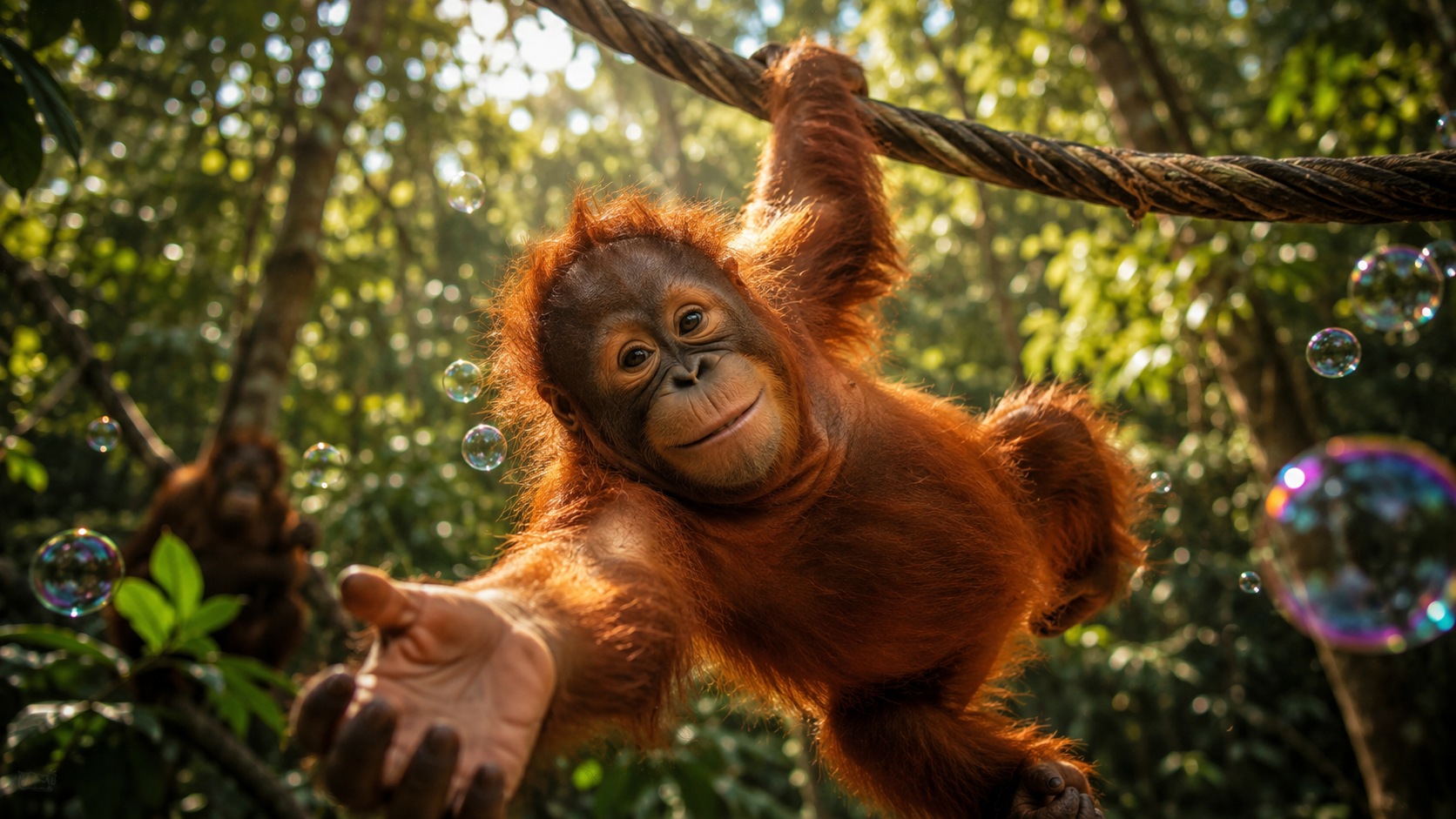
When most people think of orangutans, they picture thoughtful, intelligent primates quietly swinging through rainforest trees. Known for their remarkable problem-solving skills and human-like behaviors, orangutans have long fascinated scientists and animal lovers alike.
But there may be another side to these great apes that deserves more attention: their playful nature.
For years, researchers primarily focused on orangutans’ intelligence, tool use, and survival strategies. However, growing observations from wildlife experts, conservationists, and zoo caretakers suggest that these animals may be far more playful, curious, and fun-loving than many people realize.
From practical jokes and creative games to spontaneous acts of curiosity, orangutans often display behaviors that seem strikingly similar to the way humans play.
While scientists continue to study the role of play in animal behavior, one thing is becoming increasingly clear: playfulness may be a much bigger part of orangutan life than previously understood.
Here are ten signs that orangutans may be among the most playful creatures in the animal kingdom.
1. They Turn Everyday Objects Into Toys
One of the clearest indicators of playfulness is the ability to transform ordinary objects into sources of entertainment.
Orangutans excel at this.
In the wild, they have been observed interacting with leaves, sticks, branches, bark, and other natural materials in ways that go beyond simple survival needs. In managed care settings, they often invent games using ropes, buckets, blankets, cardboard boxes, and virtually anything available in their environment.
Rather than using objects solely as tools, they frequently manipulate them for apparent enjoyment.
This behavior mirrors what children do when they turn household items into imaginary toys. It reflects creativity, curiosity, and a desire for stimulation beyond basic necessities.
2. Young Orangutans Spend Hours Playing
Like human children, young orangutans dedicate significant portions of their day to play.
Researchers studying juvenile orangutans have documented playful chasing, climbing, wrestling, swinging, and mock fighting. These activities help young apes develop physical coordination and social skills while also providing enjoyment.
What’s especially interesting is that many of these behaviors appear to occur simply because the animals enjoy them.
The amount of time devoted to play suggests it serves an important developmental purpose.
Through playful exploration, young orangutans learn how to navigate their environment, interact with others, and build confidence in their abilities.
3. They Display a Strong Sense of Curiosity
Play and curiosity often go hand in hand.
Orangutans are famously inquisitive creatures. They investigate unfamiliar objects, examine new situations, and frequently test their surroundings.
A curious animal tends to engage more deeply with its environment, which naturally creates opportunities for playful behavior.
Observers have reported orangutans carefully inspecting unusual items, experimenting with different ways to use them, and repeatedly interacting with objects simply to see what happens.
This willingness to explore reflects a mindset that goes beyond survival instincts. It suggests a desire to learn, experiment, and have fun while doing so.
4. They Invent Their Own Games
Perhaps one of the strongest signs of playfulness is spontaneous game creation.
Many animals engage in instinctive forms of play, but orangutans often appear capable of inventing entirely new activities.
Caretakers have observed orangutans repeatedly performing behaviors that resemble self-created games. Some enjoy swinging in unusual ways, balancing objects, tossing items into the air, or creating playful challenges for themselves.
The fact that these activities are often repeated suggests they provide enjoyment rather than serving any practical purpose.
This creativity demonstrates impressive mental flexibility and a capacity for entertainment that closely resembles human behavior.
5. They Engage in Playful Social Interactions
Although orangutans are generally less social than some other great apes, they still engage in playful interactions with others.
Young orangutans frequently chase one another, wrestle, and participate in mock contests. These interactions help establish social boundaries and strengthen relationships.
Importantly, play behavior often follows recognizable patterns. Participants take turns, avoid causing harm, and display body language that signals friendly intentions.
Such behaviors indicate that orangutans understand the difference between genuine aggression and playful interaction.
This social awareness is an important component of advanced play.
6. They Seem to Enjoy Surprising Others
One fascinating aspect of animal behavior is the possibility that some species engage in forms of playful mischief.
There have been observations of orangutans startling companions, hiding objects, or engaging in behaviors that appear designed to provoke reactions.
While scientists remain cautious about interpreting intent, these actions sometimes resemble practical jokes.
Whether it’s gently teasing another orangutan or creating unexpected situations, these behaviors suggest a level of social awareness that supports playful interaction.
The possibility that orangutans enjoy surprising others adds another layer to our understanding of their personalities.
7. They Continue Playing Into Adulthood
In many species, play decreases dramatically after adolescence.
Orangutans, however, often retain playful tendencies well into adulthood.
Adult individuals have been observed engaging with enrichment items, experimenting with objects, and participating in recreational activities even after reaching maturity.
This continued interest in play is significant because it suggests that playfulness isn’t merely a developmental stage.
Instead, it may remain an important part of mental stimulation, learning, and emotional well-being throughout life.
Humans are among the few species known to maintain playful behavior into adulthood. Orangutans appear to share this characteristic to a surprising degree.
8. They Demonstrate Imagination and Creativity
One reason orangutans fascinate researchers is their remarkable creativity.
They often use familiar objects in new ways, adapting materials to suit different situations. Sometimes these adaptations serve practical purposes, but other times they seem entirely recreational.
For example, orangutans may drape leaves over themselves, experiment with unusual object combinations, or create temporary structures for no obvious reason.
These actions hint at imaginative thinking.
Creativity and play are closely linked because both involve exploring possibilities rather than following fixed patterns.
The more researchers study orangutans, the more evidence emerges that they possess rich and flexible minds.
9. They Seek Out Entertainment
Animals that actively pursue enjoyable experiences often display advanced cognitive abilities.
Orangutans frequently appear to seek stimulation beyond what is required for survival.
When given opportunities to explore new environments or interact with novel objects, many eagerly engage with them. They often revisit activities they seem to enjoy and may spend considerable time repeating entertaining behaviors.
This willingness to pursue recreation suggests that play itself may hold intrinsic value.
In other words, orangutans don’t merely play because they have to—they may play because they want to.
That distinction is important when evaluating the complexity of animal behavior.
10. Their Expressions and Body Language Reflect Enjoyment
One of the most compelling signs of playfulness comes from body language.
Researchers studying great apes have identified facial expressions and behavioral signals associated with playful interactions. Orangutans often display relaxed movements, open-mouth expressions, and exaggerated gestures during recreational activities.
These signals help communicate that an interaction is friendly rather than threatening.
Observers frequently report that playful orangutans appear energetic, engaged, and enthusiastic.
While it’s impossible to know exactly what another species experiences emotionally, these visible indicators strongly suggest that play is associated with positive experiences.
Their behavior often looks remarkably familiar to anyone who has watched children at play.
Why Play Matters More Than We Once Thought
For many years, play was viewed as little more than a way for young animals to pass time while learning survival skills.
Today, scientists increasingly recognize that play may serve a much broader purpose.
Play can strengthen problem-solving abilities, improve social intelligence, encourage creativity, and help animals adapt to changing environments.
In highly intelligent species, play may even contribute to innovation and learning.
Because orangutans possess exceptional cognitive abilities, understanding their playful behavior offers valuable insights into how intelligence evolves and functions.
The more researchers study play, the more important it appears to be.
What Orangutan Play Reveals About Intelligence
Playfulness is often associated with intelligence.
The ability to invent games, experiment with objects, and engage in flexible thinking requires advanced mental processing.
Orangutans consistently demonstrate these capabilities.
Their playful behaviors reveal a willingness to explore possibilities rather than simply react to immediate needs. They show curiosity about the world around them and often display behaviors that appear driven by enjoyment rather than necessity.
These qualities are hallmarks of sophisticated cognition.
In many ways, play serves as a window into the mind.
By observing how orangutans play, researchers gain a better understanding of how these remarkable animals think, learn, and experience their environment.
A New Perspective on Orangutans
Stories about orangutans often focus on their intelligence, tool use, and conservation challenges—and rightly so. These animals are among our closest relatives in the natural world and face significant threats in their native habitats.
Yet their playful side deserves recognition as well.
Play reveals personality.
It showcases creativity.
It highlights emotional complexity.
Most importantly, it reminds us that orangutans are not simply surviving in their environments—they are actively engaging with them.
Their playful behaviors demonstrate a richness of experience that continues to surprise researchers and inspire animal lovers around the world.
Final Thoughts
As scientists learn more about orangutans, one conclusion becomes increasingly difficult to ignore: these great apes may be far more playful than we once believed.
From inventing games and exploring objects to engaging in social fun and expressing curiosity, orangutans display many of the qualities commonly associated with playfulness.
These behaviors not only make them fascinating to observe but also deepen our appreciation for their intelligence and emotional complexity.
The next time you see an orangutan interacting with its surroundings, look closely. What may appear to be a simple action could actually be evidence of a playful mind at work.
And that playful spirit might be one of the many reasons orangutans continue to captivate people around the globe.







