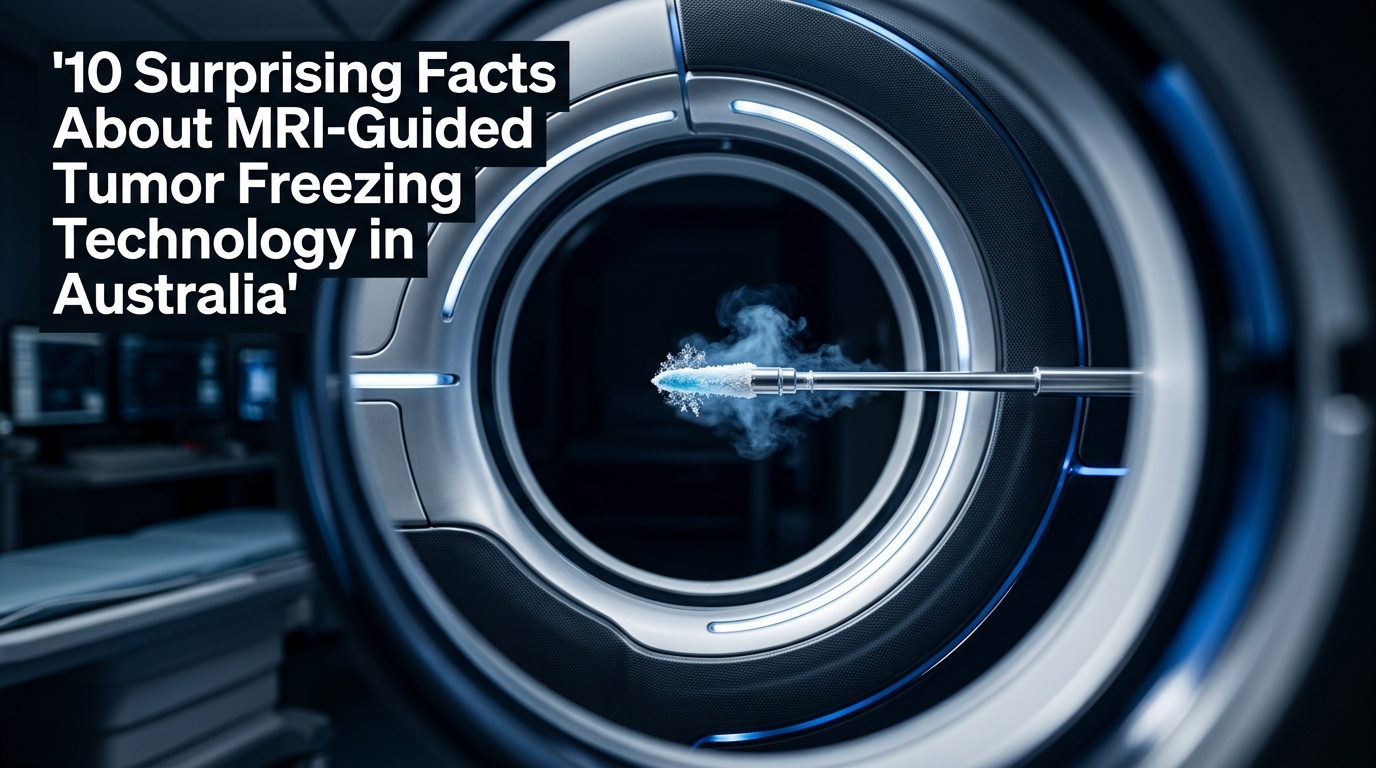
Cancer treatment is rapidly evolving, and one of the most intriguing advances in interventional oncology is MRI-guided tumor cryoablation—often described as “tumor freezing technology.” In Australia, this approach is gaining attention as a highly precise, minimally invasive way to destroy certain cancers without traditional surgery.
At its core, the technique uses extremely cold temperatures delivered through thin probes to freeze and destroy cancer cells, while MRI imaging provides real-time guidance. Rather than removing a tumor with a scalpel, doctors effectively “freeze it in place” and monitor the process from inside the MRI scanner for maximum accuracy.
Although still limited to select centers and specific tumor types, this technology represents a major shift in how some cancers may be treated in the future. Here are 10 surprising facts about MRI-guided tumor freezing technology in Australia.
1. It is already being performed in select Australian hospitals
MRI-guided cryoablation is not theoretical—it is already in clinical use in Australia at specialized interventional radiology centers. In particular, teams in Sydney have introduced in-bore MRI-guided procedures for carefully selected cancer patients, marking one of the most advanced uses of this technology in the country.
However, it is still highly specialized and not widely available across all hospitals.
2. The MRI machine does not freeze anything
Despite the dramatic name, the MRI scanner is not responsible for freezing the tumor.
Instead, the MRI acts as a real-time imaging system, allowing doctors to see the tumor and surrounding tissues in high detail while guiding thin cryoprobes into position. The actual freezing is done by the probe using compressed gas that rapidly drops temperatures to extreme lows.
In simple terms: MRI = navigation, cryoprobe = destruction.
3. The treatment creates an “ice ball” inside the body
Once activated, the cryoprobe forms a growing sphere of frozen tissue around the tumor, often called an “ice ball.”
This ice ball is carefully monitored on MRI scans to ensure it fully covers the tumor while sparing nearby healthy structures.
Inside this frozen zone, cancer cells are destroyed through ice crystal formation, membrane rupture, and loss of cellular integrity.
4. It can preserve surrounding healthy tissue with millimeter precision
One of the biggest advantages of MRI guidance is precision.
MRI provides exceptional soft-tissue contrast, allowing physicians to see both the tumor and nearby critical structures such as nerves, blood vessels, or the spinal cord. This makes it possible to control the ice ball expansion in real time and stop freezing before damaging important anatomy.
This level of precision is especially valuable in difficult tumor locations.
5. It is considered minimally invasive compared to surgery
Unlike traditional cancer surgery, MRI-guided cryoablation typically requires only a small skin puncture to insert the probe.
There are no large incisions, and in many cases, patients can return home the same day or after a short hospital stay.
Recovery times are generally much shorter than surgical alternatives, often measured in days rather than weeks.
6. It is especially useful for tumors that are hard to see on other scans
Not all tumors are clearly visible on CT or ultrasound imaging.
MRI guidance becomes particularly valuable when tumors are:
- Hidden within organs like the kidney or liver
- Small or deeply located
- Near sensitive structures
- Poorly defined on other imaging methods
MRI’s superior contrast resolution helps doctors identify and target lesions that would otherwise be difficult to treat accurately.
7. It is not suitable for all cancers
Despite its promise, MRI-guided cryoablation is not a universal cancer treatment.
It is generally unsuitable for:
- Large or widespread cancers
- Tumors without clear boundaries
- Cancers of hollow organs (such as bowel or stomach)
- Patients who cannot undergo MRI scanning
Because it is a focal therapy, it works best for small, localized tumors rather than advanced metastatic disease.
8. It is often used when surgery is too risky
One of the most important roles of this technology is offering an alternative for patients who are not ideal surgical candidates.
This includes individuals who:
- Have significant medical comorbidities
- Have a single functioning organ (e.g., one kidney)
- Cannot tolerate general anesthesia
- Have tumors in surgically challenging locations
In these cases, cryoablation can provide tumor control with fewer physiological stresses than major surgery.
9. It is part of a broader trend toward “image-guided oncology”
MRI-guided cryoablation is part of a growing field called interventional oncology, where imaging is used not just for diagnosis—but for treatment.
Other related technologies include:
- CT-guided ablation
- Ultrasound-guided tumor destruction
- MRI-guided focused ultrasound therapies
Together, these methods reflect a shift toward treating cancer with precision instruments rather than large surgical procedures whenever possible.
10. Research is expanding its future potential
Although current use is limited, research in MRI-guided tumor ablation is rapidly advancing.
Scientists and clinicians are working on:
- Better probe designs for larger or more complex tumors
- Improved MRI thermometry (temperature mapping during treatment)
- AI-assisted planning for probe placement
- Expanded applications in liver, kidney, bone, and prostate tumors
Some experimental studies also explore combining cryoablation with immunotherapy, with the idea that freezing tumors may help stimulate the immune system to recognize cancer cells more effectively.
Why this technology matters
MRI-guided tumor freezing represents a shift in cancer treatment philosophy—from removing large sections of tissue to precisely targeting only diseased cells.
Its main strengths include:
- High precision targeting
- Real-time visual monitoring
- Minimally invasive approach
- Shorter recovery times
- Suitability for difficult tumor locations
However, it remains a specialized technique that complements—not replaces—standard cancer treatments such as surgery, chemotherapy, radiation, and immunotherapy.
The bottom line
MRI-guided tumor cryoablation in Australia is an emerging, highly specialized cancer treatment that uses extreme cold and real-time MRI imaging to destroy tumors with precision. While still limited in availability and applicable only to select cases, it represents one of the most advanced examples of modern image-guided cancer therapy.
As technology improves and clinical experience grows, this “freeze-and-destroy” approach may play an increasingly important role in the future of minimally invasive cancer care.







