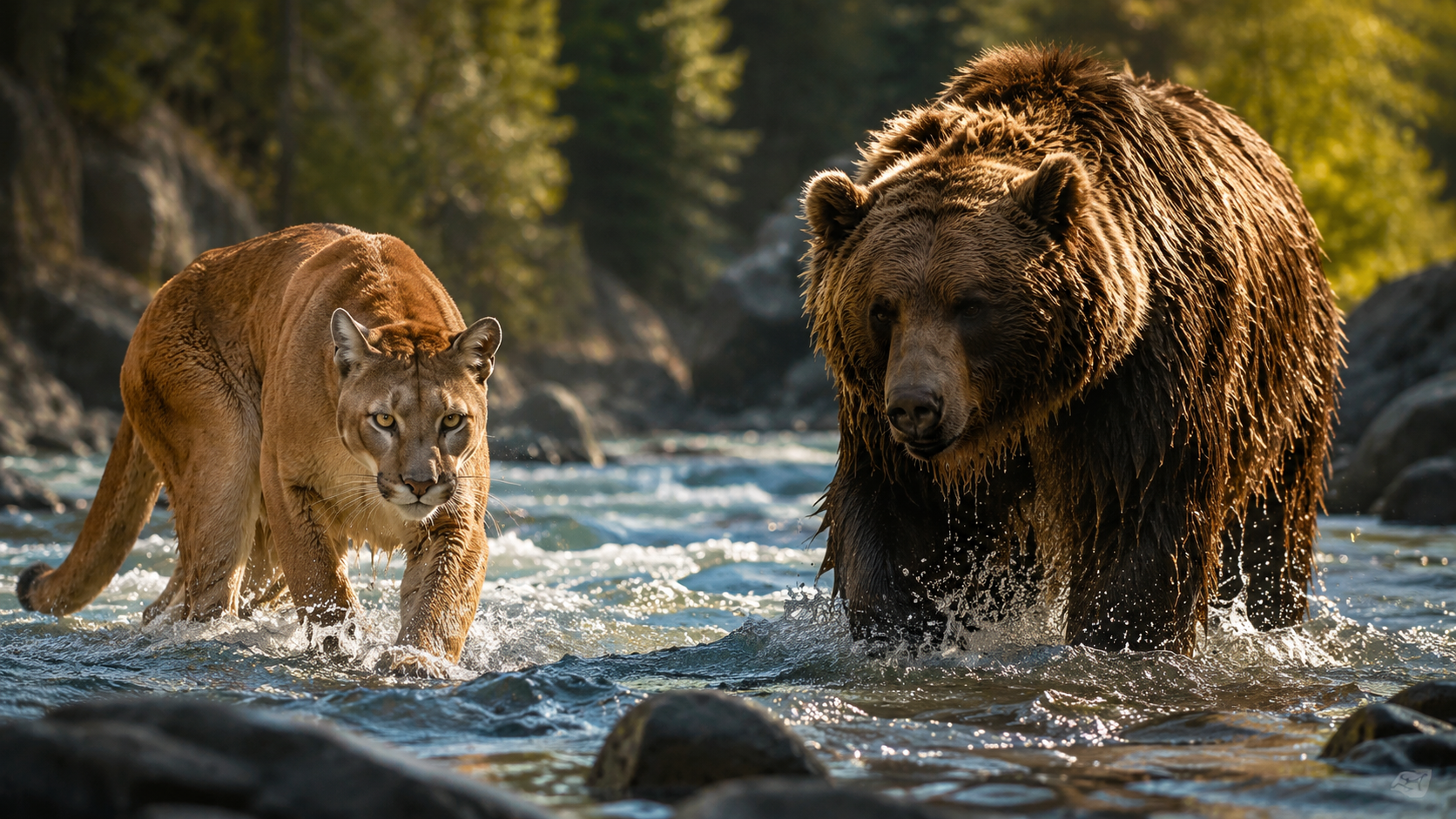
Wildlife encounters can be unpredictable, but every so often, nature delivers a scene so unusual that it captures the attention of researchers, photographers, and animal enthusiasts alike. One such moment occurred when a mountain lion and a bear were observed sharing the same river area at nearly the same time—a rare sight involving two of North America’s most powerful predators.
Although both species often inhabit overlapping territories, direct encounters between them are not commonly witnessed by humans. Their interactions tend to take place in remote forests, rugged mountains, and isolated river valleys, far from public view. When cameras or observers manage to document these moments, they offer a fascinating glimpse into how large predators coexist in the wild.
Here are 11 intriguing facts about the rare moment a mountain lion and a bear shared a river and what it reveals about life in the natural world.
1. Both Animals Are Apex Predators
Mountain lions and bears rank among the most formidable animals in North America.
Mountain lions are stealthy hunters capable of taking down deer and other large prey. Bears, depending on the species, are powerful omnivores that can dominate many habitats through sheer size and strength.
When two apex predators occupy the same area, their presence highlights the complexity of the ecosystem supporting them.
The fact that both animals were using the same river corridor suggests the area provided valuable resources for multiple species.
2. Rivers Act as Natural Wildlife Highways
To humans, a river may seem like a simple water source. To wildlife, it often serves as a transportation route.
Animals frequently travel along rivers because these areas provide water, food, shelter, and easier movement through dense terrain. Deer, elk, raccoons, birds, and countless other species rely on river ecosystems.
Predators naturally follow these routes because prey animals are often concentrated there.
The shared river encounter likely occurred because both animals were independently taking advantage of the same resource-rich environment.
3. Such Encounters Are Rarely Observed
While mountain lions and bears may occasionally cross paths in the wild, humans rarely witness it.
Both animals tend to avoid people and spend much of their time in remote locations. Mountain lions are especially elusive and are often active during dawn, dusk, or nighttime hours.
As a result, many interactions between large predators go completely unnoticed.
Wildlife cameras have dramatically increased scientists’ ability to document these hidden moments.
4. Neither Animal Necessarily Saw the Other as Prey
One common misconception is that every meeting between predators results in conflict.
In reality, most large carnivores prefer to avoid unnecessary fights. Injuries can be life-threatening in the wild, making confrontation a risky choice.
A mountain lion is unlikely to view a healthy adult bear as prey, while a bear may have little interest in chasing an alert mountain lion.
In many cases, coexistence is the safer and more energy-efficient strategy.
5. Bears Often Have a Size Advantage
Although mountain lions are agile and powerful hunters, bears generally possess a significant size advantage.
Adult bears can weigh several times more than a mountain lion, depending on the species and region. Their strength, thick build, and powerful limbs make them intimidating competitors.
Because of this difference, mountain lions often choose caution when a bear is nearby.
This size disparity influences how both species behave when sharing habitat.
6. Mountain Lions Rely on Stealth
One reason mountain lions are so successful is their ability to remain unseen.
Unlike bears, which often use strength and size to their advantage, mountain lions depend heavily on stealth, patience, and surprise. They move quietly through vegetation and use cover to avoid detection.
Even when sharing the same landscape with larger animals, mountain lions frequently go unnoticed.
Their secretive nature may explain why documented encounters with bears are relatively uncommon.
7. Rivers Provide Valuable Food Sources
A river ecosystem offers far more than drinking water.
Fish, small mammals, birds, vegetation, and animal carcasses can all attract wildlife to riverbanks. During certain seasons, rivers become especially important feeding areas.
Bears may search for fish or forage along the shoreline, while mountain lions may patrol for deer and other prey visiting the water.
The abundance of resources reduces competition and allows multiple species to use the same area.
8. Wildlife Cameras Have Revolutionized Observation
Many rare animal encounters are now documented through motion-activated cameras.
These devices operate continuously and capture images or video whenever movement is detected. Because they function without human presence, they reveal natural behaviors that might otherwise remain hidden.
Researchers have used camera traps to study migration patterns, predator-prey relationships, and interactions between species.
The sight of a mountain lion and bear sharing a river area is exactly the type of discovery that camera technology makes possible.
9. Coexistence Is More Common Than Conflict
Although dramatic wildlife confrontations often attract headlines, coexistence is usually the norm.
Predators develop behavioral strategies that allow them to share landscapes while minimizing dangerous encounters. They may use different hunting times, travel routes, or feeding areas to reduce competition.
This ecological separation helps maintain balance within the ecosystem.
The river encounter serves as a reminder that wildlife often shares space more peacefully than people might assume.
10. The Event Highlights a Healthy Ecosystem
The presence of both a mountain lion and a bear in the same location is often a positive sign.
Large predators require extensive habitat, abundant food, and relatively intact ecosystems. Their survival depends on healthy populations of prey species and functioning natural landscapes.
When multiple top predators thrive in the same area, it often indicates strong biodiversity and ecological stability.
In many ways, these animals act as indicators of environmental health.
11. Encounters Like This Inspire Conservation Efforts
Rare wildlife moments capture public imagination because they offer a glimpse into a world most people rarely experience.
Photographs and videos showing predators in their natural environment help raise awareness about habitat preservation and wildlife management.
As human development continues to expand, maintaining connected landscapes becomes increasingly important for species such as mountain lions and bears.
Every documented encounter reinforces the value of protecting the ecosystems that make such moments possible.
Why Predator Interactions Matter
Scientists study interactions between large predators because they reveal important information about ecosystem dynamics.
Understanding how species share resources, avoid conflict, and adapt to changing environments helps researchers make informed conservation decisions.
These observations also improve our knowledge of animal behavior and population health.
Even a brief encounter between two predators can provide valuable insights into the broader ecological picture.
The Hidden Drama of the Wild
Nature is filled with moments that occur far from human eyes.
A mountain lion silently moving through the trees, a bear foraging along a riverbank, or both animals passing through the same location within minutes of each other are examples of the unseen drama unfolding every day in wild landscapes.
Modern technology is allowing us to witness more of these events than ever before, deepening our appreciation for the complexity of natural ecosystems.
Conclusion
The rare moment when a mountain lion and a bear shared a river offers a fascinating look into the lives of two of North America’s most iconic predators. Rather than highlighting conflict, the encounter demonstrates how wildlife often coexists within shared habitats, relying on abundant resources and natural behaviors to avoid unnecessary confrontation.
From the importance of river ecosystems to the role of camera technology in revealing hidden wildlife activity, this remarkable event provides valuable lessons about ecology, conservation, and the delicate balance of nature. It serves as a powerful reminder that even in landscapes occupied by powerful predators, cooperation through coexistence is often the key to survival.







