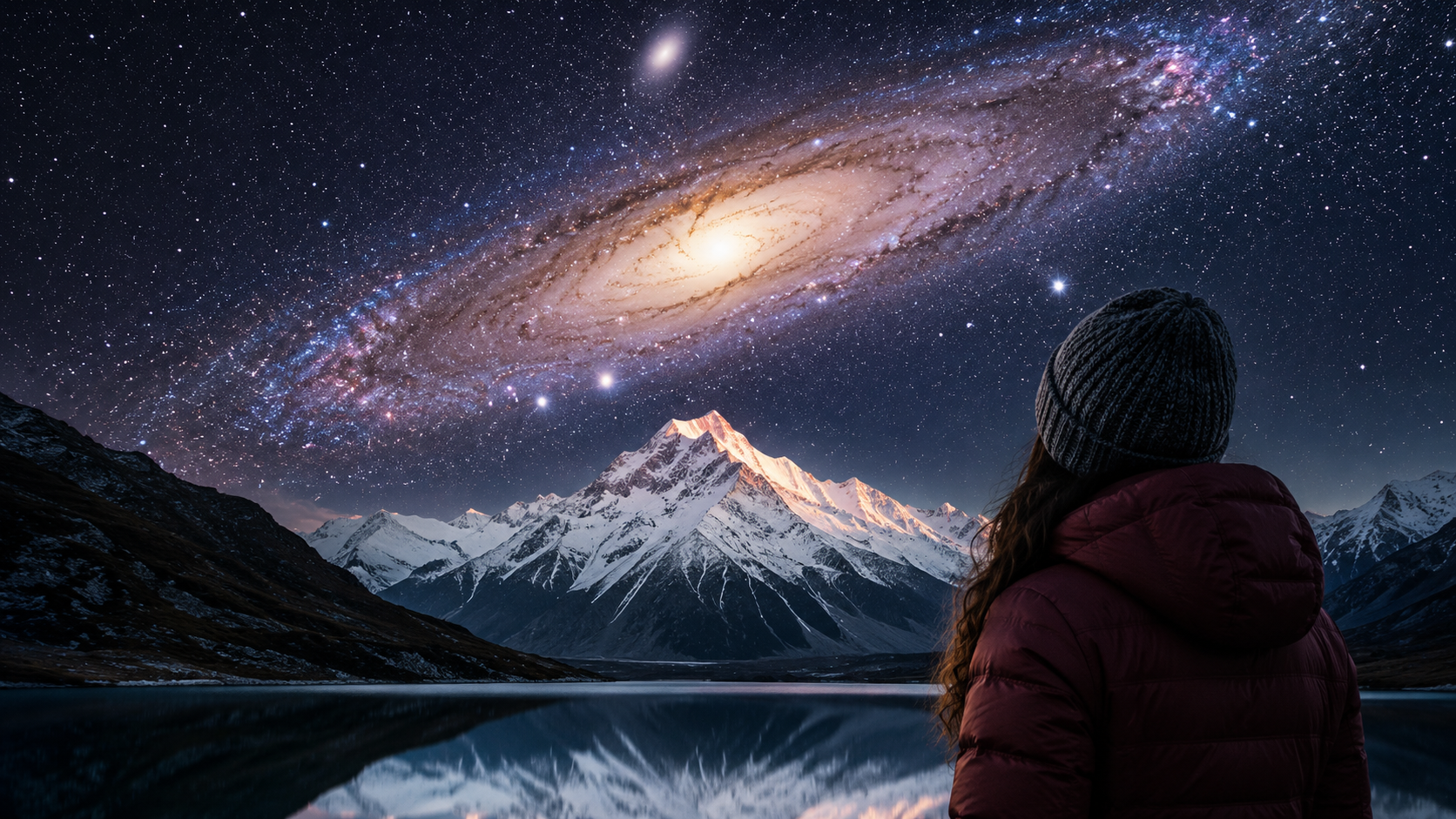
Few sights in astronomy are as awe-inspiring as seeing the Andromeda Galaxy suspended above a dark mountain landscape. When photographed above New Zealand’s majestic Mount Aoraki, the scene feels almost unreal—a distant island of stars floating over one of Earth’s most breathtaking natural landmarks.
The image is more than just visually stunning. It represents an extraordinary meeting of cosmic and terrestrial scales: a galaxy containing roughly a trillion stars appearing above a mountain shaped by glaciers, tectonic forces, and millions of years of geological history.
Here are 11 fascinating facts about the Andromeda Galaxy shining above Mount Aoraki.
1. You’re Looking at the Most Distant Object Visible to the Naked Eye
Under dark, clear skies, the Andromeda Galaxy can often be seen without binoculars or a telescope.
This makes it one of the farthest objects that most people can observe using only their eyes. While it appears as a faint smudge of light, that glow comes from an entire galaxy containing hundreds of billions—or possibly more than a trillion—stars.
Every glance toward Andromeda is a glimpse into the vastness of the universe.
2. Its Light Began Traveling Millions of Years Ago
The Andromeda Galaxy lies about 2.5 million light-years from Earth.
That means the light reaching your eyes tonight began its journey roughly 2.5 million years ago. When that light left Andromeda, early human ancestors were just beginning to walk the Earth.
In a sense, observing Andromeda is a form of time travel.
3. It Is the Closest Major Galaxy to Our Own
Astronomers consider Andromeda the nearest large galactic neighbor to the Milky Way.
Although there are smaller satellite galaxies closer to us, Andromeda is the nearest spiral galaxy of comparable size. Its proximity makes it one of the most studied galaxies beyond our own.
Scientists often use it as a cosmic laboratory to better understand how galaxies evolve.
4. Andromeda Is Enormous
The Andromeda Galaxy stretches across roughly 220,000 light-years.
That makes it larger than the Milky Way in diameter. Its immense structure includes vast spiral arms, dense star clusters, glowing nebulae, and a supermassive black hole at its center.
The faint patch visible from Earth represents only a tiny fraction of its true scale.
5. Mount Aoraki Provides an Exceptional Viewing Location
Mount Aoraki, also known as Aoraki/Mount Cook, sits within one of the world’s premier stargazing regions.
The surrounding area benefits from low levels of light pollution, clear mountain air, and strict efforts to preserve dark skies. These conditions make it an ideal location for observing deep-sky objects such as Andromeda.
Photographers from around the world travel there specifically to capture scenes like this.
6. The Galaxy Appears Larger Than the Full Moon
Most people are surprised to learn that Andromeda occupies a larger area of the sky than the full Moon.
The reason it doesn’t appear enormous is that much of its light is extremely faint. Human eyes can only detect the bright central region under most conditions.
Long-exposure photography reveals the galaxy’s true size and structure.
7. It Contains Hundreds of Billions of Planets
If Andromeda contains hundreds of billions or even a trillion stars, it likely hosts an unimaginable number of planets as well.
Many of those worlds may orbit stars similar to our Sun. While scientists have not yet detected Earth-like planets in Andromeda directly, statistical estimates suggest that countless planetary systems exist there.
The possibility sparks endless questions about life elsewhere in the universe.
8. The Milky Way and Andromeda Are Moving Toward Each Other
One of the most fascinating facts about Andromeda is that it is not standing still.
The galaxy is approaching the Milky Way at a speed of roughly 250,000 miles per hour (400,000 kilometers per hour). Although that sounds dramatic, the immense distance between the two galaxies means a collision won’t occur for about 4 to 5 billion years.
For now, the approach is detectable only through precise astronomical measurements.
9. The Future Collision Won’t Be Catastrophic
The word “collision” may sound alarming, but galaxies are mostly empty space.
When the Milky Way and Andromeda eventually merge, relatively few stars are expected to collide directly. Instead, gravitational interactions will slowly reshape both galaxies over billions of years.
The result will likely be a new, larger galaxy formed from the combination of the two.
10. Ancient Skywatchers Saw It Too
Long before telescopes existed, people observed the faint glow of Andromeda.
Ancient astronomers recorded it as a mysterious cloud-like object in the sky. For centuries, no one understood its true nature. It wasn’t until the 20th century that scientists confirmed it was an entirely separate galaxy beyond the Milky Way.
That discovery dramatically expanded humanity’s understanding of the universe.
11. The View Combines Two Different Kinds of Wonder
The image of Andromeda above Mount Aoraki is remarkable because it blends two extraordinary scales of nature.
Below stands a mountain sculpted over millions of years by geological forces. Above shines a galaxy so vast that its light requires millions of years to cross intergalactic space.
Together, they create a scene that reminds us how small we are—and how fortunate we are to witness such beauty.
Why This Celestial View Captivates People Worldwide
The sight of the Andromeda Galaxy above Mount Aoraki is more than a beautiful photograph. It represents a connection between Earth and the wider cosmos. It links a mountain peak rising above New Zealand’s landscape with a galaxy containing countless stars, planets, and mysteries yet to be explored.
For astronomers, it highlights the scale of the universe. For photographers, it offers a dream composition. For everyone else, it serves as a reminder that some of the most extraordinary sights imaginable are already waiting above our heads.
On a clear, dark night, looking toward Andromeda is more than stargazing—it’s a glimpse into a universe far larger and older than we can easily comprehend.







