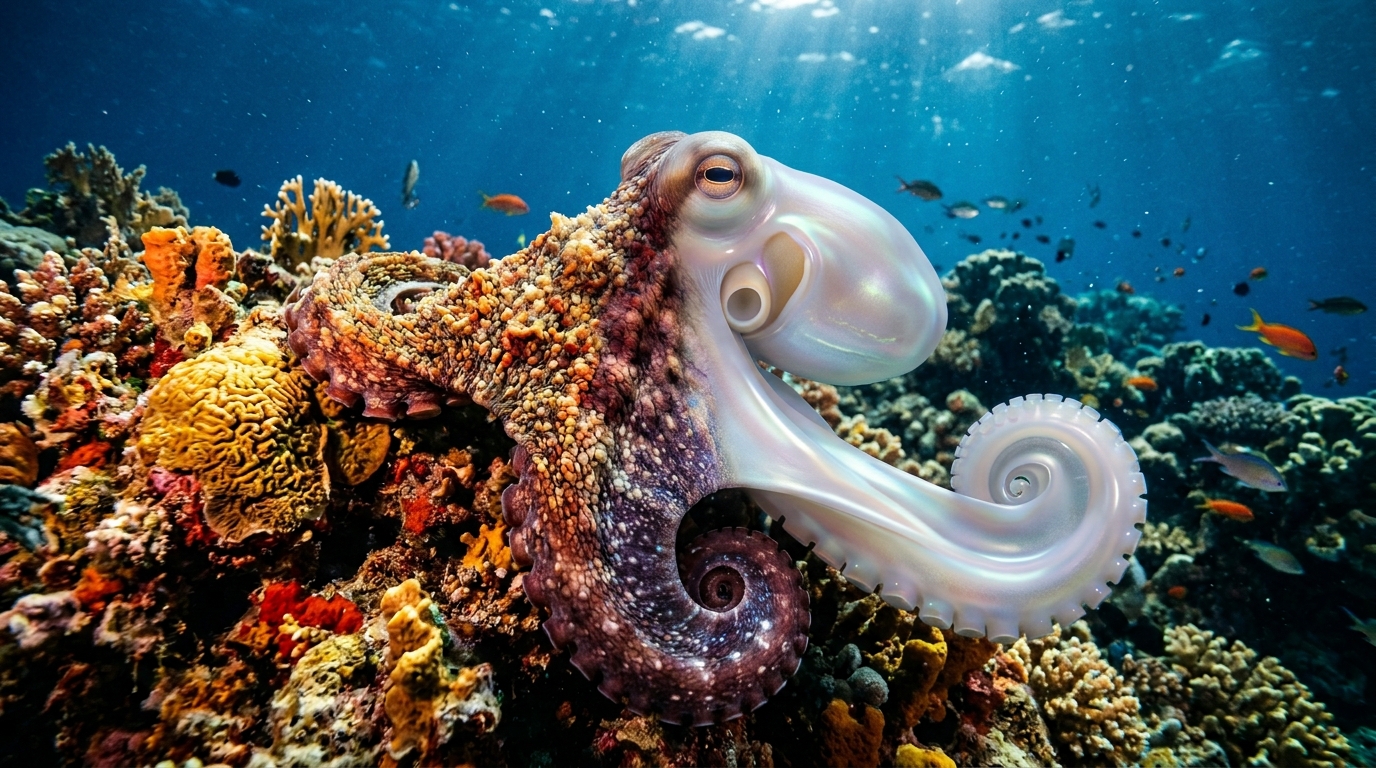
The ocean is home to countless extraordinary creatures, but few capture the imagination quite like the octopus. With eight flexible arms, remarkable intelligence, and abilities that seem straight out of science fiction, octopuses have fascinated scientists and nature enthusiasts for generations.
These soft-bodied marine animals belong to a group known as cephalopods, yet even among their relatives, they stand out as some of the most unusual creatures on Earth. From solving puzzles to changing color in an instant, octopuses possess a collection of traits that make them unlike almost any other animal in the natural world.
Here are 11 reasons octopuses are truly one of nature’s most extraordinary creations.
1. They Have Three Hearts
Most animals get by with a single heart, but octopuses have three.
Two hearts pump blood to the gills, where oxygen is absorbed, while a third circulates oxygen-rich blood throughout the rest of the body. Interestingly, the main heart temporarily stops beating when an octopus swims, which is one reason these animals often prefer crawling along the seafloor rather than expending energy through constant swimming.
2. Their Blood Is Blue
Octopus blood looks very different from human blood.
Instead of using iron-based hemoglobin to transport oxygen, octopuses rely on a copper-containing protein called hemocyanin. This compound gives their blood a blue color and allows oxygen to be transported efficiently in cold, low-oxygen marine environments.
The adaptation helps them thrive in habitats where many other animals would struggle.
3. They Can Change Color in an Instant
One of the octopus’s most famous abilities is its extraordinary camouflage.
Specialized skin cells called chromatophores allow these animals to rapidly alter their color and patterns. In a matter of seconds, an octopus can blend into rocks, coral reefs, or sandy seabeds, making it incredibly difficult for predators to spot.
Some species can produce highly detailed patterns that mimic their surroundings with astonishing accuracy.
4. They Can Change Texture Too
Color is only part of the disguise.
Octopuses can also alter the texture of their skin, creating bumps, ridges, and folds that resemble rocks, seaweed, coral, or other objects in their environment. This combination of color and texture transformation makes their camouflage among the most advanced in the animal kingdom.
5. They Are Remarkably Intelligent
Scientists consider octopuses among the most intelligent invertebrates on Earth.
Research has shown that they can solve puzzles, navigate mazes, recognize patterns, and learn through observation. In laboratory studies, octopuses have demonstrated impressive problem-solving skills and the ability to remember solutions for future use.
Their intelligence continues to surprise researchers.
6. Much of Their Nervous System Is in Their Arms
An octopus’s brain is only part of the story.
More than half of its neurons are located within its arms. Each arm can process information and perform complex movements with a degree of independence, allowing the animal to interact with multiple objects simultaneously.
This unique nervous system is unlike anything found in humans or most other animals.
7. They Have No Bones
Octopuses are completely soft-bodied.
Without a skeleton, they can squeeze through incredibly small openings. If their beak—the only hard part of their body—can fit through a gap, the rest of the animal can usually follow.
This flexibility helps them escape predators and access hidden shelters or hunting grounds.
8. They Use Tools
Tool use was once considered a trait largely limited to certain mammals and birds.
However, scientists have observed octopuses collecting coconut shells, arranging objects for protection, and using available materials as portable shelters. These behaviors demonstrate planning and adaptability rarely associated with invertebrates.
Tool use is often viewed as an important indicator of advanced intelligence.
9. They Can Regrow Lost Arms
If an octopus loses an arm to a predator or injury, it can grow a replacement.
Over time, the new arm regenerates and regains its normal functionality. This remarkable ability improves survival prospects and allows octopuses to recover from encounters that might be fatal for many other animals.
Regeneration remains an active area of biological research.
10. Their Reproductive Strategy Is Extraordinary
The life cycle of an octopus is one of the most unusual in nature.
Most species reproduce only once. After mating, males eventually die, while females devote themselves entirely to protecting and caring for their eggs. Some mothers guard their developing offspring for months—or even years—without eating before dying shortly after the eggs hatch.
This intense parental investment is among the most dramatic examples found in the animal kingdom.
11. Scientists Are Still Discovering Their Secrets
Despite decades of research, octopuses continue to surprise experts.
New studies regularly uncover previously unknown behaviors, hunting strategies, communication methods, and cognitive abilities. Their unique biology challenges many traditional assumptions about intelligence, evolution, and animal behavior.
Every discovery seems to reveal another layer of complexity.
Why Octopuses Fascinate Scientists
Octopuses are unlike most animals because they combine advanced intelligence, extraordinary physical abilities, and unique biological adaptations in a single creature.
Researchers study them to better understand everything from problem-solving and learning to camouflage, regeneration, and nervous system function. Their unusual traits provide valuable insights into how intelligence and complex behaviors can evolve in different branches of the animal kingdom.
In many ways, octopuses represent an entirely different approach to life on Earth.
Masters of Survival
The ocean can be an unforgiving environment filled with predators and competition. Yet octopuses have developed a remarkable collection of survival tools.
Their camouflage allows them to disappear into their surroundings. Their flexibility helps them escape danger. Their intelligence enables them to solve problems and adapt to changing conditions. Together, these abilities make them some of the most successful and fascinating hunters in the sea.
Final Thoughts
Octopuses are living proof that nature can produce creatures that seem almost alien in their abilities. With three hearts, blue blood, shape-shifting skin, incredible intelligence, and arms capable of acting semi-independently, they challenge our understanding of what animals can do.
Every year, scientists uncover new discoveries that deepen our appreciation for these remarkable cephalopods. The more we learn about them, the clearer it becomes that octopuses are not just unusual—they are among the most extraordinary animals on the planet.
In the vast and mysterious world beneath the waves, few creatures rival the octopus when it comes to complexity, adaptability, and sheer wonder.







