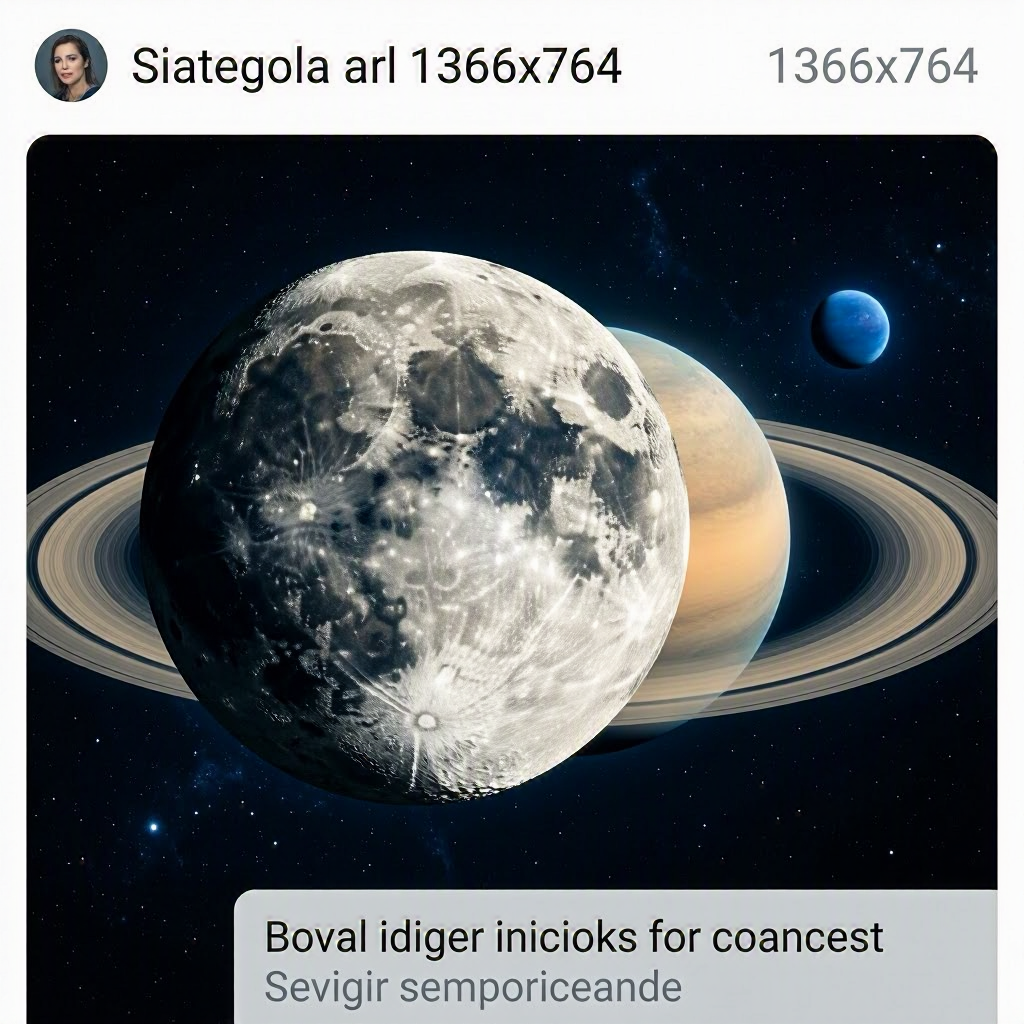
Skywatchers have plenty to look forward to when the Moon appears to meet Saturn and Neptune in the night sky. While the three worlds are separated by vast distances in space, their apparent close approach creates a fascinating celestial event that offers both beauty and a chance to learn more about our solar system.
Planetary conjunctions involving the Moon are among the easiest astronomical events to observe. They require little or no equipment, can often be seen from backyards and city parks, and provide a striking visual reminder of the constant motion of celestial bodies above us.
Before the Moon makes its close approach to Saturn and Neptune, here are 12 amazing things worth knowing.
1. The Three Objects Aren’t Actually Close Together
When astronomers say the Moon will “meet” Saturn and Neptune, it doesn’t mean the objects are physically near one another.
The event is known as a conjunction, which occurs when celestial objects appear close together from Earth’s perspective. In reality, the Moon, Saturn, and Neptune remain separated by hundreds of millions to billions of miles.
The alignment is a matter of viewing angle rather than actual proximity.
2. The Moon Will Be the Easiest Object to Spot
Of the three objects involved, the Moon will naturally draw the most attention.
Its bright glow makes it one of the most recognizable features of the night sky. Depending on its phase, it may also help observers locate Saturn nearby.
For beginners, the Moon often serves as a useful guide for finding planets.
3. Saturn Is Visible Without a Telescope
One of the highlights of this celestial pairing is the opportunity to see Saturn with the naked eye.
Saturn typically appears as a steady, yellowish point of light. Unlike stars, planets generally do not twinkle as strongly because they appear as tiny disks rather than distant points.
Under clear skies, Saturn is often easy to identify once you know where to look.
4. Neptune Is Far More Challenging to Observe
Unlike Saturn, Neptune is usually too faint to be seen without optical aid.
Most observers will need binoculars or a telescope to locate the distant ice giant. Even then, Neptune appears as a small bluish dot rather than a detailed planetary disk.
Its subtle appearance reflects its incredible distance from Earth.
5. Neptune Is the Most Distant Major Planet
Neptune orbits the Sun at an average distance of about 2.8 billion miles (4.5 billion kilometers).
Because of this immense distance, sunlight takes more than four hours to reach the planet. By comparison, sunlight reaches Earth in just over eight minutes.
Looking at Neptune means viewing one of the most remote worlds in our planetary neighborhood.
6. Saturn’s Rings Make It a Favorite Telescope Target
Although Saturn appears as a bright point to the naked eye, a telescope reveals one of the most breathtaking sights in astronomy.
Its magnificent ring system is made up of countless particles of ice, rock, and dust orbiting the planet. Even a modest telescope can reveal the rings, making Saturn one of the most rewarding objects for amateur astronomers.
Many people remember their first view of Saturn through a telescope for the rest of their lives.
7. The Moon’s Position Changes Faster Than the Planets’
The Moon moves noticeably across the sky from night to night.
Because it orbits Earth approximately every 27 days, its position relative to stars and planets changes quickly. Saturn and Neptune, on the other hand, move much more slowly against the background stars.
This rapid motion is what creates many of the Moon’s close encounters with planets throughout the year.
8. Conjunctions Have Inspired Skywatchers for Centuries
Long before modern astronomy, close approaches between the Moon and planets attracted attention from cultures around the world.
Ancient observers often interpreted celestial alignments as significant events, recording them in calendars and historical texts. Today, astronomers understand the mechanics behind these encounters, but the visual appeal remains just as powerful.
The sight continues to inspire curiosity and wonder.
9. Binoculars Can Greatly Improve the Experience
A good pair of binoculars can transform a simple observation into something far more memorable.
They can help reveal Neptune, provide a clearer view of Saturn, and enhance details on the Moon’s surface, including craters, mountain ranges, and dark lava plains.
For many observers, binoculars offer the perfect balance between simplicity and improved viewing.
10. The Event Highlights the Scale of the Solar System
This apparent meeting involves objects separated by extraordinary distances.
The Moon lies about 238,855 miles (384,400 kilometers) from Earth. Saturn is roughly 900 million miles away on average, while Neptune resides more than three times farther than Saturn.
The conjunction provides a visual lesson in the immense scale of our solar system.
11. Photography Opportunities Can Be Stunning
Astrophotographers often seek conjunctions because they combine multiple celestial objects in a single frame.
A bright Moon paired with Saturn can create beautiful compositions, especially when photographed near the horizon alongside landscapes, city skylines, or natural landmarks.
The event offers both artistic and scientific appeal.
12. It’s a Reminder That the Sky Is Constantly Changing
One of the most fascinating aspects of astronomy is that the sky never remains exactly the same.
The Moon continually shifts position, planets move along their orbits, and celestial alignments come and go. Events like this conjunction remind us that the universe is dynamic and constantly evolving.
Every night presents a slightly different view of the cosmos.
Why This Celestial Meeting Is Worth Watching
The Moon’s close approach to Saturn and Neptune is more than a simple astronomical curiosity. It is an opportunity to observe three very different worlds sharing the same patch of sky from our perspective on Earth.
The event showcases the brightness of the Moon, the elegance of Saturn, and the distant mystery of Neptune. Together, they offer a glimpse into the diversity and scale of our solar system.
Whether you’re using a telescope, binoculars, or simply your eyes, taking a few moments to observe this celestial gathering can provide a deeper appreciation for the universe above. Sometimes the most extraordinary journeys don’t require traveling anywhere at all—they begin by looking up.







