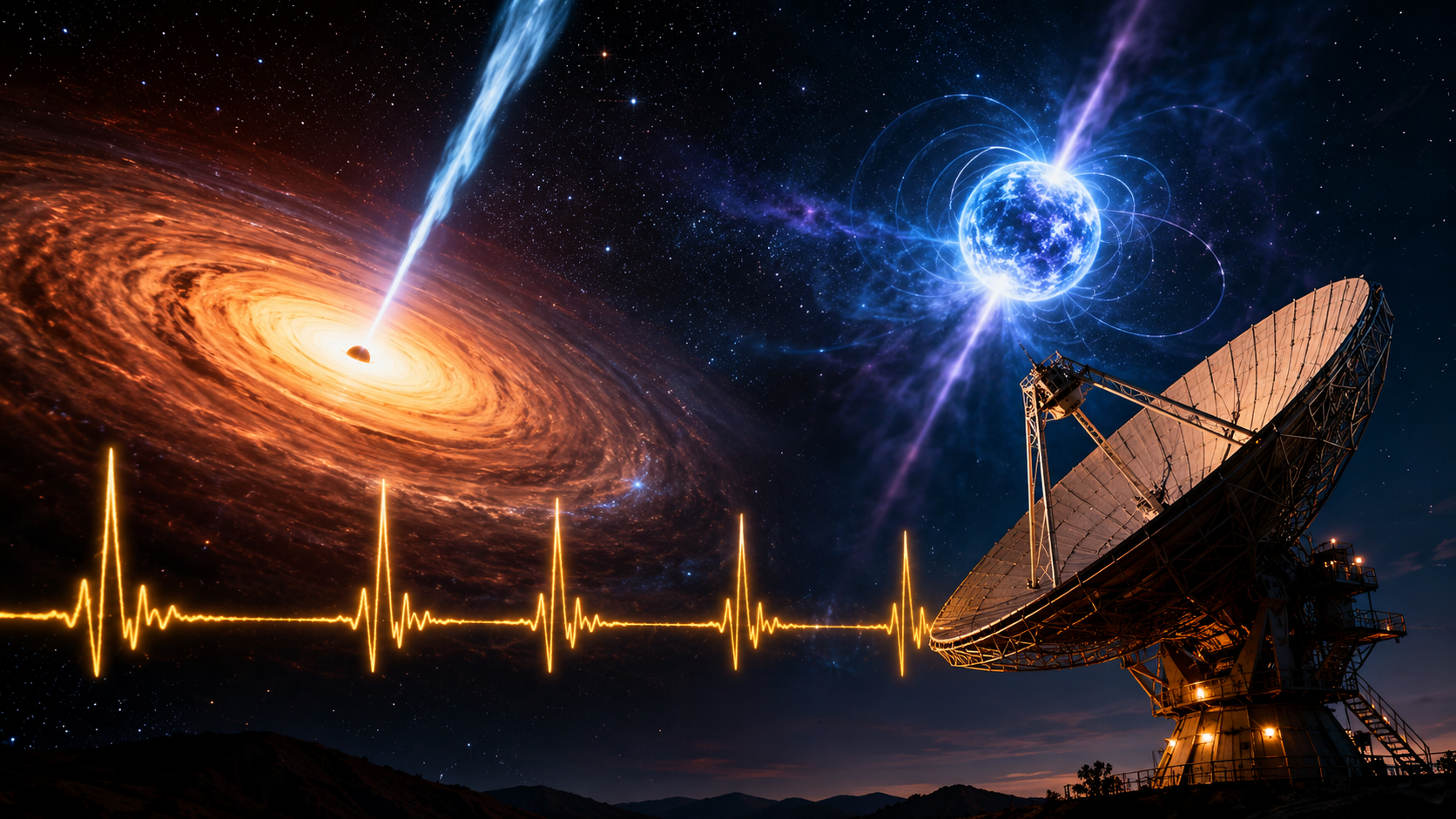
The universe is filled with extraordinary objects, but few are as mysterious and captivating as those that appear to blink across space in radio waves and X-rays. These cosmic lighthouses, known as pulsars, are among the most extreme objects ever discovered. They spin at incredible speeds, generate powerful magnetic fields, and emit beams of radiation that sweep across the cosmos like the rotating beam of a lighthouse.
When these beams point toward Earth, astronomers detect regular pulses of energy, making the object appear to blink on and off. Since their accidental discovery in 1967, pulsars have revolutionized our understanding of stellar evolution, gravity, and the behavior of matter under conditions that cannot be recreated on Earth.
From spinning hundreds of times per second to helping scientists search for gravitational waves, pulsars continue to reveal new secrets about the universe. Here are 12 fascinating facts about these remarkable objects that blink in radio waves and X-rays.
1. Pulsars Are the Remains of Exploded Stars
Every pulsar begins its life as a massive star.
When a giant star exhausts its nuclear fuel, it can no longer support itself against gravity. The star collapses and explodes in a dramatic supernova, one of the most powerful events in the universe.
What remains after the explosion is often an incredibly dense neutron star. Some of these neutron stars become pulsars, emitting beams of radiation from their magnetic poles as they rotate.
In many ways, pulsars are the surviving cores of stars that once dwarfed our Sun.
2. They Are Incredibly Dense
Pulsars pack an astonishing amount of mass into a tiny volume.
A typical pulsar may contain more mass than the Sun while measuring only about 20 kilometers (12 miles) across. This makes them among the densest known objects in the universe.
A single teaspoon of pulsar material would weigh billions of tons on Earth.
The matter inside these objects exists under pressures so extreme that scientists are still trying to understand exactly what happens within their interiors.
3. They Spin at Extraordinary Speeds
One of the defining features of pulsars is their rapid rotation.
Young pulsars may rotate several times every second, while some older “millisecond pulsars” spin hundreds of times per second.
The fastest known pulsars complete more than 700 rotations every second, meaning they spin faster than the blades of many industrial machines.
This incredible rotation helps generate the powerful electromagnetic beams that make pulsars detectable from Earth.
4. Their Signals Are Remarkably Precise
Pulsars are often compared to cosmic clocks.
Many emit pulses with such regularity that their timing rivals the accuracy of some atomic clocks. Astronomers can predict the arrival of individual pulses years in advance.
This precision makes pulsars valuable tools for scientific research, allowing researchers to test theories of gravity and study subtle changes in space-time.
Few natural phenomena in the universe display such extraordinary consistency.
5. The “Blinking” Is an Optical Illusion
Pulsars do not actually switch on and off.
Instead, they emit continuous beams of radiation from regions near their magnetic poles. Because the magnetic axis is usually tilted relative to the rotation axis, the beams sweep through space as the pulsar spins.
When one of these beams crosses Earth’s line of sight, astronomers detect a pulse.
The effect is similar to watching a lighthouse from a distance. The light appears to blink even though it shines continuously.
6. They Emit More Than Radio Waves
Although pulsars were first discovered through radio observations, they emit energy across multiple parts of the electromagnetic spectrum.
Many pulsars produce visible light, infrared radiation, ultraviolet light, X-rays, and even gamma rays.
Some are especially powerful X-ray emitters, making them important targets for space-based observatories.
Studying different wavelengths helps astronomers build a more complete picture of how these extreme objects function.
7. Their Magnetic Fields Are Almost Unimaginably Strong
Pulsars possess some of the strongest magnetic fields known in nature.
Their magnetic fields can be trillions of times stronger than Earth’s magnetic field.
These enormous magnetic forces accelerate charged particles to near-light speeds and play a central role in generating the radiation that pulsars emit.
The extreme magnetic environment surrounding a pulsar would be lethal to any nearby spacecraft or form of life.
8. Some Pulsars Orbit Other Stars
Not all pulsars exist alone in space.
Many are members of binary systems, orbiting companion stars in complex gravitational dances. In some cases, the pulsar pulls material from its companion, creating spectacular interactions.
These binary systems allow astronomers to study gravity under extreme conditions and have provided some of the strongest evidence supporting Einstein’s theory of general relativity.
The behavior of binary pulsars continues to be a major area of astrophysical research.
9. Pulsars Help Scientists Search for Gravitational Waves
One of the most exciting uses of pulsars involves the search for gravitational waves.
As gravitational waves pass between Earth and a pulsar, they slightly alter the timing of the pulsar’s signals. By monitoring many pulsars spread across the sky, scientists can detect these tiny timing variations.
This technique, known as a pulsar timing array, effectively transforms the galaxy into a giant gravitational-wave detector.
It offers a unique way to study some of the largest and most energetic events in the universe.
10. Some Pulsars Can “Recycle” Themselves
Over time, pulsars gradually lose energy and slow down.
However, in certain binary systems, a pulsar can regain speed by pulling material from a companion star. As the incoming matter transfers angular momentum, the pulsar spins faster and faster.
This process creates what astronomers call a recycled pulsar.
Some recycled pulsars become millisecond pulsars, among the fastest-spinning objects known in the cosmos.
11. They Can Produce Powerful X-Ray Outbursts
Certain pulsars experience dramatic bursts of high-energy radiation.
These outbursts can release enormous amounts of energy in a short period, making them visible across vast distances.
X-ray pulsars often form when material from a nearby companion star falls onto the neutron star’s surface. The infalling matter becomes intensely heated, generating bright X-ray emissions.
These events provide valuable information about the behavior of matter in extreme gravitational and magnetic environments.
12. Pulsars May Help Future Space Navigation
Scientists have proposed using pulsars as natural navigation beacons for deep-space missions.
Because their signals are highly regular and predictable, spacecraft could potentially determine their positions by measuring the arrival times of pulsar pulses.
The concept is similar to GPS navigation on Earth but would function on an interplanetary or even interstellar scale.
As humanity expands its presence in space, pulsar-based navigation could become an important tool for future exploration.
How Pulsars Were Discovered
The discovery of pulsars is one of astronomy’s most fascinating stories.
In 1967, graduate student Jocelyn Bell Burnell noticed unusual repeating signals while analyzing radio telescope data. The signals were so regular that researchers initially considered the possibility of an artificial origin.
The source was jokingly labeled “LGM,” short for “Little Green Men.”
Further observations soon revealed that the signals came from rapidly rotating neutron stars, leading to the identification of an entirely new class of astronomical objects.
The discovery transformed astrophysics and opened a new window into the study of extreme cosmic phenomena.
Why Pulsars Matter
Pulsars are far more than astronomical curiosities.
They provide laboratories for studying matter under extreme densities, magnetic fields, and gravitational forces. Their predictable signals help scientists test fundamental laws of physics and explore phenomena that cannot be replicated in terrestrial laboratories.
From probing the nature of gravity to aiding future spacecraft navigation, pulsars continue to contribute to some of the most important scientific discoveries of our time.
Conclusion
Objects that blink in radio waves and X-rays may seem mysterious, but pulsars are among the most valuable tools in modern astronomy. Born from the explosive deaths of massive stars, these spinning neutron stars combine incredible density, rapid rotation, and immense magnetic power into one extraordinary package.
Their rhythmic pulses have helped scientists uncover new insights into gravity, stellar evolution, gravitational waves, and the structure of the universe itself. More than half a century after their discovery, pulsars remain one of the most fascinating and scientifically important objects in the cosmos, proving that even the smallest stellar remnants can have an enormous impact on our understanding of space.







