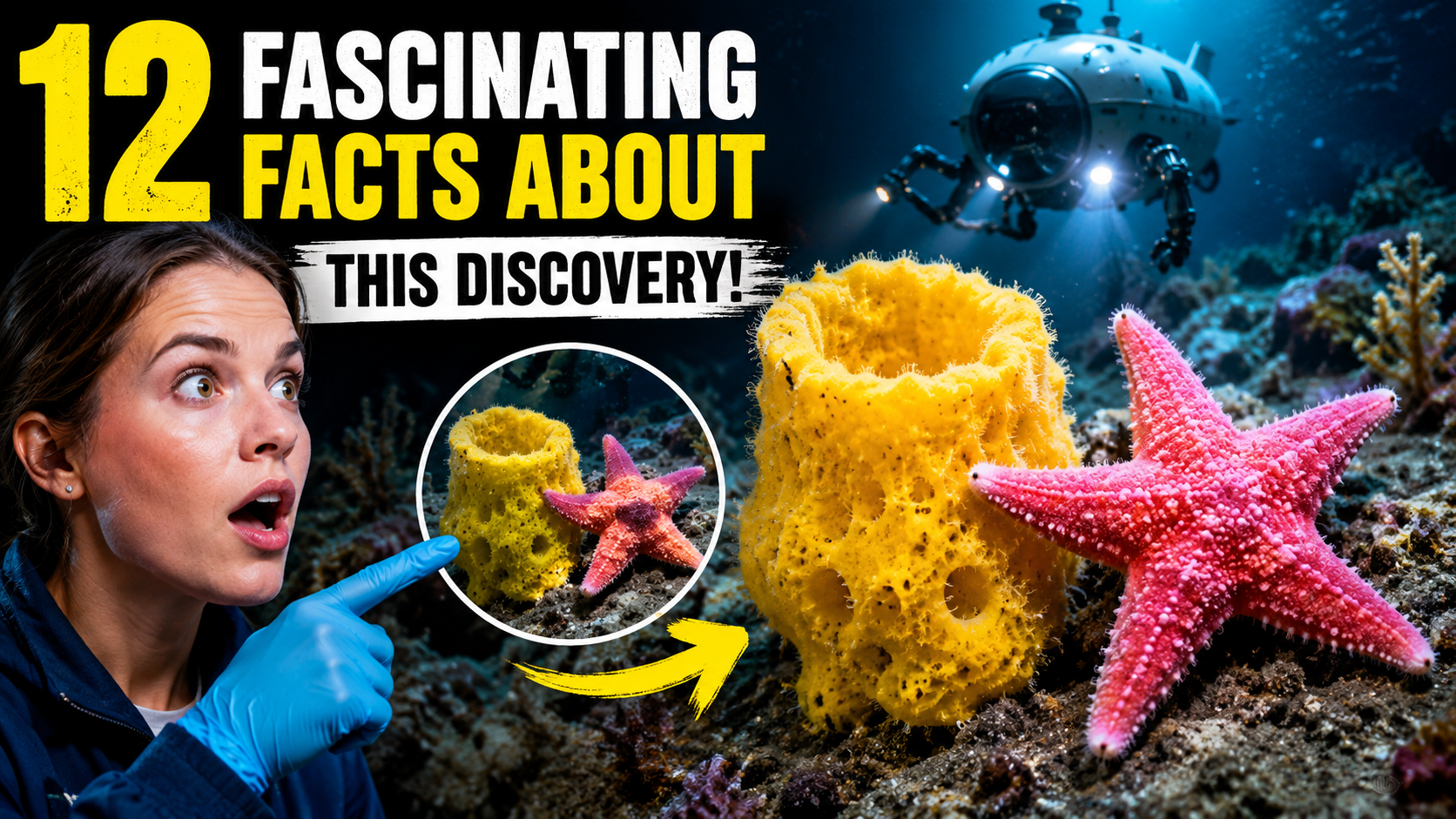
The deep ocean remains one of the least explored places on Earth. Hidden beneath miles of water are strange landscapes, unusual creatures, and discoveries that continue to surprise scientists. One such discovery recently captured the attention of people around the world: a bright yellow sponge and a pink sea star resting side by side on the Atlantic Ocean floor.
What made the sight so remarkable wasn’t just the marine life itself. The two creatures appeared strikingly similar to the beloved cartoon characters SpongeBob SquarePants and Patrick Star. The image quickly spread across social media, sparking curiosity, laughter, and renewed interest in the mysteries of the deep sea.
While the resemblance was a fun coincidence, the discovery also highlighted important facts about ocean ecosystems and the incredible diversity of life beneath the waves. Here are 12 fascinating facts about this unusual deep-sea encounter and what it reveals about our planet.
1. The Discovery Happened Far Below the Ocean’s Surface
The yellow sponge and pink sea star were found deep in the Atlantic Ocean at a depth where sunlight cannot reach. Conditions in these waters are extreme, with cold temperatures, immense pressure, and complete darkness.
Despite these challenging conditions, many species have evolved unique adaptations that allow them to survive and thrive. Scientists continue to uncover new forms of life in these remote environments, proving that much of the deep ocean remains unexplored.
2. The Sponge’s Color Was Surprisingly Bright
Most people imagine deep-sea creatures as dark-colored animals that blend into the shadows. However, many organisms living in the deep ocean display vibrant colors, including yellow, orange, red, and pink.
The bright yellow sponge immediately stood out because of its striking appearance. Although color may seem unnecessary in darkness, scientists believe pigments can serve various biological functions unrelated to visibility.
3. The Pink Sea Star Added to the Perfect Coincidence
The discovery became especially memorable because the sponge wasn’t alone. Resting nearby was a pink sea star whose shape and color closely resembled Patrick Star from the famous animated series.
The positioning of the two creatures made the image even more remarkable. It looked almost as if nature had recreated the famous cartoon friendship on the ocean floor.
4. The Resemblance Was Purely Accidental
As amusing as the image appeared, there is no scientific connection between the marine animals and the fictional characters they resembled.
The similarity is simply an example of coincidence combined with the human brain’s tendency to recognize familiar patterns. This psychological phenomenon helps explain why people often see faces, shapes, or recognizable figures in clouds, rocks, and other natural objects.
5. Sponges Are Among Earth’s Oldest Animals
Marine sponges are incredibly ancient creatures. Scientists believe sponge-like organisms have existed for hundreds of millions of years, making them among the earliest forms of animal life on Earth.
Unlike most animals, sponges do not have brains, hearts, or complex organs. Instead, they survive by filtering water and extracting tiny food particles and nutrients.
Their simplicity has allowed them to endure major environmental changes throughout Earth’s history.
6. Sea Stars Are More Complex Than They Appear
Although sea stars may seem simple, they possess fascinating biological features. They move using hundreds of tiny tube feet located underneath their bodies and have a unique water vascular system that helps control movement.
Perhaps even more impressive is their ability to regenerate damaged limbs. Some species can regrow entire arms after injury, demonstrating one of nature’s most remarkable survival strategies.
7. Deep-Sea Exploration Relies on Advanced Technology
Scientists did not stumble upon this discovery by accident. Exploring extreme ocean depths requires sophisticated equipment, including remotely operated vehicles, high-definition cameras, and specialized research vessels.
These technologies allow researchers to study environments that would otherwise be inaccessible to humans. Every expedition has the potential to reveal previously unknown species and ecosystems.
8. Most of the Ocean Remains Unexplored
One of the most surprising facts about the discovery is where it occurred. Despite covering more than 70 percent of Earth’s surface, the ocean remains largely unexplored.
Experts estimate that only a small fraction of the seafloor has been thoroughly mapped and studied. Every new expedition reminds us how much there is still to learn about our own planet.
The yellow sponge and pink sea star serve as a simple example of the countless surprises waiting beneath the surface.
9. Viral Science Stories Can Inspire Public Interest
The image quickly attracted attention because it connected scientific exploration with something familiar and entertaining.
Many people who might not normally read about marine biology became interested in the discovery simply because of the resemblance to popular cartoon characters. This highlights the power of relatable stories to encourage curiosity about science and nature.
Sometimes a single photograph can inspire thousands of people to learn more about ocean conservation and scientific research.
10. Deep-Sea Ecosystems Are More Diverse Than Expected
For many years, scientists assumed the deep ocean was relatively barren. Modern research has shown the opposite.
Deep-sea habitats support an incredible variety of organisms, including corals, sponges, crustaceans, fish, worms, and countless microscopic species. Some of these creatures possess adaptations unlike anything found in shallow waters.
Each new discovery adds another piece to the puzzle of how life survives in extreme environments.
11. Human Brains Naturally Seek Familiar Patterns
Part of what made this image so popular is rooted in psychology. Humans are naturally wired to identify patterns and familiar shapes.
This ability helped our ancestors recognize faces, detect threats, and understand their surroundings. Today, the same mental process causes us to see recognizable images in everyday objects and natural scenes.
The sponge and sea star instantly triggered this response, making the discovery memorable and easy to share.
12. The Discovery Reminds Us How Much Nature Can Surprise Us
Perhaps the most important lesson from this unusual encounter is that nature still has countless surprises in store.
Even in an age of satellites, artificial intelligence, and advanced technology, researchers continue to encounter unexpected sights in the natural world. A simple pairing of two marine creatures became a global conversation because it combined science, curiosity, humor, and wonder.
Moments like these remind us that exploration is far from over. Every journey into the deep ocean has the potential to reveal something extraordinary, whether it’s a previously unknown species, a new ecosystem, or a scene that unexpectedly captures the imagination of millions.
Final Thoughts
The image of a yellow sponge and pink sea star sitting together on the Atlantic Ocean floor may have gained attention because of its resemblance to famous cartoon characters, but the real story goes much deeper. It offers a glimpse into one of Earth’s most mysterious environments and highlights the incredible diversity of life hidden beneath the waves.
From ancient sponges and resilient sea stars to the cutting-edge technology used to discover them, this remarkable encounter demonstrates why deep-sea exploration remains one of the most exciting fields in modern science. As researchers continue to investigate the ocean’s hidden depths, discoveries like this remind us that our planet still holds countless mysteries waiting to be uncovered.







