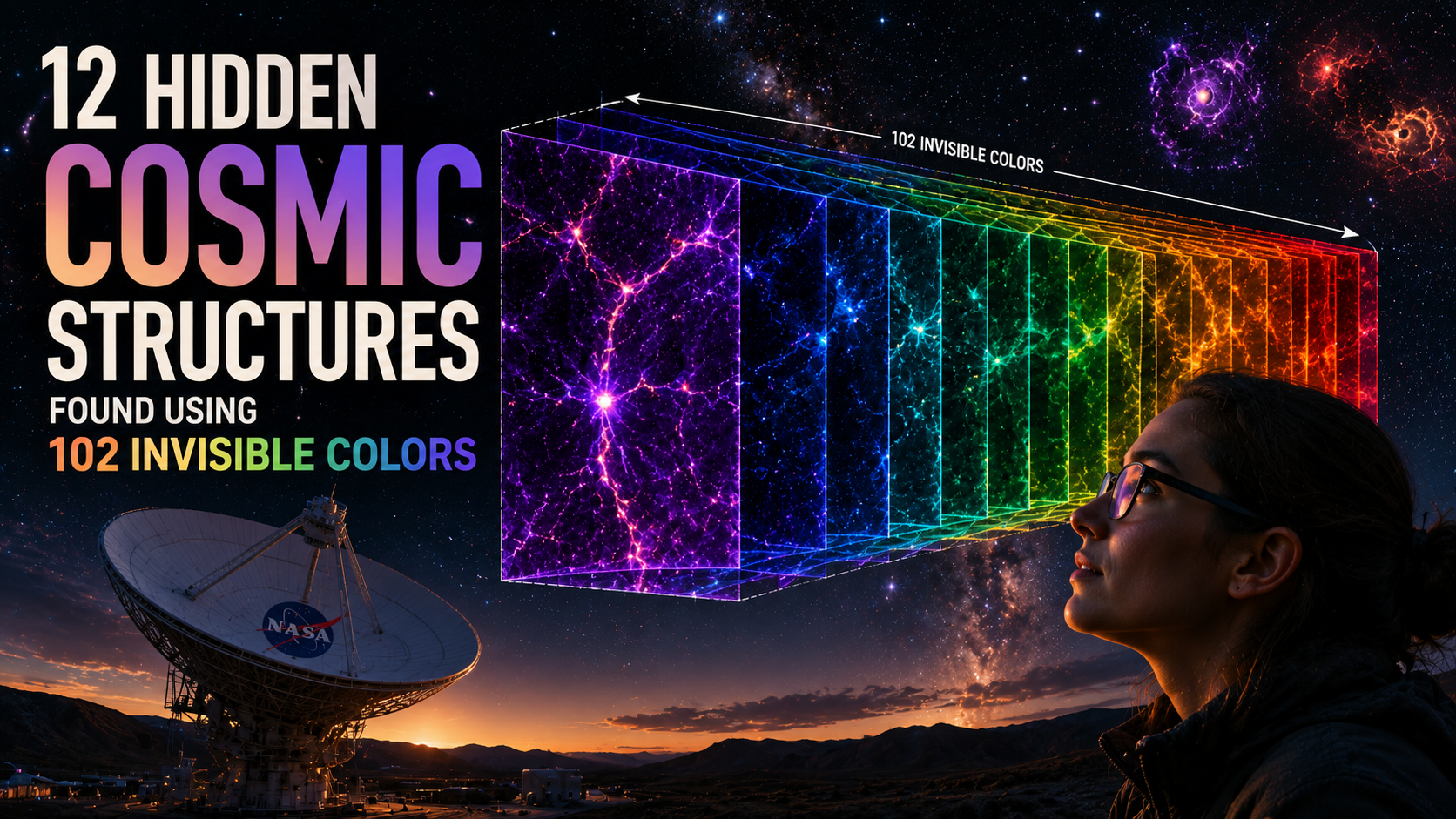
When most people look up at the night sky, they see stars, planets, and perhaps a faint band of the Milky Way. But what we see with our eyes represents only a tiny fraction of the universe. Beyond visible light exists an enormous range of wavelengths that remain invisible to humans, from infrared and ultraviolet light to X-rays and radio waves.
To uncover the hidden universe, NASA and its scientific partners use advanced telescopes capable of observing the cosmos in dozens—and sometimes more than a hundred—different wavelengths. By combining data from 102 distinct “colors” outside normal human vision, researchers have been able to map structures that were previously invisible.
These observations have transformed our understanding of how galaxies evolve, where stars are born, and how matter is distributed across the cosmos. Instead of a relatively simple sky filled with isolated objects, scientists now see a dynamic universe packed with enormous hidden structures.
Here are 12 remarkable cosmic features NASA has uncovered by looking beyond the limits of human eyesight.
1. Vast Stellar Nurseries Hidden Inside Dust Clouds
Some of the most active star-forming regions in the universe are completely concealed from visible-light telescopes.
Dense clouds of gas and dust absorb ordinary light, making it difficult to see what’s happening inside. However, infrared wavelengths can penetrate these dusty regions and reveal the activity within.
Using multi-wavelength observations, scientists have discovered enormous stellar nurseries where thousands of young stars are forming simultaneously.
These regions often resemble cosmic construction sites, with gas collapsing under gravity and new stars emerging from the surrounding material.
Without invisible wavelengths, many of these stellar birthplaces would remain hidden from view.
2. Giant Filaments Connecting Galaxies
One of the biggest surprises in modern astronomy is that galaxies are not scattered randomly throughout space.
Instead, they are linked together through enormous filament-like structures that stretch across millions of light-years.
These cosmic filaments form part of what astronomers call the cosmic web.
By combining observations across numerous wavelengths, researchers have mapped portions of these gigantic structures, revealing how galaxies cluster and interact over vast distances.
The cosmic web represents one of the largest known patterns in the universe and helps explain how matter is organized on the grandest scales.
3. Invisible Clouds of Hydrogen Spanning Intergalactic Space
Hydrogen is the most abundant element in the universe, but much of it is nearly impossible to detect with visible-light observations alone.
Specialized instruments sensitive to radio and ultraviolet wavelengths have revealed enormous hydrogen reservoirs located between galaxies.
These clouds serve as raw material for future star formation and galaxy growth.
Scientists believe they play a critical role in the long-term evolution of cosmic structures.
Mapping these hidden hydrogen regions has helped researchers better understand how galaxies acquire the fuel needed to continue producing stars.
4. Supermassive Black Hole Feeding Zones
Black holes themselves emit no light, but the material falling into them often produces extraordinary amounts of energy.
Using observations from multiple wavelengths, astronomers have identified enormous regions surrounding supermassive black holes where gas and dust spiral inward at incredible speeds.
These feeding zones can outshine entire galaxies.
X-ray, infrared, ultraviolet, and radio observations provide different pieces of the puzzle, allowing scientists to study these extreme environments in remarkable detail.
What once appeared as ordinary galactic centers often turn out to be some of the most energetic locations in the universe.
5. Massive Bubble Structures Created by Stellar Explosions
When large stars reach the end of their lives, they can explode as supernovae.
These powerful events send shockwaves through surrounding space, creating gigantic bubble-like structures that may persist for millions of years.
Many of these bubbles remain invisible in ordinary photographs.
Multi-wavelength observations reveal expanding shells of gas, magnetic fields, and energized particles produced by ancient stellar explosions.
Studying these structures helps scientists understand how stars influence their surrounding environments and contribute to the recycling of cosmic material.
6. Hidden Dark Matter Maps
Dark matter remains one of the greatest mysteries in astronomy.
Scientists cannot observe it directly because it neither emits nor reflects light.
However, researchers can detect its gravitational influence.
By analyzing light from distant galaxies across multiple wavelengths, astronomers have created detailed maps showing where dark matter is likely concentrated.
These invisible structures help shape galaxy clusters, influence cosmic evolution, and account for much of the universe’s total mass.
The ability to trace dark matter indirectly has revolutionized modern cosmology.
7. Enormous Galaxy Clusters Buried Behind Cosmic Dust
Some galaxy clusters remain difficult to detect because they lie behind dense regions of dust within our own galaxy.
Different wavelengths can penetrate these obscuring materials and reveal what lies beyond.
Using infrared and X-ray observations, scientists have discovered previously hidden clusters containing hundreds or even thousands of galaxies.
These findings have improved our understanding of large-scale cosmic structure and provided new opportunities to study galaxy evolution.
Sometimes entire galactic cities remain hidden until astronomers look at the sky in a different way.
8. Ancient Relics from the Early Universe
Looking deeper into space means looking further back in time.
Because light takes billions of years to travel across the universe, distant observations reveal objects as they existed long ago.
Multi-wavelength surveys have uncovered some of the earliest galaxies ever observed.
These ancient systems provide clues about how the first generations of stars formed and how galaxies evolved shortly after the Big Bang.
Without access to invisible wavelengths, many of these faint and distant objects would remain undetectable.
9. Invisible Magnetic Highways Through Space
Magnetic fields play a major role in shaping cosmic environments, yet they are difficult to observe directly.
By studying radio emissions and polarized light, scientists have mapped enormous magnetic structures stretching across galaxies and galaxy clusters.
These invisible fields influence the movement of charged particles, affect star formation, and help regulate galactic activity.
Researchers increasingly recognize that magnetic fields are among the universe’s most important hidden forces.
Their discovery has added another layer of complexity to our understanding of cosmic evolution.
10. Superheated Gas Between Galaxies
Space is often described as empty, but many regions contain vast quantities of extremely hot gas.
These enormous reservoirs can reach temperatures of millions of degrees and emit primarily X-rays rather than visible light.
Observations using specialized space telescopes have revealed giant clouds of superheated material connecting galaxies and clusters.
Scientists believe these structures contain a significant portion of the universe’s ordinary matter.
Finding this hidden gas helped solve part of the long-standing mystery surrounding the “missing baryons” of the cosmos.
11. Giant Rings and Arcs Formed by Gravity
Gravity can bend light in a phenomenon known as gravitational lensing.
When massive objects sit between Earth and distant galaxies, they can distort and magnify background light.
Multi-wavelength observations have revealed spectacular rings, arcs, and distorted galaxy images created by this effect.
These structures provide valuable information about both visible matter and dark matter.
They also allow astronomers to study extremely distant galaxies that would otherwise be too faint to observe.
In some cases, nature itself becomes a giant cosmic telescope.
12. Entire Hidden Populations of Faint Galaxies
One of the most important discoveries enabled by multi-wavelength astronomy is the realization that many galaxies are almost invisible in ordinary light.
Some are heavily obscured by dust. Others emit most of their energy at infrared or radio wavelengths.
When scientists combine observations from many different parts of the electromagnetic spectrum, entirely new populations of galaxies emerge.
These discoveries have dramatically changed estimates of how galaxies formed, evolved, and interacted throughout cosmic history.
The universe turns out to be far more crowded and complex than early astronomers ever imagined.
Why 102 Invisible Colors Matter
Human vision evolved to detect only a narrow band of electromagnetic radiation.
While useful for everyday life, our eyes miss most of the information the universe provides.
Each wavelength reveals something different.
Infrared light exposes warm dust and newborn stars. Radio waves trace hydrogen gas and magnetic fields. X-rays highlight extreme environments around black holes and exploding stars. Ultraviolet observations reveal energetic young stellar populations.
By combining data from 102 distinct wavelength channels, scientists create a far more complete picture of cosmic reality.
It’s similar to assembling a giant puzzle where each wavelength contributes a unique piece.
Only when all the pieces come together does the full image emerge.
How Multi-Wavelength Astronomy Changed Science
The ability to study the universe across multiple wavelengths has transformed astronomy from a largely visual science into a sophisticated investigation of physical processes.
Early astronomers relied almost entirely on visible light.
Today’s researchers use a fleet of space-based and ground-based observatories to study everything from radio emissions to gamma rays.
This approach has led to discoveries involving black holes, dark matter, exoplanets, galaxy evolution, and the large-scale structure of the universe.
Many of the most important breakthroughs in modern astronomy would have been impossible using visible light alone.
The Hidden Universe Is Still Expanding
Despite remarkable progress, scientists believe they have only begun exploring the invisible cosmos.
New observatories continue to reveal previously unknown structures and phenomena.
Advanced telescopes are providing higher-resolution images, broader wavelength coverage, and deeper observations than ever before.
Each new survey uncovers additional layers of complexity.
Entire classes of objects that were once invisible are becoming accessible to study.
The universe continues to surprise researchers with discoveries that challenge existing theories and inspire new questions.
Final Thoughts
NASA’s use of 102 invisible colors of the sky has revealed a universe far richer and more complex than what human eyes can see alone. From giant galaxy-spanning filaments and hidden stellar nurseries to dark matter maps and ancient galaxies, these discoveries have transformed our understanding of cosmic structure.
The night sky may appear calm and familiar, but beneath that visible surface lies a vast hidden realm of activity, energy, and interconnected systems stretching across unimaginable distances.
As technology continues to improve, astronomers will uncover even more concealed structures lurking in the darkness. And with every new discovery, we gain a deeper appreciation for just how much of the universe remains waiting to be explored.







