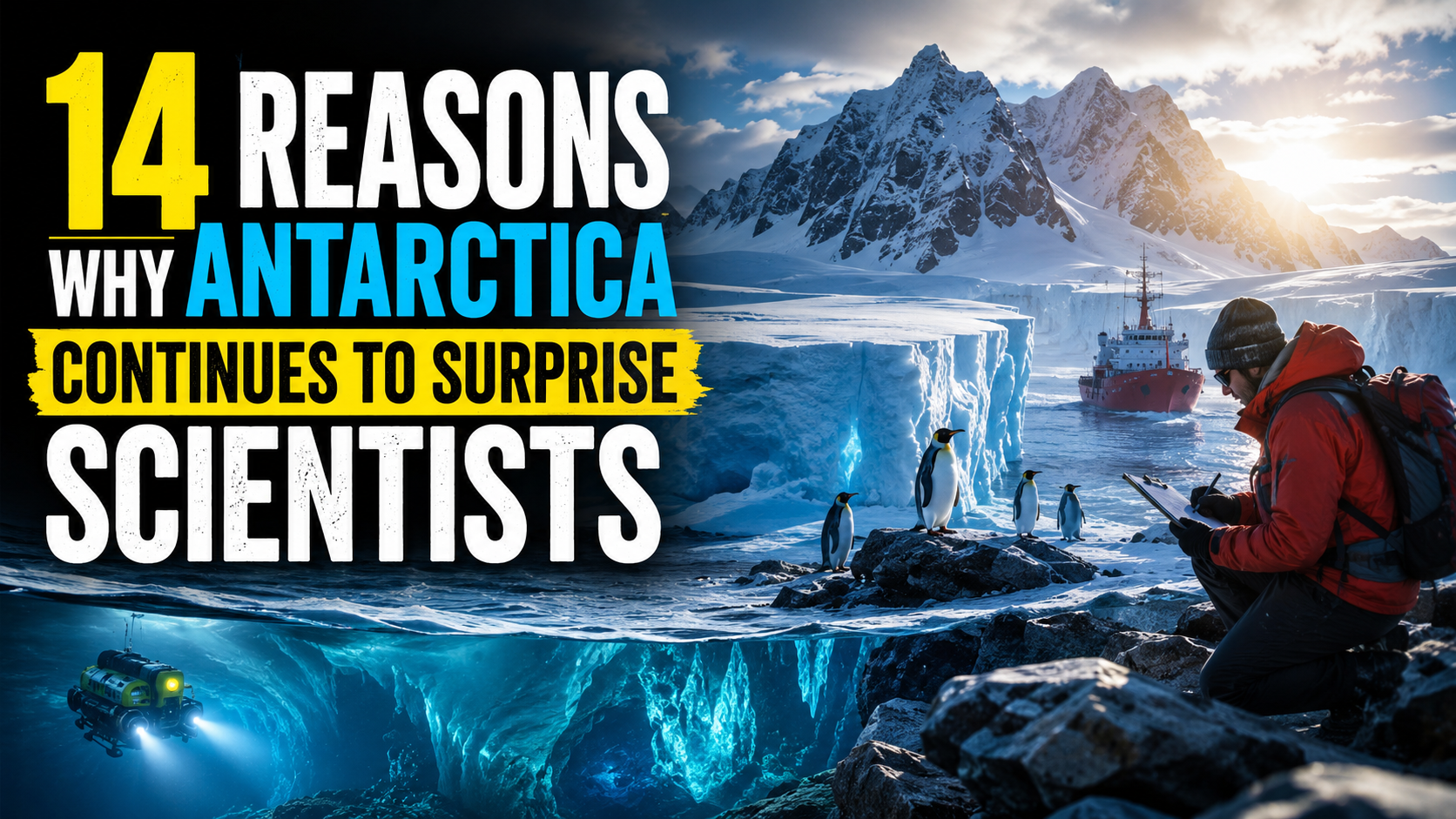
When most people think of Antarctica, they imagine an endless white wilderness—a frozen continent locked in ice, untouched by time and largely unchanged for millions of years. At first glance, it seems like one of the most predictable places on Earth.
Yet scientists who study Antarctica know the opposite is true.
Beneath its vast ice sheets lies a world of hidden lakes, ancient landscapes, unusual ecosystems, and powerful natural forces that continue to challenge our understanding of the planet. Every year, researchers uncover new discoveries that reveal just how dynamic and mysterious this remote continent really is.
Despite decades of exploration, Antarctica remains one of the least understood regions on Earth. It plays a critical role in global climate systems, ocean circulation, and sea-level changes, making it one of the most important places for scientific research.
Here are 14 reasons why Antarctica continues to surprise scientists and capture the imagination of people around the world.
1. It Contains Most of Earth’s Freshwater
One of Antarctica’s most astonishing features is its enormous supply of freshwater.
Although the continent is covered in ice, that ice represents roughly 70 percent of the world’s freshwater reserves. If all Antarctic ice melted, global coastlines would change dramatically.
This enormous frozen reservoir influences sea levels worldwide and makes Antarctica one of the most important components of Earth’s climate system.
Its significance extends far beyond the South Pole.
2. There Are Hidden Lakes Beneath the Ice
For many years, scientists assumed Antarctica’s ice sheet rested directly on solid ground.
Modern technology revealed something far more surprising.
Researchers have discovered hundreds of lakes buried beneath miles of ice. These hidden bodies of water remain liquid because geothermal heat from Earth’s interior prevents them from freezing completely.
Some of these lakes have been isolated for hundreds of thousands—or even millions—of years.
Studying them may provide clues about extreme environments both on Earth and potentially on other planets.
3. Antarctica Has Its Own Mountain Ranges
The continent is often imagined as flat and featureless.
In reality, Antarctica contains massive mountain ranges hidden beneath ice and snow.
The Transantarctic Mountains stretch across the continent for thousands of kilometers and rank among the longest mountain systems on Earth.
Many peaks remain partially buried, creating a landscape that scientists are still mapping and exploring.
4. Volcanoes Exist Beneath the Ice
A frozen continent and active volcanoes may seem like an unlikely combination.
Yet Antarctica hosts numerous volcanic structures.
Some are dormant, while others show signs of activity. Researchers continue studying how volcanic heat affects surrounding ice and contributes to local geological processes.
These hidden volcanoes remind us that Antarctica is not merely a frozen surface but a geologically active region.
5. The Coldest Temperature Ever Recorded Occurred Here
Antarctica is famous for extreme cold, but the numbers remain difficult to comprehend.
Scientists have recorded temperatures below minus 89 degrees Celsius (minus 128 degrees Fahrenheit), making Antarctica the coldest place on Earth.
At such temperatures, exposed skin can freeze within minutes.
These extreme conditions create a unique natural laboratory for studying how matter, ecosystems, and weather behave under extraordinary circumstances.
6. It Wasn’t Always Frozen
One of the most surprising discoveries about Antarctica is its distant past.
Millions of years ago, the continent looked dramatically different.
Evidence suggests Antarctica once supported forests, rivers, and a much warmer climate. Fossils of ancient plants and animals reveal a world that would be almost unrecognizable today.
This history helps scientists understand how Earth’s climate has changed over geological timescales.
7. Ice Moves Like a Slow River
Many people imagine ice sheets as completely stationary.
In reality, Antarctic ice is constantly moving.
Under immense pressure, glaciers slowly flow across the landscape much like rivers. Some move only a few feet each year, while others travel much faster.
Scientists monitor these movements carefully because they provide important information about climate trends and future sea-level changes.
8. Antarctica Influences Global Ocean Currents
The continent’s impact extends far beyond its icy borders.
Antarctica helps drive major ocean circulation systems that transport heat and nutrients around the globe.
Cold, dense water sinks near Antarctica and contributes to deep ocean currents that influence weather patterns and marine ecosystems worldwide.
Changes in Antarctic conditions can have ripple effects across entire continents.
9. Life Thrives in Unexpected Places
At first glance, Antarctica appears too harsh to support much life.
Yet scientists continue discovering organisms that have adapted to survive in extreme conditions.
Microbes live beneath ice, within rocks, and in subglacial lakes. Penguins, seals, and seabirds thrive along the coastline.
These resilient forms of life provide valuable insights into biological adaptation and survival.
Some discoveries even influence the search for life beyond Earth.
10. The Ice Preserves Ancient Climate Records
Antarctic ice functions like a giant historical archive.
As snow falls and compresses into ice, tiny bubbles of ancient air become trapped inside.
Scientists drill deep ice cores and analyze these samples to reconstruct Earth’s climate history.
Some ice records extend back hundreds of thousands of years, offering remarkable insights into past atmospheric conditions.
These frozen records are among the most valuable climate resources available to researchers.
11. It Experiences Months of Continuous Darkness
Antarctica’s location creates unusual seasonal cycles.
During winter, some regions experience months without sunlight. In summer, the opposite occurs, with the Sun remaining above the horizon around the clock.
These dramatic light cycles influence wildlife behavior, weather patterns, and scientific operations.
For researchers stationed there, adapting to months of darkness can be both physically and psychologically challenging.
12. Scientists Keep Discovering New Species
Although Antarctica seems inhospitable, researchers regularly identify previously unknown organisms.
Many discoveries occur in the surrounding Southern Ocean, which contains rich ecosystems adapted to cold conditions.
From unusual fish species to microscopic life forms, Antarctica continues expanding our understanding of biodiversity.
Each discovery reminds scientists how much remains unexplored.
13. Weather Conditions Change Rapidly
Antarctica’s weather can be remarkably unpredictable.
Powerful winds, sudden storms, and dramatic temperature fluctuations create challenging conditions for research teams.
Katabatic winds—cold, dense air flowing downhill from elevated ice sheets—can reach extraordinary speeds.
These powerful weather systems contribute to Antarctica’s reputation as one of Earth’s most extreme environments.
14. Scientists Still Have More Questions Than Answers
Perhaps the greatest surprise is how much remains unknown.
Despite decades of study, Antarctica continues to present new mysteries.
Researchers are still investigating:
- Ice sheet stability
- Subglacial ecosystems
- Hidden geological features
- Ocean interactions
- Climate feedback systems
- Ancient environmental history
Each expedition generates new data, but often raises additional questions.
This ongoing sense of discovery is one reason Antarctica remains such an important focus of scientific research.
Why Antarctica Matters to the Entire World
It’s easy to think of Antarctica as a distant place disconnected from everyday life.
In reality, what happens there affects people everywhere.
The continent influences:
- Global sea levels
- Ocean circulation
- Weather systems
- Climate patterns
- Marine ecosystems
Understanding Antarctica helps scientists improve climate models and make more accurate predictions about future environmental changes.
Its importance extends far beyond scientific curiosity.
The Challenges of Conducting Research There
Studying Antarctica is not easy.
Researchers face some of the harshest conditions on Earth.
Extreme cold, isolation, logistical difficulties, and limited accessibility make scientific work challenging and expensive.
Equipment must function reliably in freezing temperatures. Supplies often travel thousands of miles. Field teams must prepare carefully for rapidly changing weather.
Despite these obstacles, scientists continue returning because the potential discoveries are so valuable.
Antarctica and the Future of Exploration
Many experts believe some of the continent’s most important discoveries still lie ahead.
Advances in satellite imaging, robotics, autonomous vehicles, and drilling technology are allowing researchers to explore regions that were previously inaccessible.
Future investigations may reveal:
- New ecosystems
- Ancient climate records
- Hidden geological structures
- Better understanding of ice dynamics
- Insights into planetary science
The continent remains one of Earth’s last great frontiers.
What Antarctica Teaches Us About the Planet
Beyond its scientific value, Antarctica offers a broader lesson.
It demonstrates how interconnected Earth’s systems truly are.
A change in Antarctic ice can influence sea levels thousands of miles away. Ocean currents originating near the continent can affect weather patterns on other continents.
The frozen landscape serves as a powerful reminder that our planet functions as a complex and interconnected system.
Understanding one part often helps us understand the whole.
Final Thoughts
Antarctica may appear quiet and unchanging, but beneath its icy surface lies one of the most dynamic and fascinating environments on Earth. Hidden lakes, ancient climate records, active geology, unique ecosystems, and powerful environmental processes make the continent a constant source of scientific surprises.
Every year, new discoveries reveal that Antarctica is far more complex than most people realize. Its mysteries continue to challenge researchers, inspire explorers, and deepen our understanding of the planet we call home.
As technology advances and exploration continues, Antarctica will almost certainly remain one of the most exciting places for scientific discovery—proving that even in the coldest corner of Earth, there is still much left to learn.







