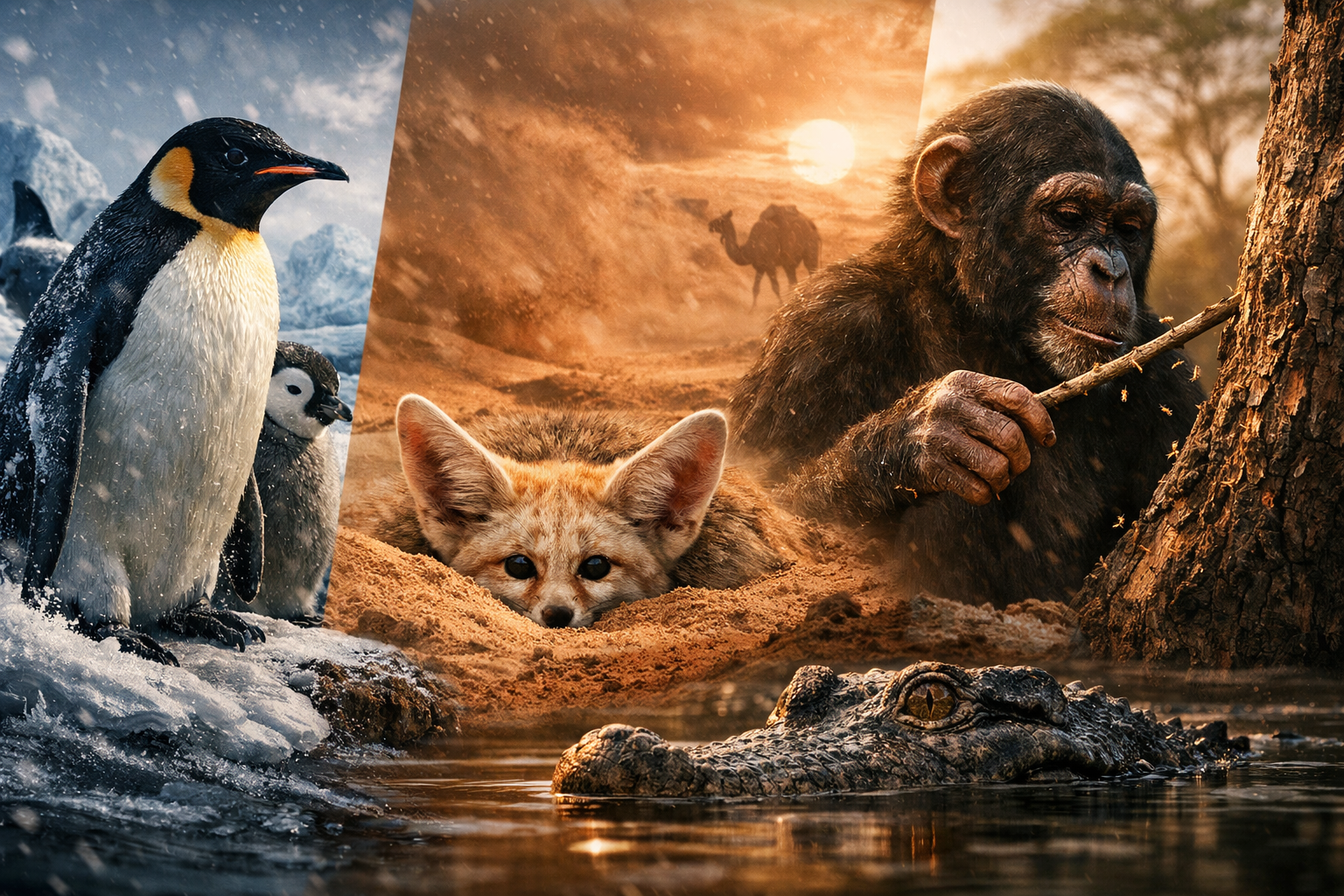
Nature is full of surprises. Across forests, deserts, oceans, and frozen landscapes, animals face countless obstacles every day. Finding food, avoiding predators, surviving extreme weather, and raising offspring all require remarkable problem-solving abilities. Over millions of years, wildlife has developed extraordinary behaviors that help them overcome these challenges and thrive in environments that might seem impossible to survive.
These adaptations are more than simple instincts. Many animals demonstrate impressive intelligence, teamwork, creativity, and resilience when responding to threats and environmental changes. From birds that use tools to mammals that communicate complex warnings, the natural world offers endless examples of survival strategies that continue to amaze scientists.
Here are 15 remarkable animal behaviors that reveal just how adaptable and resourceful wildlife can be.
1. Crows Use Tools to Solve Problems
Crows are widely considered among the smartest animals on Earth. Studies have shown that these birds can create and use tools to obtain food, a skill once thought to be unique to humans and a few primates.
Some crow species bend twigs into hooks to pull insects out of tree bark. Others drop nuts onto roads, allowing passing cars to crack them open before safely retrieving the contents. Their ability to plan ahead and solve problems demonstrates a level of intelligence that rivals many mammals.
This behavior helps crows access food sources that would otherwise be unavailable, giving them a significant survival advantage.
2. Elephants Communicate Across Great Distances
Elephants live in complex social groups where communication is essential. While they use visible gestures and vocal calls, they also rely on low-frequency sounds known as infrasound.
These powerful signals can travel several miles through the air and even through the ground. Other elephants detect these vibrations through sensitive receptors in their feet.
Long-distance communication allows elephant herds to coordinate movements, locate water sources, and warn each other about potential dangers, especially in vast landscapes where visual contact isn’t always possible.
3. Arctic Foxes Change Their Coat Color
Surviving in the Arctic requires exceptional adaptation. One of the Arctic fox’s most impressive survival strategies is its seasonal color change.
During winter, its coat becomes bright white, blending seamlessly with snowy surroundings. As temperatures rise and snow melts, the fox’s fur shifts to brown or gray, matching rocky tundra terrain.
This natural camouflage helps the animal remain hidden from predators while also increasing its chances of sneaking up on prey.
4. Dolphins Cooperate to Catch Fish
Dolphins are famous for their intelligence, but their teamwork is equally remarkable.
In some regions, dolphins work together to herd schools of fish into tight groups. One dolphin may create a ring of mud or bubbles around the fish, while others wait nearby to feed.
This cooperative hunting technique increases the success rate for the entire group. It demonstrates how social behavior and communication can improve survival in competitive environments.
5. Meerkats Assign Lookouts
Life in the desert can be dangerous, especially for small animals. Meerkats have developed a highly organized social system to stay safe.
While most members of the group search for food, one individual stands guard from an elevated position. If a predator appears, the lookout issues a warning call that sends the group rushing to safety.
This division of responsibilities allows meerkats to feed more efficiently while maintaining protection from threats such as eagles, snakes, and jackals.
6. Octopuses Use Camouflage and Mimicry
Octopuses are masters of disguise. Their skin contains specialized cells that allow them to change color, texture, and even patterns within seconds.
Some species go a step further by mimicking other marine creatures. The mimic octopus, for example, can imitate the appearance and movements of venomous sea snakes, lionfish, and flatfish.
These abilities help octopuses avoid predators and approach prey undetected, making them some of the most adaptable hunters in the ocean.
7. Emperor Penguins Share Warmth
The Antarctic is one of the coldest places on the planet, with temperatures often dropping far below freezing. Emperor penguins survive these brutal conditions through cooperation.
During winter, thousands of penguins gather in tightly packed groups known as huddles. Individuals constantly rotate positions so that no bird remains exposed to the freezing outer edge for too long.
This collective behavior conserves energy and helps the entire colony survive conditions that would otherwise be deadly.
8. Beavers Transform Their Environment
Beavers are often called nature’s engineers for good reason.
Using branches, mud, and stones, they construct dams that alter the flow of streams and rivers. These structures create ponds that provide protection from predators and easy access to food.
By reshaping landscapes, beavers don’t just help themselves. Their dams create habitats for fish, birds, amphibians, and countless other species, making them one of nature’s most influential ecosystem builders.
9. Honeybees Perform the Waggle Dance
Communication isn’t limited to mammals and birds. Honeybees have developed one of the most sophisticated information-sharing systems in the insect world.
When a worker bee discovers a rich food source, it returns to the hive and performs a movement known as the waggle dance. The direction and duration of the dance communicate the location and distance of flowers.
This behavior allows entire colonies to efficiently gather nectar and pollen while minimizing wasted energy.
10. Kangaroo Rats Survive Without Drinking Water
Desert environments present a constant challenge: water scarcity. Kangaroo rats have evolved extraordinary adaptations that allow them to survive without drinking water directly.
They obtain moisture from the seeds they eat and possess highly efficient kidneys that conserve nearly every drop of water in their bodies.
By minimizing water loss, these small rodents can thrive in some of the driest regions on Earth where many other animals would struggle to survive.
11. Chimpanzees Learn and Pass Down Skills
Chimpanzees display behaviors that resemble human culture. Different groups use different tools and techniques, depending on their environment.
For example, some chimpanzees use sticks to fish termites from nests, while others crack nuts using stones. Young chimps learn these skills by observing older group members.
This transfer of knowledge across generations allows populations to adapt to local challenges and improve their chances of survival.
12. Prairie Dogs Build Underground Cities
Prairie dogs are highly social rodents that live in extensive underground tunnel systems.
These burrows include sleeping chambers, nurseries, escape routes, and ventilation shafts. Some colonies can stretch across hundreds of acres and house thousands of individuals.
Their elaborate underground communities protect them from predators, harsh weather, and temperature extremes while supporting a complex social structure.
13. Sea Otters Use Rocks as Tools
Sea otters are among the few marine animals known to use tools regularly.
When feeding on shellfish, they place a rock on their chest and repeatedly strike the shell against it until it breaks open. Some otters even carry favorite stones in loose skin pockets under their forearms.
This clever behavior allows them to access nutrient-rich food sources that would otherwise remain inaccessible.
14. Bats Navigate Using Echolocation
Many bat species hunt at night when visibility is limited. To overcome darkness, they rely on echolocation.
Bats emit high-frequency sounds that bounce off surrounding objects. By interpreting the returning echoes, they can determine the location, size, and movement of insects, obstacles, and prey.
This remarkable biological sonar system enables bats to fly and hunt with extraordinary precision in complete darkness.
15. Ant Colonies Operate as Superorganisms
Individually, ants may appear simple, but together they create highly efficient societies.
Colonies divide labor among workers, soldiers, and queens. Some ants form living bridges using their own bodies, while others cultivate fungus gardens or herd aphids for food.
Scientists often describe ant colonies as “superorganisms” because individuals work together so closely that the colony functions like a single living entity.
This cooperation allows ants to dominate ecosystems across nearly every continent.
Why Animal Adaptations Matter
The incredible behaviors seen throughout the animal kingdom reveal more than just survival strategies. They provide valuable insights into evolution, intelligence, cooperation, and resilience.
As environments change due to climate shifts, habitat loss, and human activity, many species continue to demonstrate remarkable flexibility. Understanding these adaptations helps researchers predict how wildlife may respond to future challenges and informs conservation efforts aimed at protecting vulnerable ecosystems.
Every behavior—from a crow crafting a tool to a penguin sharing body heat—represents a solution to a specific problem. These solutions have been refined through countless generations, showcasing the power of adaptation in the natural world.
Final Thoughts
Animals face challenges every day that would test even the most capable survivors. Yet through innovation, cooperation, communication, and specialized adaptations, they continue to thrive in some of the harshest environments on Earth.
These 15 fascinating behaviors highlight the incredible diversity of strategies wildlife uses to overcome obstacles. They remind us that survival in nature is not simply about strength or speed. Often, success depends on intelligence, teamwork, flexibility, and the ability to adapt when conditions change.
The more we learn about animal behavior, the more we appreciate the extraordinary ingenuity that exists throughout the natural world. Each species has its own story of adaptation, proving that nature remains one of the greatest problem-solvers ever known.