Countries Most Likely to Face the Greatest Risks in a Global Conflict
As geopolitical tensions continue to rise across several regions of the world, concerns about the possibility of a large-scale international conflict remain a topic of debate among analysts and policymakers. While no one can predict the future with certainty, some countries would likely find themselves at the center of any major global war due to their military power, strategic importance, alliances, or ongoing disputes.
Here are some of the nations that experts believe could face the highest level of risk if a worldwide conflict were to occur.
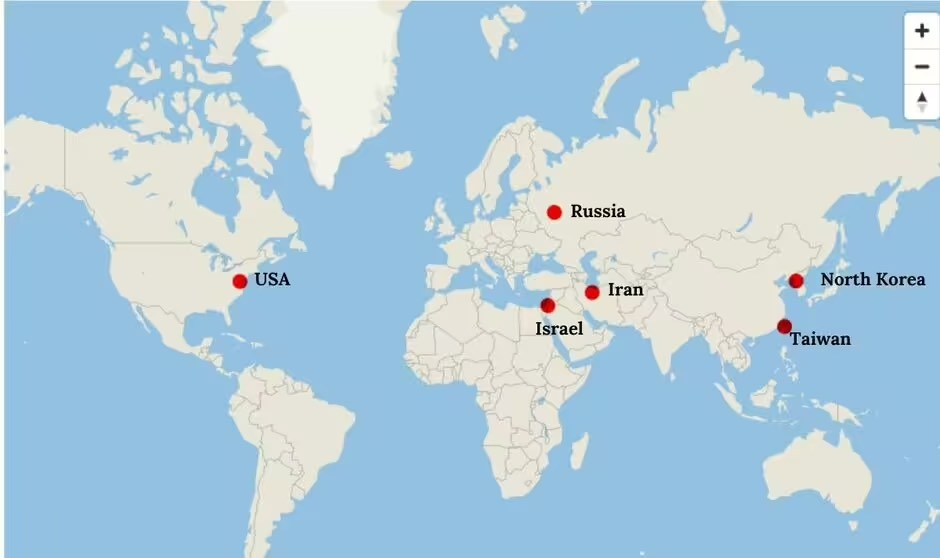
United States

The United States would almost certainly play a central role in any major international war. As one of the world’s leading military, economic, and political powers, the country maintains extensive alliances and security commitments across the globe.
America’s support for partners such as Israel and Ukraine has already placed it at the heart of several international disputes. Rising tensions with countries including China, Russia, and Iran could further increase the likelihood of direct involvement should a larger conflict emerge.
In a worst-case scenario involving nuclear weapons, major metropolitan areas and government centers could become potential targets. Cities such as New York and Washington, D.C., are often mentioned in strategic assessments due to their political and economic significance. Critical military infrastructure, including missile facilities and defense installations located throughout the country, would also be considered high-priority targets.
Israel

Israel has long existed in one of the world’s most politically sensitive and volatile regions. Since its establishment, the nation has faced repeated security challenges and regional conflicts.
Recent confrontations and missile exchanges involving Iran have heightened concerns about the potential for broader instability in the Middle East. Although ceasefires and diplomatic efforts can temporarily reduce tensions, the underlying disputes remain unresolved.
Israel’s close relationship with the United States means that any significant escalation could attract wider international involvement. As concerns persist regarding Iran’s nuclear ambitions and regional influence, the possibility of a local conflict expanding into a larger international crisis remains a major concern for global leaders.
Iran

Iran occupies a critical position in Middle Eastern geopolitics and would likely be a key participant in any conflict involving the region.
Long-standing disputes with both Israel and the United States have placed Tehran under constant international scrutiny. Questions surrounding Iran’s nuclear program continue to be a source of tension, despite diplomatic efforts aimed at reducing hostilities.
If regional fighting were to intensify, Iran could potentially receive political or military backing from strategic partners. Such involvement could increase the risk of a localized conflict drawing in multiple major powers, creating a broader international confrontation with far-reaching consequences.
Russia

Russia remains one of the most influential military powers in the world and continues to be deeply involved in geopolitical disputes, particularly through its ongoing conflict with Ukraine.
Relations between Moscow and many Western nations remain strained, contributing to an atmosphere of uncertainty. As a nuclear-armed state with significant military capabilities, Russia would almost certainly be a central actor in any large-scale global conflict.
The possibility of direct confrontation between Russia and Western powers is one of the scenarios that international security experts monitor most closely. Any escalation involving nuclear-armed nations would carry serious risks not only for the countries involved but for global stability as a whole.
Taiwan

Taiwan represents one of the most sensitive geopolitical flashpoints in Asia. The island’s political status remains a source of disagreement between Taiwan and mainland China, which considers the territory part of its sovereign domain.
Should a major international crisis occur, Taiwan could become a focal point of military activity in the region. Any attempt by China to assert control through force would likely draw significant international attention and potentially trigger responses from allies and partners throughout the Asia-Pacific region.
Countries such as Japan, South Korea, and the Philippines could find themselves affected by developments in the Taiwan Strait, making the issue a matter of global strategic importance.
North Korea

North Korea continues to be one of the world’s most isolated and unpredictable states. The country possesses nuclear weapons and has repeatedly demonstrated missile capabilities that concern neighboring nations and the international community.
In the event of a broader conflict, North Korea would likely align itself with nations that share strategic interests in opposing Western influence. Its military posture and nuclear arsenal would add another layer of complexity to any international crisis.
South Korea and Japan, due to their proximity, would face particularly significant security concerns if tensions on the Korean Peninsula escalated into open conflict.
Potential Safe Havens During a Global Crisis
While some countries could become focal points of military activity, others may be relatively insulated due to geography, neutrality, or limited strategic value.
Nations often cited as potentially safer locations include Switzerland, Iceland, Greenland, Fiji, South Africa, and New Zealand. These countries benefit from factors such as geographic isolation, political neutrality, or distance from major military hotspots.
Antarctica is frequently mentioned as one of the most remote places on Earth. Its lack of strategic military importance and extreme isolation make it an unlikely location for direct involvement in global conflicts.
Final Thoughts
Although discussions about a potential world war often involve speculation, certain nations would almost certainly face greater risks because of their military significance, strategic alliances, or geopolitical rivalries. At the same time, diplomatic efforts, international cooperation, and conflict prevention remain the most effective tools for avoiding such scenarios altogether.
Understanding these geopolitical realities helps provide insight into why global stability remains a priority for governments and international organizations around the world.