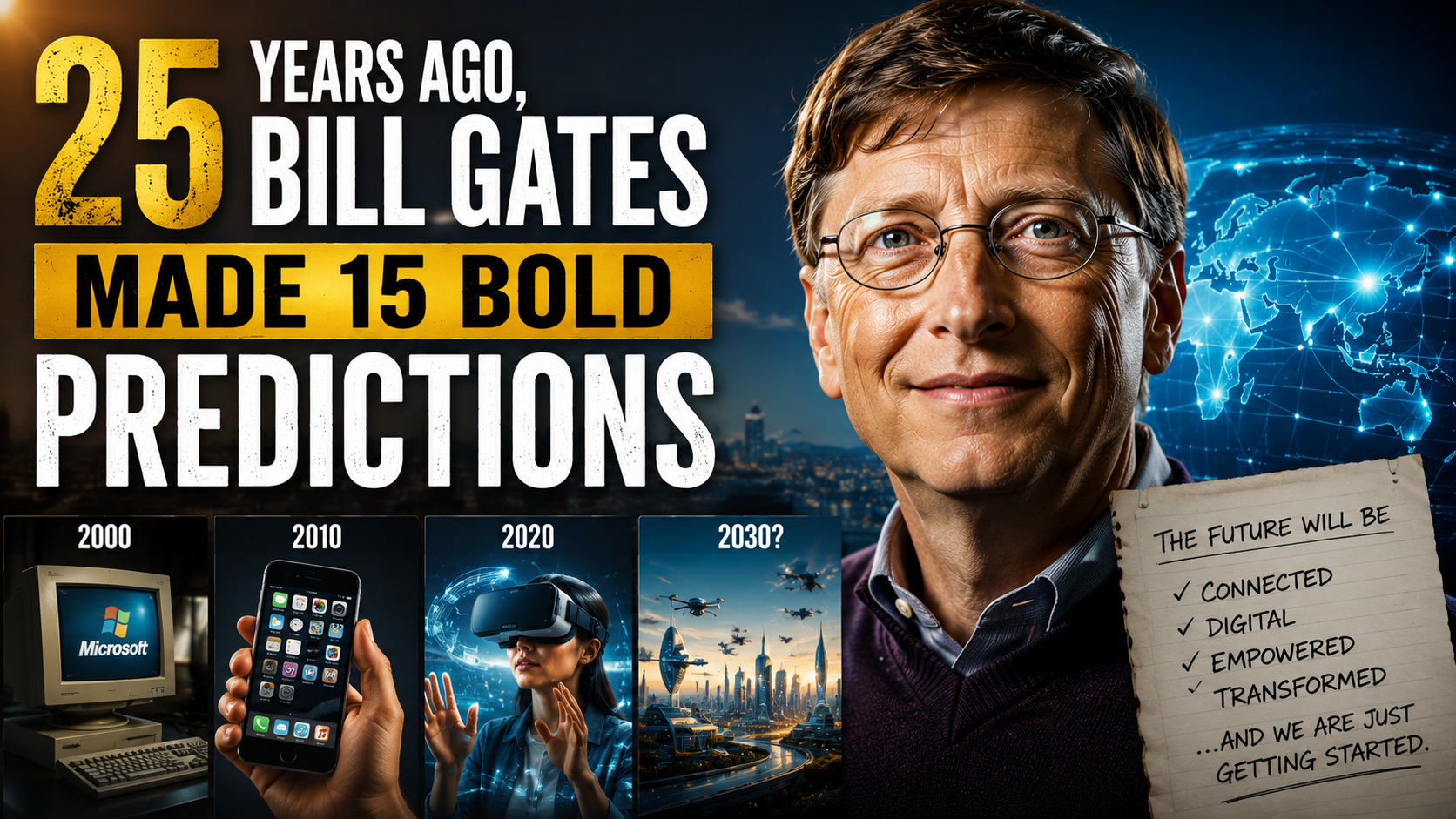
Predicting the future is never easy. While pop culture often celebrates surprising forecasts from television shows and science fiction films, few people have demonstrated the foresight of Microsoft co-founder Bill Gates.
In his 1999 book Business @ the Speed of Thought, Gates outlined a vision of how technology would transform everyday life. At the time, many of his ideas sounded ambitious—even far-fetched. The internet was still in its early stages, smartphones didn’t exist, and social media was years away from becoming mainstream.
Yet more than two decades later, many of his predictions have become part of everyday life.
Here are 15 ways Bill Gates accurately anticipated the digital world we live in today.
1. Online Price Comparison Tools
Shopping in the late 1990s often meant visiting multiple stores or spending hours researching products and prices.
Gates predicted that consumers would eventually use automated services to compare prices across different retailers instantly. Today, comparison websites help people find the best deals on everything from electronics and travel bookings to insurance policies and utility providers.
What once required significant effort can now be done in seconds.
2. Smartphones Becoming Essential Devices
When Gates made his prediction, mobile phones were primarily used for calls and text messages.
He envisioned small portable devices that would allow people to stay connected, access information, manage schedules, and conduct business from virtually anywhere.
Modern smartphones now serve as cameras, wallets, navigation systems, entertainment centers, communication tools, and personal assistants—all in one device.
3. Digital Banking and Online Financial Services
Gates anticipated a future where people could handle financial tasks without ever stepping into a bank branch.
Today, online banking allows users to:
- Transfer money
- Pay bills
- Deposit checks
- Monitor investments
- Apply for loans
The convenience of digital finance has fundamentally changed how people manage their money.
4. Online Healthcare Services
Long before telemedicine became common, Gates predicted that people would communicate with healthcare providers through the internet.
Today, virtual doctor visits, digital medical records, online appointment scheduling, and electronic prescriptions have become standard features of healthcare systems around the world.
The shift accelerated even further during the COVID-19 pandemic.
5. Intelligent Virtual Assistants
Although technologies like Siri, Alexa, and Google Assistant didn’t exist in 1999, Gates correctly anticipated the rise of digital assistants capable of organizing information and helping users manage their daily lives.
Modern virtual assistants can:
- Answer questions
- Set reminders
- Control smart home devices
- Schedule appointments
- Provide real-time information
They have become an increasingly integrated part of everyday life.
6. Smart Home Monitoring Systems
Home security has evolved dramatically since the late 1990s.
Gates predicted that homeowners would be able to monitor their properties remotely through live video feeds and receive alerts when someone arrived at their home.
Today, smart doorbells, connected security cameras, and home-monitoring systems allow homeowners to check on their properties from anywhere using a smartphone.
7. Social Networking Platforms
Before Facebook, Instagram, or X (formerly Twitter), Gates imagined online spaces where friends and family could communicate, share information, and organize events.
While modern social networks have evolved far beyond his original concept, the core idea remains remarkably similar.
Billions of people now use social platforms to stay connected regardless of geographical distance.
8. Personalized Travel Recommendations
Gates foresaw technology that could recognize travel plans and automatically suggest activities, attractions, discounts, and experiences tailored to an individual’s interests.
Today, travel apps and booking platforms routinely offer personalized recommendations based on:
- Previous searches
- Booked destinations
- Travel history
- User preferences
Artificial intelligence has made these suggestions increasingly accurate.
9. Targeted Digital Advertising
One of Gates’ more controversial predictions involved personalized advertising.
He envisioned advertising systems capable of learning consumer preferences and displaying highly relevant promotions.
Modern online advertising operates largely on this principle, using browsing habits, interests, and purchasing behavior to deliver customized marketing messages.
10. Interactive Sports Experiences
Gates predicted that sports fans would eventually interact with live events while they were happening.
Today, fans can:
- Follow real-time statistics
- Participate in live discussions
- Join fantasy leagues
- Place sports wagers in regulated markets
- Vote in polls and contests
Sports viewing has become a far more interactive experience than it was in the 1990s.
11. Television Connected to the Internet
Long before smart TVs became common, Gates anticipated that television programming would include links to related online content.
Today, viewers can instantly access additional information through streaming platforms, QR codes, companion apps, and integrated internet-connected television systems.
Traditional television and online content have become deeply intertwined.
12. Digital Community Discussions
Gates also predicted that people would use the internet to discuss local issues affecting their communities.
Online forums, neighborhood groups, and community platforms now allow residents to debate topics such as:
- Local government decisions
- Public safety concerns
- Development projects
- School policies
Digital participation has become an important part of civic engagement.
13. Interest-Based Online Communities
One of Gates’ most accurate predictions involved the rise of online communities built around shared interests rather than geographic location.
Platforms such as Reddit, Discord, and countless online forums allow people from around the world to connect over hobbies, careers, entertainment, sports, technology, and virtually any other topic imaginable.
The internet has made it possible for niche communities to thrive on a global scale.
14. Online Recruiting and Professional Networking
Years before LinkedIn transformed professional networking, Gates envisioned a system where individuals could showcase their skills and connect with potential employers online.
Today, job seekers routinely use digital platforms to:
- Search for opportunities
- Build professional profiles
- Network with industry peers
- Recruit talent
- Explore career development options
The hiring process has become increasingly digital.
15. Online Project Collaboration and Outsourcing
Gates predicted that businesses would use internet-based platforms to find talent, assemble teams, and outsource projects more efficiently.
This prediction has become reality through tools and platforms that enable:
- Remote collaboration
- Freelance hiring
- Virtual project management
- Global outsourcing
- Distributed workforces
The modern workplace now relies heavily on digital collaboration technologies that connect people across continents.
Why Gates Was Able to See the Future
What makes these predictions so impressive is not that Gates predicted specific products, but that he accurately identified the broader direction technology would take.
He understood that the internet would become deeply integrated into daily life, changing how people communicate, shop, work, learn, and manage information.
Rather than focusing on individual inventions, he recognized the larger trend toward connectivity, automation, personalization, and digital convenience.
Final Thoughts
Looking back at Bill Gates’ 1999 predictions is a reminder of how quickly technology can reshape society. At the time, many of these ideas seemed futuristic. Today, they are so common that most people take them for granted.
From smartphones and online banking to social media and virtual assistants, Gates correctly anticipated many of the innovations that now define modern life.
While no one can predict the future perfectly, his track record demonstrates why he remains one of the most influential voices in technology. More than two decades later, many of his forecasts continue to serve as a fascinating example of visionary thinking—and a glimpse into how understanding trends can sometimes be just as important as inventing the technology itself.