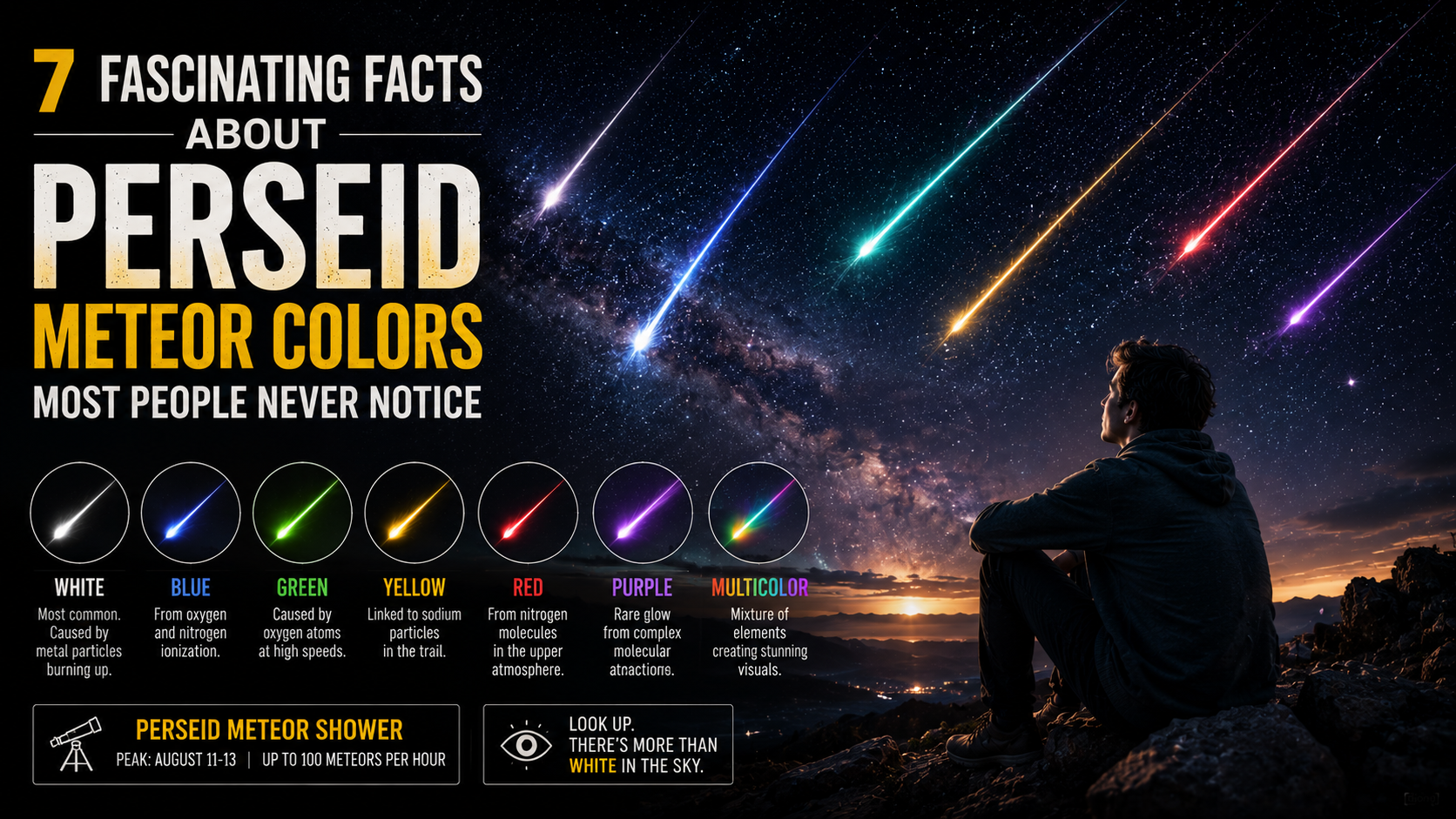
Every year, skywatchers around the world look forward to one of the most reliable and spectacular meteor showers: the Perseid meteor shower. Known for its bright, fast-moving streaks of light, the Perseids are often described as white or bluish flashes racing across the night sky.
But what many casual observers do not realize is that Perseid meteors are not all the same color. In fact, they can appear in a surprising range of hues—some subtle, others vivid—depending on their speed, composition, and interaction with Earth’s atmosphere.
These colors are more than just visual effects. They are scientific clues that reveal what meteors are made of and how they burn as they enter our planet’s protective atmosphere.
Here are seven fascinating facts about Perseid meteor colors that most people never notice when watching the night sky.
1. Most Perseid Meteors Appear White Because of Extreme Speed
One of the most common observations during the Perseid meteor shower is that many meteors appear bright white or slightly bluish.
This is largely due to their incredible speed. Perseid meteors enter Earth’s atmosphere at speeds of up to about 59 kilometers per second, one of the fastest among annual meteor showers.
At such high velocity, the energy released during atmospheric entry is so intense that it produces a bright, incandescent glow that often overwhelms subtle color variations.
This white light is essentially a combination of multiple wavelengths blending together due to extreme heating and ionization.
To the naked eye, this creates the impression of a simple white streak, even though more complex colors may be present at a microscopic level.
2. Green and Blue Colors Often Come From Metal Vaporization
Some Perseid meteors show distinct green or blue hues, especially during brighter fireball events.
These colors are typically caused by the vaporization of specific elements as the meteor burns up.
For example:
- Magnesium and oxygen interactions can produce bluish tones
- Nickel and ionized oxygen can contribute to greenish light emissions
When the meteor heats up upon entering the atmosphere, these elements are excited and emit light at specific wavelengths.
Even though these colors may only appear for a fraction of a second, they provide valuable information about the meteor’s chemical composition.
Green and blue meteors are often among the most visually striking, even if they are less common than white streaks.
3. Yellow and Orange Tones Indicate Sodium Content
Another subtle but important color seen in Perseid meteors is yellow or orange.
These warmer tones are typically associated with the presence of sodium.
As sodium atoms are heated during atmospheric entry, they emit a strong yellow-orange glow.
This same chemical property is why sodium vapor lamps on Earth also produce a yellowish light.
When observers notice a meteor with a warm orange tint, it is often a sign that sodium-rich material is burning up in the upper atmosphere.
These colors tend to appear in slightly slower or lower-altitude fragments, where heating conditions allow sodium emission to become more visible.
4. Red Colors Are Often Caused by Oxygen at High Altitudes
Red meteor colors are less common but particularly interesting from a scientific perspective.
They usually occur when meteors burn at higher altitudes where oxygen atoms in the upper atmosphere are more likely to interact with the incoming material.
Excited oxygen emissions can produce a faint red glow, especially during fragmentation events.
Because red light has a longer wavelength and is less intense than other emissions, it can be harder for the human eye to detect in real time.
However, sensitive cameras often capture red-tinted meteor trails that observers may miss during live viewing.
These red hues provide insight into the altitude and atmospheric conditions of meteor entry.
5. Color Variations Reveal the Meteor’s Composition
Every Perseid meteor is essentially a tiny fragment of cosmic debris, often originating from the comet Comet Swift–Tuttle.
As these fragments enter Earth’s atmosphere, their chemical makeup determines the colors we see.
Different elements produce different light signatures:
- Iron → yellow or golden tones
- Magnesium → blue-white flashes
- Sodium → orange glow
- Oxygen interactions → red hues
This means that meteor colors are not random—they are direct indicators of cosmic chemistry.
By studying these colors, scientists can infer the composition of the meteoroids without physically collecting them.
6. Atmospheric Pressure Plays a Role in Color Intensity
The color of a meteor is not determined solely by its composition. Atmospheric pressure also plays a significant role.
As meteors descend, they pass through layers of increasing density in Earth’s atmosphere.
At higher altitudes, where the air is thin, ionization processes dominate and produce faint, often bluish or greenish light.
At lower altitudes, increased pressure and friction intensify heating, often leading to brighter white or yellow-orange colors.
This layered interaction creates a dynamic color transition as meteors streak across the sky.
In many cases, a single meteor can shift color multiple times during its descent.
7. Camera Technology Reveals Colors the Human Eye Misses
One of the most fascinating discoveries in modern meteor observation is how much color detail is missed by the human eye.
The Perseid meteor shower is often described visually as mostly white streaks, but long-exposure photography and digital sensors reveal a much richer spectrum of colors.
High-sensitivity cameras can detect:
- Subtle green ion trails
- Deep red atmospheric interactions
- Multi-colored fragmentation bursts
- Extended glowing meteor trails
This happens because cameras can capture longer exposure times and lower light intensities than human vision allows.
As a result, what looks like a simple flash in real time can appear as a complex, colorful event in photographs.
This has transformed how astronomers and enthusiasts study meteor showers, revealing details that were previously invisible.
Why Perseid Meteor Colors Matter Scientifically
Meteor colors are more than just visual beauty—they are scientific data points.
By analyzing these colors, researchers can learn about:
- The chemical makeup of space debris
- The speed and angle of atmospheric entry
- The density and structure of Earth’s upper atmosphere
- The behavior of comet-derived materials
This information helps scientists better understand both near-Earth space and the origins of the solar system.
Every streak of light in the Perseid meteor shower is essentially a tiny experiment happening in real time above our heads.
The Best Way to Observe Meteor Colors
To see meteor colors more clearly, conditions matter.
Observers have the best chance of noticing color variations when:
- The sky is very dark with minimal light pollution
- The eyes are fully adjusted to darkness
- Meteors are bright fireballs rather than faint streaks
- Cameras or binocular-assisted viewing are used
Patience is also key. Many colors appear for only fractions of a second, making them easy to miss without careful observation.
The Emotional Impact of Meteor Watching
Beyond science, meteor showers like the Perseids create a powerful emotional experience.
Watching streaks of light flash across the night sky often evokes feelings of wonder, connection, and perspective.
The fleeting nature of meteors—burning up in seconds after traveling through space for millions of years—adds to their emotional weight.
Color variations make the experience even more vivid, turning simple light trails into dynamic celestial displays.
Final Thoughts
The Perseid meteor shower is one of the most accessible and visually stunning astronomical events of the year, but its true complexity often goes unnoticed.
The seven key insights about meteor colors reveal a hidden world of science behind each flash of light:
- White light from extreme speed
- Blue and green from metal vaporization
- Yellow and orange from sodium
- Red from high-altitude oxygen reactions
- Chemical composition clues
- Atmospheric pressure effects
- Camera-enhanced color detection
Together, these factors show that meteor colors are not random—they are signatures of cosmic chemistry and atmospheric physics.
The next time you watch a Perseid meteor streak across the sky, remember that you are not just seeing light.
You are witnessing a fragment of space revealing its secrets in color.







