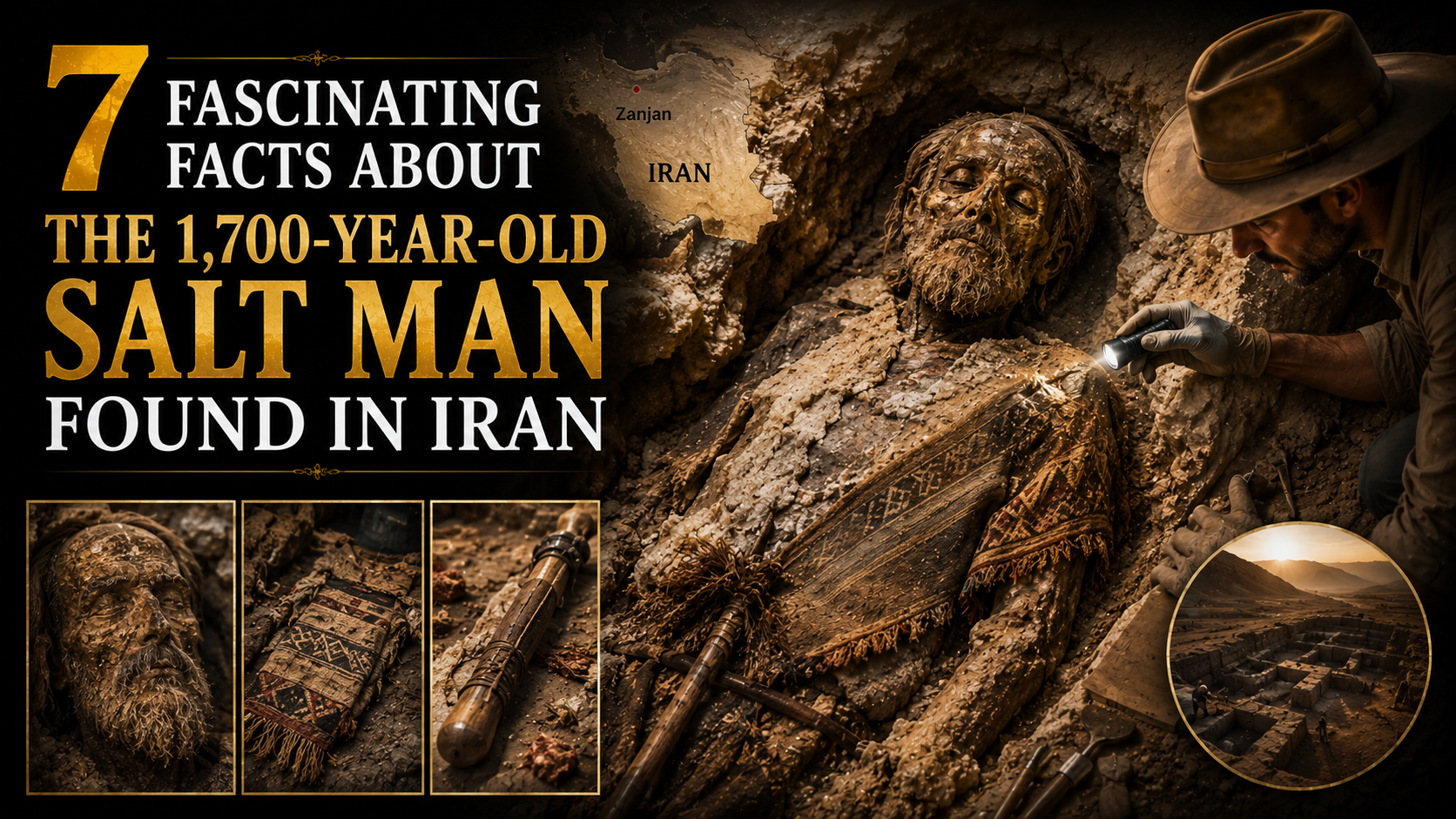
Archaeology often reveals stories that feel almost frozen in time, but few discoveries are as striking as the “Salt Man” of Iran. Found in a salt mine and preserved for more than 1,700 years, this ancient individual offers an extraordinary glimpse into life—and death—in the distant past.
Unlike most human remains that decompose over centuries, the unique environment of the salt mine created natural preservation conditions that kept skin, hair, clothing, and even facial features remarkably intact. The result is one of the most compelling archaeological finds in the region.
The Salt Man is not just a scientific curiosity; he is a historical time capsule that helps researchers understand ancient mining practices, regional cultures, and environmental conditions.
Here are seven fascinating facts about the 1,700-year-old Salt Man found in Iran.
1. He Was Naturally Mummified by Salt
The most important factor behind the Salt Man’s preservation is the environment in which he was discovered.
Salt has powerful dehydrating properties that prevent the growth of bacteria and slow decomposition.
Because of this, the body was naturally mummified without any human intervention.
This rare process allowed soft tissues and clothing to survive for centuries.
2. He Was Discovered Accidentally in a Salt Mine
The Salt Man was not the result of a planned excavation.
He was discovered by miners working in a salt mine in Iran who unexpectedly uncovered human remains.
Subsequent archaeological investigations revealed the extraordinary level of preservation.
This accidental discovery made the find even more significant for researchers.
3. His Clothing and Personal Items Were Still Intact
One of the most remarkable aspects of the Salt Man is the survival of his clothing.
Fragments of fabric, leather, and accessories were found alongside his body.
These items provide valuable insight into the materials and craftsmanship of the time period.
They also help historians understand everyday life in ancient Iran.
4. He Likely Died During a Mining Accident
Evidence suggests that the Salt Man may have been a miner who died in a collapse.
The location of the body deep within the mine supports this theory.
Rock falls or structural failures were common risks in ancient mining operations.
This makes his story not just archaeological, but also deeply human.
5. His Hair and Facial Features Are Still Visible
Unlike most ancient remains, the Salt Man’s facial features were preserved with surprising clarity.
Researchers have been able to observe details such as hair, beard, and facial structure.
This level of preservation allows for rare reconstructions of ancient human appearance.
It brings a personal dimension to an otherwise distant historical period.
6. The Find Offers Insight Into Ancient Mining Techniques
The Salt Man is not just about the individual—it also reveals information about ancient industry.
Salt mining was an important economic activity in the region for centuries.
The discovery of tools and mine structures alongside the body helps researchers understand how mining was conducted.
It shows that ancient mining was both advanced and dangerous.
7. Scientific Analysis Continues to Reveal New Details
Even decades after the discovery, researchers continue to study the Salt Man using modern technology.
Advanced imaging, chemical analysis, and DNA testing are being used to extract new information.
These studies help determine diet, health, and possible origin of the individual.
Each new analysis adds another layer to the story.
Why the Salt Man Matters in Archaeology
The Salt Man is more than an unusually well-preserved body—he is a rare connection to everyday life in ancient times.
While kings and monumental structures often dominate historical narratives, discoveries like this highlight the experiences of ordinary people.
He represents workers who lived and labored in harsh environments, contributing to ancient economies.
This human perspective is what makes the discovery so valuable.
The Science Behind Salt Preservation
Salt preservation occurs when extremely dry conditions prevent microbial activity.
In environments with high salt concentration, moisture is rapidly removed from organic material.
This halts the normal decomposition process that would otherwise occur within days or weeks.
As a result, bodies can remain preserved for centuries under the right conditions.
Final Thoughts
The 1,700-year-old Salt Man of Iran remains one of the most extraordinary archaeological discoveries in the world.
From natural mummification and preserved clothing to insights into ancient mining life, every detail adds depth to our understanding of the past.
More importantly, he serves as a reminder that history is not only about empires and rulers, but also about individuals whose lives were shaped by the environments they worked in.
Even after nearly two millennia, the Salt Man continues to speak across time, offering a silent but powerful story preserved in salt.







