Ancient Egypt continues to captivate historians, archaeologists, and travelers alike. Each discovery along the Nile adds another layer to our understanding of one of the world’s most advanced early civilizations. Among the most intriguing recent finds is a remarkably well-preserved sphinx uncovered near Kom Ombo, a site already known for its temple complex and rich archaeological significance.
Unlike many weathered statues scattered across Egypt, this sphinx appears to have survived in exceptional condition, offering researchers a rare glimpse into ancient craftsmanship, religious symbolism, and artistic precision.
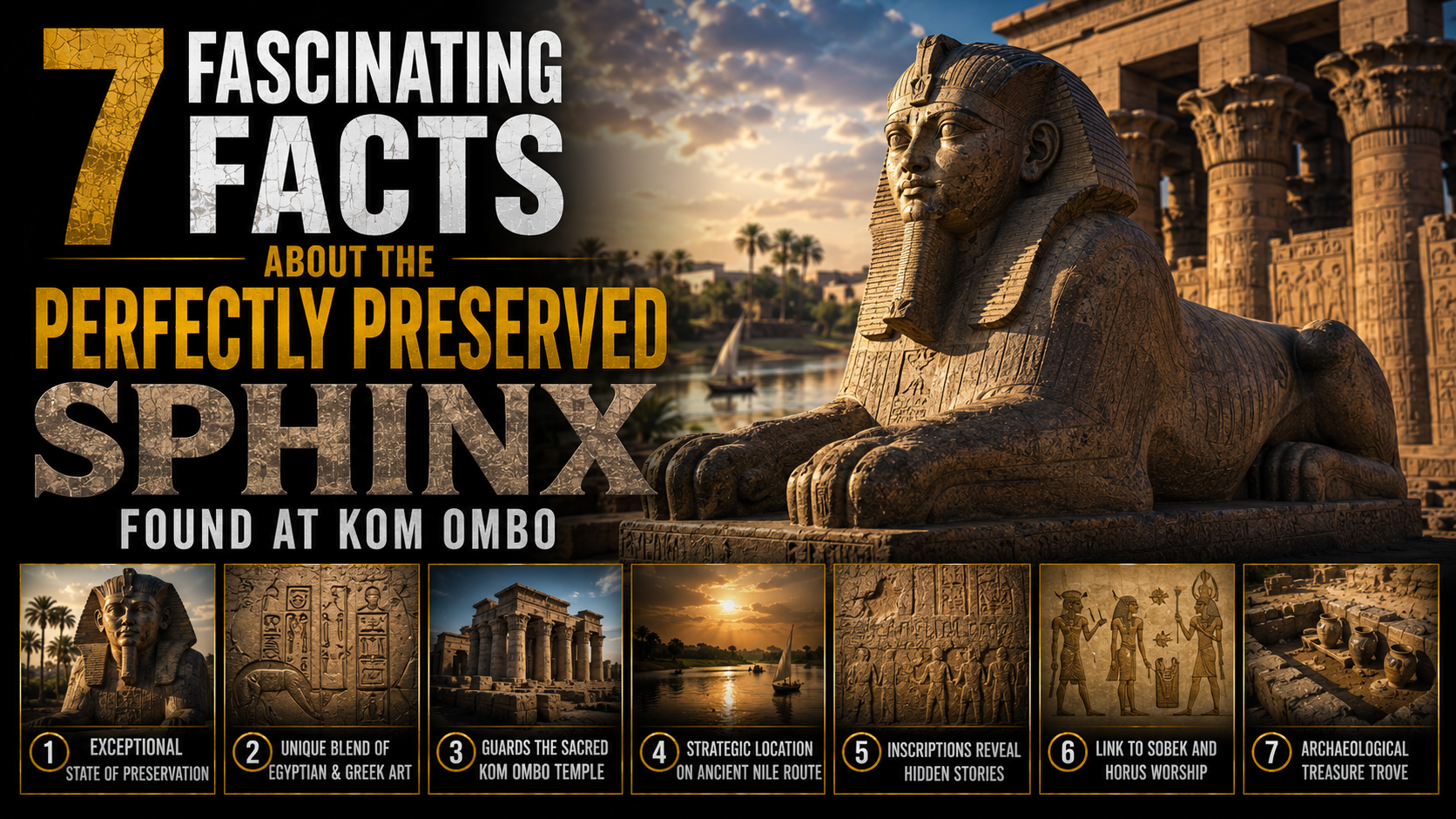
Here are seven fascinating facts about the perfectly preserved sphinx found at Kom Ombo.
1. The Sphinx Was Found Near a Dual Temple Complex
Kom Ombo is unique in Egypt because it is home to a double temple dedicated to two gods: Sobek, the crocodile deity, and Horus the Elder.
The sphinx was discovered in proximity to this sacred complex.
Its placement suggests it may have played a ceremonial or protective role connected to the temple.
This location adds significant religious context to the statue’s purpose.
2. Its Preservation State Is Exceptionally Rare
What makes this sphinx especially remarkable is its level of preservation.
Many ancient Egyptian statues have suffered erosion, vandalism, or burial damage over millennia.
However, this sphinx retains fine details in its facial features and carved structure.
Such preservation allows researchers to study artistic techniques more clearly than usual.
3. It Reflects Classical Egyptian Artistic Proportions
The sphinx follows traditional artistic conventions used in ancient Egypt.
Its body combines a lion’s form with a human head, symbolizing strength and intelligence.
The proportions align with known standards used during major dynastic periods.
This suggests it was created by skilled artisans working within established artistic traditions.
4. Inscriptions Provide Clues About Its Origin
Fragments of inscriptions found near the sphinx help archaeologists identify its possible historical context.
While some inscriptions are damaged, partial hieroglyphs suggest royal or religious connections.
These markings may indicate the name of a ruler or deity associated with the structure.
Researchers continue to study these inscriptions for clearer interpretation.
5. The Sphinx May Have Had a Protective Function
In ancient Egyptian culture, sphinxes were often placed at entrances to temples and sacred spaces.
They were believed to act as guardians, protecting against evil forces.
The positioning of this sphinx supports the idea that it served a symbolic protective role.
Its presence would have reinforced the sacred nature of the surrounding area.
6. Geological Conditions Helped Preserve It
The environment around Kom Ombo played a key role in preserving the sphinx.
Over time, layers of sand and sediment helped shield it from weathering and human interference.
This natural covering slowed erosion and protected carved details.
As a result, the statue remained hidden and relatively intact until its discovery.
7. The Discovery Enhances Understanding of Kom Ombo’s History
Kom Ombo is already an important archaeological site, but this sphinx adds new depth to its historical significance.
It suggests that the area may have contained more ceremonial structures than previously believed.
Each new discovery helps researchers reconstruct how the temple complex functioned in ancient times.
It also strengthens the site’s importance as a religious and cultural center along the Nile.
Why This Sphinx Matters
The discovery of a well-preserved sphinx at Kom Ombo is more than just an archaeological highlight—it is a window into ancient Egyptian belief systems and artistic mastery.
Sphinxes were not merely decorative; they represented power, protection, and divine connection.
Finding one in such good condition allows historians to study these meanings in greater detail than usual.
It also provides valuable context for understanding how sacred spaces were designed and protected.
The Role of Sphinxes in Ancient Egyptian Culture
Sphinxes played a significant symbolic role in ancient Egypt.
They combined human intelligence with animal strength, representing balance and divine authority.
Often placed along temple pathways or entrances, they were believed to guard sacred spaces.
Their presence reinforced the power of pharaohs and the gods they served.
Ongoing Research and Excavation
Archaeologists continue to study the Kom Ombo sphinx to uncover more details about its origin and purpose.
Advanced imaging and preservation techniques are being used to analyze its surface and inscriptions.
Each new layer of analysis brings researchers closer to understanding its historical context.
Future discoveries at the site may reveal additional artifacts connected to the sphinx.
Final Thoughts
The perfectly preserved sphinx discovered at Kom Ombo stands as a remarkable reminder of Egypt’s enduring legacy.
From its symbolic role as a guardian figure to its exceptional state of preservation, it offers a rare and valuable glimpse into ancient craftsmanship and religious tradition.
As research continues, this discovery will likely deepen our understanding of Kom Ombo’s cultural and spiritual importance.
In many ways, the sphinx is not just a relic of the past—it is a bridge connecting modern exploration with the mysteries of ancient Egypt.







