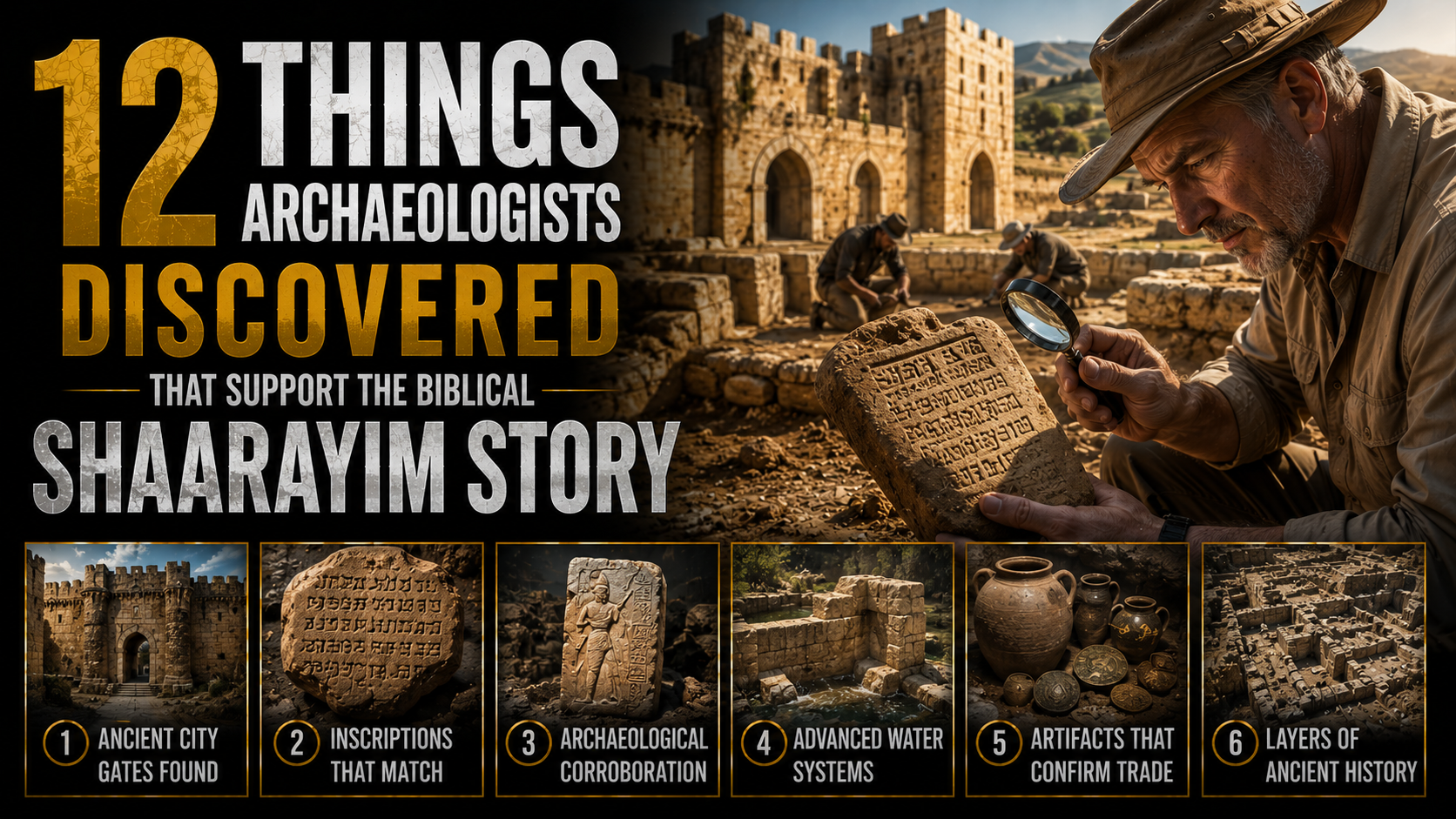
Ancient history and archaeology often intersect in ways that spark both excitement and debate. One of the most discussed topics in Near Eastern archaeology is the identification of Shaarayim, a city mentioned in the Hebrew Bible in connection with ancient battles and early settlements in the region of Judah.
While scholars continue to debate the exact location and interpretation of biblical references, several archaeological discoveries have been linked by some researchers to the possible existence of Shaarayim. These findings come from excavations in the southern Levant, particularly in areas associated with early Iron Age settlements.
It is important to note that archaeological interpretations vary, and not all scholars agree on the identification of specific sites. However, the evidence uncovered so far provides fascinating insight into ancient urban life, warfare, and settlement patterns that may align with biblical descriptions.
Here are 12 things archaeologists have discovered that some researchers believe support the Shaarayim narrative.
1. The Discovery of a Fortified Iron Age Settlement
One of the strongest pieces of evidence comes from the excavation of a fortified settlement dating to the Iron Age.
The site includes defensive walls and strategic construction typical of important border towns.
Such fortifications suggest the location had military significance.
This aligns with biblical references to Shaarayim as a site connected to conflict.
2. Two Gates Found in the City Layout
The name “Shaarayim” is often translated as “two gates.”
At one excavation site, archaeologists identified a city layout featuring what may have been a dual-gate system.
This unusual design has drawn attention because most ancient cities typically had a single main gate.
The structure has become central to the debate over the city’s identity.
3. Evidence of Administrative Activity
Artifacts such as seals, pottery markings, and storage jars suggest organized administration.
These findings indicate the presence of a structured governing system.
Such organization would be expected in a city of regional importance.
It also supports the idea of a politically significant settlement.
4. Strategic Location Along Ancient Trade Routes
The site is located near important ancient travel and trade routes.
These routes connected inland settlements with coastal regions.
Control of such a location would have provided economic and military advantages.
This strategic positioning fits descriptions of fortified biblical towns.
5. Signs of Warfare and Destruction Layers
Archaeologists have identified layers of ash and destruction debris at the site.
These layers suggest episodes of conflict or invasion.
Such evidence is consistent with the turbulent historical period described in ancient texts.
It supports the idea that the settlement experienced violent events.
6. Agricultural Tools and Storage Facilities
Excavations have uncovered tools used for farming and food production.
Large storage jars indicate surplus production and resource management.
This suggests a stable population capable of sustaining itself during conflict periods.
Agriculture would have been essential for a fortified settlement’s survival.
7. Pottery Styles Consistent With the Iron Age Judah Region
The pottery found at the site matches styles known from Iron Age Judah.
These artifacts help archaeologists date the settlement and compare it to nearby sites.
Pottery analysis is one of the most reliable methods for establishing historical timelines.
This strengthens the connection between the site and regional ancient cultures.
8. Residential Structures Indicating Organized Urban Planning
Remains of houses show evidence of planned urban design.
Buildings were arranged in structured clusters rather than random layouts.
This suggests a degree of central authority and city planning.
Such organization is consistent with established ancient settlements.
9. Animal Bones Reflecting Local Diet and Economy
Excavated animal remains reveal a diet based on livestock such as sheep and goats.
This indicates pastoral and agricultural activity typical of ancient highland communities.
The presence of domesticated animals supports the idea of a settled population.
It also provides insight into daily life and economic practices.
10. Water Systems and Infrastructure Remains
Evidence of cisterns and water collection systems has been found.
These systems were essential for survival, especially in dry climates.
Their presence indicates advanced planning and engineering knowledge.
Water management would have been crucial for a fortified city.
11. Geographic Alignment With Biblical Descriptions
Some researchers point out that the site’s geographic position aligns with biblical narratives describing Shaarayim’s location near battlefields.
Its proximity to valleys and strategic terrain supports this interpretation.
However, exact correlations remain debated among scholars.
Still, the alignment continues to attract archaeological interest.
12. Ongoing Excavations Continue to Reveal New Evidence
The site is still under active archaeological study.
New findings continue to emerge each season, adding more detail to the historical picture.
As excavation methods improve, more data may help clarify the site’s identity.
For now, the evidence remains suggestive but not conclusive.
Why Shaarayim Remains an Archaeological Mystery
The identification of Shaarayim is not universally agreed upon.
Archaeology often requires interpreting incomplete evidence, and ancient place names can be difficult to match with physical locations.
However, the combination of dual gates, fortifications, and Iron Age artifacts makes this site one of the strongest candidates under discussion.
The debate reflects the broader challenge of connecting ancient texts with archaeological findings.
The Importance of Evidence-Based Interpretation
Modern archaeology relies on careful analysis rather than assumptions.
While biblical narratives provide historical context, physical evidence must support any identification.
This balance ensures that interpretations remain scientifically grounded.
It also allows multiple perspectives to contribute to ongoing research.
Final Thoughts
The archaeological discoveries linked to the biblical Shaarayim story offer a fascinating glimpse into ancient life in the Iron Age Levant.
From fortified walls and dual gates to pottery and destruction layers, each finding adds depth to the historical picture.
While the exact identity of the site remains uncertain, the evidence continues to fuel scholarly discussion and exploration.
In the end, Shaarayim stands as a reminder of how history, archaeology, and ancient texts continue to intersect—revealing fragments of a world still being uncovered today.







