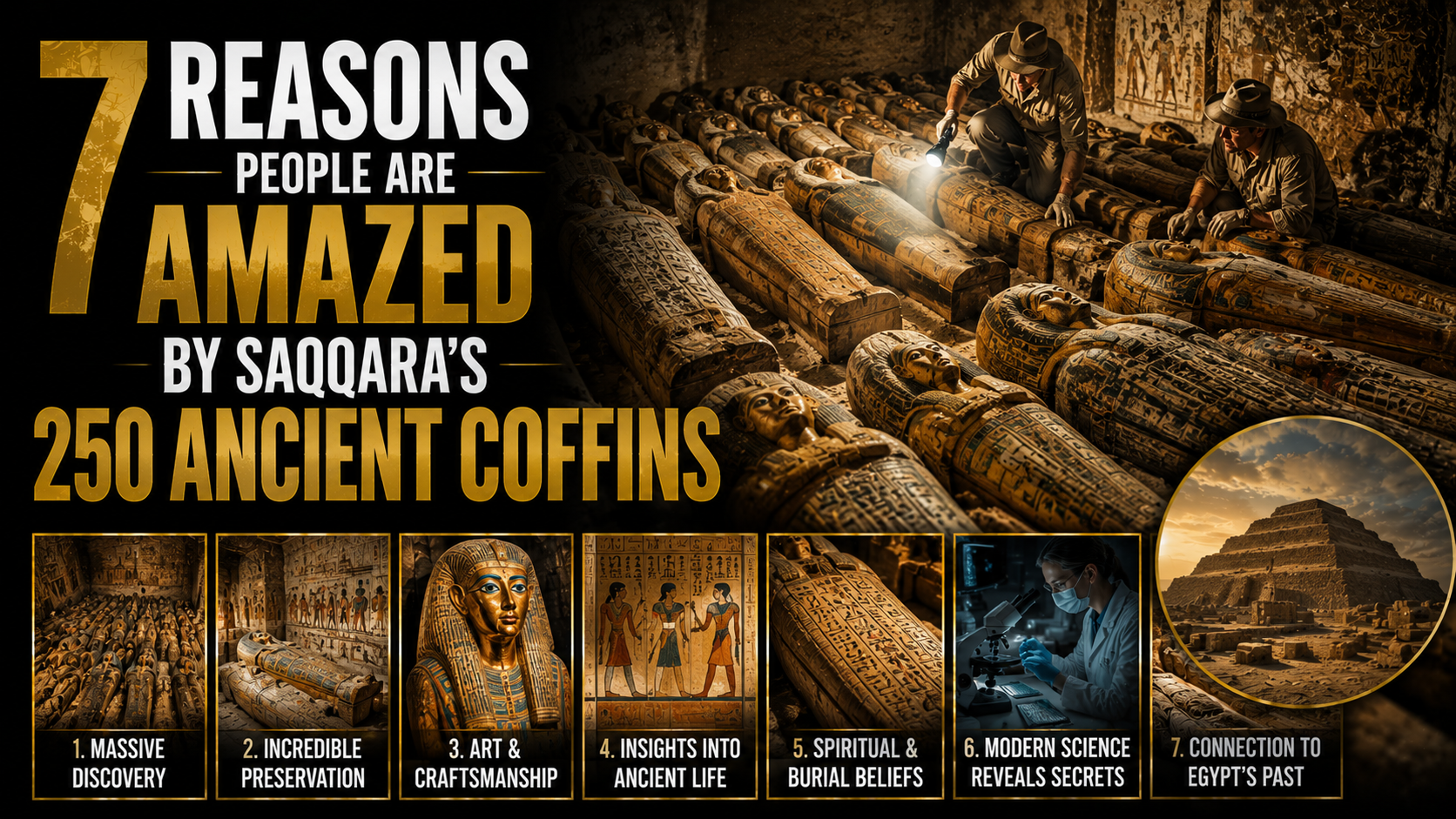
Saqqara, one of Egypt’s most important archaeological sites, continues to deliver discoveries that reshape how we understand ancient civilization. Among its most astonishing finds are more than 250 sealed coffins uncovered in remarkably preserved condition. These wooden sarcophagi, buried for over two millennia, have stunned archaeologists, historians, and the public alike.
What makes this discovery so compelling is not just the number of coffins, but their condition, artistry, and the insights they provide into ancient Egyptian burial traditions. Each coffin carries clues about beliefs, craftsmanship, and social structures that defined life thousands of years ago.
Here are seven reasons people around the world are amazed by Saqqara’s 250 ancient coffins.
1. The Coffins Were Found Completely Sealed
One of the most striking aspects of the discovery is that many of the coffins were still tightly sealed when unearthed.
This means they had not been disturbed since they were originally buried over 2,000 years ago.
Such untouched preservation is extremely rare in archaeology.
It offers researchers an unbroken window into ancient burial practices.
2. The Preservation Quality Is Extraordinary
Despite their age, many of the coffins remain in surprisingly good condition.
The painted surfaces, inscriptions, and structural details are still visible in many cases.
This level of preservation suggests stable burial conditions deep within the Saqqara necropolis.
It allows historians to study artistic and religious elements with exceptional clarity.
3. Each Coffin Features Unique Artistic Designs
No two coffins are exactly alike.
Each one contains distinctive patterns, colors, and symbolic artwork.
These designs often reflect religious beliefs about the afterlife and protection of the deceased.
The individuality of each coffin highlights the importance of personal identity in ancient Egyptian burial traditions.
4. The Discovery Reveals Social Diversity
The coffins belong to individuals from different social backgrounds.
Some appear to have belonged to priests, officials, and members of the elite class.
Others may represent lower-ranking individuals who still received formal burial rites.
This variety provides valuable insight into how ancient Egyptian society structured its burial customs.
5. The Coffins Contain Rich Religious Symbolism
Ancient Egyptians believed strongly in the afterlife, and this belief is reflected in the coffin designs.
Many are decorated with protective deities, spells, and symbolic imagery.
These elements were intended to guide and protect the deceased in the journey beyond death.
The presence of such symbolism helps researchers understand ancient religious practices in greater detail.
6. The Discovery Sheds Light on Ancient Burial Techniques
The way the coffins were arranged and buried offers clues about funerary rituals.
They were carefully stacked in burial shafts, indicating organized and intentional placement.
This suggests a well-developed system of funerary planning and execution.
It also reflects the importance placed on proper burial for ensuring safe passage to the afterlife.
7. Modern Technology Has Revealed Hidden Details Without Opening Them
One of the most exciting aspects of the discovery is how modern technology has been used to study the coffins.
CT scans and 3D imaging allow researchers to examine what lies inside without physically opening them.
This non-invasive approach preserves the integrity of the artifacts while still revealing important details.
It has already provided insights into mummification methods, burial goods, and skeletal remains.
Why Saqqara Continues to Fascinate the World
Saqqara is one of Egypt’s oldest and most important burial grounds, serving as a necropolis for Memphis, the ancient capital.
It contains pyramids, tombs, and monuments spanning thousands of years of history.
Each new discovery adds another layer to our understanding of ancient Egyptian civilization.
The 250 coffins represent one of the most significant recent finds, both in scale and preservation.
The Role of Saqqara in Ancient Egyptian Culture
Saqqara was not just a burial site—it was a sacred landscape.
It reflected the Egyptians’ deep beliefs about death, rebirth, and eternal life.
Burial practices evolved over centuries, and Saqqara preserves this long historical timeline.
The coffins help illustrate how these beliefs were expressed through art and ritual.
Final Thoughts
The discovery of 250 ancient coffins at Saqqara is one of the most remarkable archaeological finds of recent years.
From their vivid artwork and exceptional preservation to their cultural and religious significance, these coffins offer an extraordinary glimpse into ancient Egyptian life and death.
Each coffin is more than a burial container—it is a story, carefully preserved across millennia.
As research continues, Saqqara will likely reveal even more secrets, deepening our understanding of one of the world’s most fascinating civilizations.