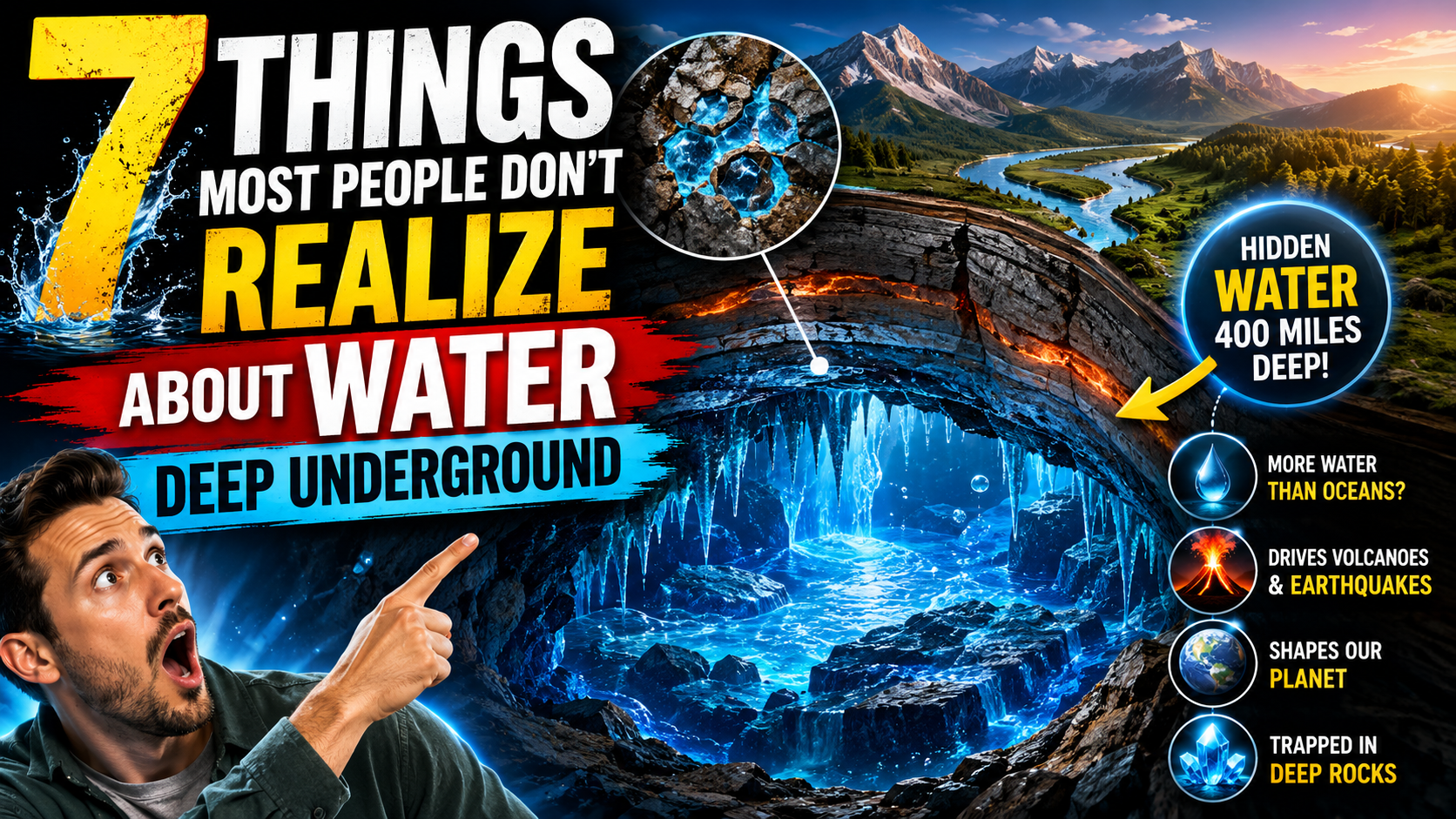
When most people think about Earth’s water, they picture oceans, rivers, lakes, glaciers, and rain clouds. After all, these are the forms of water we see every day. Yet some of the planet’s most fascinating water isn’t visible at all. It exists far beneath our feet, hidden deep within the Earth’s interior.
In recent years, scientific discoveries have revealed that vast amounts of water may be stored hundreds of miles below the surface. These findings have challenged long-standing assumptions about Earth’s water cycle and raised new questions about how our planet formed and evolved.
The idea of an “underground ocean” often sounds like something from a science fiction movie. But the reality is even more intriguing. Scientists aren’t talking about a giant underground sea where fish are swimming in dark caverns. Instead, they’re uncovering evidence that water exists deep within minerals and rocks inside the Earth’s mantle.
This hidden water may play a crucial role in shaping everything from volcanic activity to plate tectonics and even the long-term stability of Earth’s climate.
Here are seven surprising things most people don’t realize about water deep underground.
1. The Water Isn’t Stored Like an Underground Ocean
One of the biggest misconceptions about deep-Earth water is that it exists as a giant underground lake or ocean.
In reality, scientists believe much of this water is trapped inside minerals found deep within the mantle. These minerals can hold hydrogen and oxygen within their crystal structures, effectively storing enormous amounts of water without it existing as a liquid ocean.
Imagine a sponge holding water—not as a pool sitting inside it, but as part of its structure. The comparison isn’t perfect, but it helps explain how water can be stored deep underground.
This distinction is important because it changes how scientists think about the movement of water inside the planet.
Rather than flowing freely through giant underground chambers, much of Earth’s deep water may be locked within rocks under immense pressure.
2. There Could Be More Water Underground Than in Surface Oceans
One reason this topic has attracted worldwide attention is the possibility that Earth’s interior may contain staggering quantities of water.
Some research suggests that the amount of water stored within the mantle could rival—or even exceed—the total volume found in all of Earth’s surface oceans combined.
If true, this means that the familiar oceans covering about 70 percent of Earth’s surface may represent only part of the planet’s total water inventory.
This possibility has profound implications for geology, planetary science, and our understanding of Earth’s history.
Scientists continue investigating exactly how much water exists underground, but even conservative estimates suggest the numbers are enormous.
3. Deep Water Helps Drive Plate Tectonics
The movement of Earth’s tectonic plates shapes continents, creates mountains, and triggers earthquakes.
Many people don’t realize that water plays a critical role in these processes.
Deep within the Earth, water can affect the behavior of rocks by lowering melting temperatures and influencing how materials flow under extreme pressure.
This helps drive geological processes that have shaped our planet for billions of years.
Without water in the mantle, Earth’s tectonic system might operate very differently—or perhaps not as effectively at all.
Researchers increasingly view water as one of the key ingredients that makes Earth’s geology unique.
4. Volcanic Eruptions May Release Ancient Underground Water
When volcanoes erupt, they don’t only release lava and gases.
They can also release water that has been stored deep within Earth’s interior for millions—or even billions—of years.
As tectonic plates move and materials circulate through the mantle, water trapped in minerals can eventually be carried upward. Under changing temperatures and pressures, that water may be released and contribute to volcanic activity.
In a sense, some of the water emerging from volcanoes today may have spent unimaginable lengths of time hidden deep beneath the surface.
This process forms part of a long-term geological recycling system that scientists are still working to understand.
5. Deep Water May Have Influenced Earth’s Habitability
One of the most fascinating questions in planetary science is why Earth became capable of supporting life while many other worlds did not.
Water is a major part of the answer.
Researchers believe deep-Earth water may have helped regulate geological processes that contribute to a stable environment over long periods.
The interaction between water, volcanic activity, and plate tectonics may play a role in controlling atmospheric conditions and maintaining a climate suitable for life.
Although many factors contribute to habitability, water hidden within Earth’s interior may be more important than previously recognized.
Understanding this relationship could also help scientists evaluate the potential for life on other planets.
6. Scientists Are Still Discovering What’s Beneath Us
Despite centuries of scientific advancement, humanity has explored only a tiny fraction of Earth’s interior.
The deepest hole ever drilled by humans barely scratched the surface compared to the thousands of kilometers separating us from the planet’s core.
As a result, much of what scientists know about the deep Earth comes from indirect evidence.
Researchers study seismic waves generated by earthquakes, analyze minerals brought to the surface, conduct laboratory experiments, and use advanced computer models to understand conditions far below ground.
Every new discovery reveals that our planet is more complex than previously imagined.
The existence of vast underground water reservoirs is just one example of how much remains unknown.
7. Deep Water Is Changing How Scientists View Earth’s Water Cycle
Most people learn about the water cycle in school through a familiar process: evaporation, condensation, clouds, rain, rivers, and oceans.
While this explanation is correct, it tells only part of the story.
Scientists now recognize that Earth may have a much deeper and more complex water cycle operating over geological timescales.
Water doesn’t simply move between oceans and the atmosphere. It may also travel deep into the mantle through subducting tectonic plates and eventually return to the surface through volcanic activity.
This deep water cycle can take millions of years to complete.
The realization that water constantly moves between the surface and Earth’s interior is transforming how researchers understand planetary systems.
Why This Discovery Matters
At first glance, hidden water deep underground may seem like an interesting scientific curiosity. But its implications are far-reaching.
Understanding deep-Earth water helps scientists answer important questions about:
- How Earth formed.
- Why tectonic plates move.
- What drives volcanic activity.
- How the planet’s climate evolved.
- Why Earth became habitable.
- How water is distributed throughout the planet.
Each of these questions connects to larger mysteries about our world and its place in the universe.
The more scientists learn about underground water, the better they can understand the forces that have shaped Earth over billions of years.
Common Misunderstandings About the “Hidden Ocean”
Media headlines often describe this discovery as an ocean hidden beneath Earth’s surface.
While this phrase captures attention, it can also create confusion.
Most scientists are not describing a vast underground sea similar to the Atlantic or Pacific Ocean.
Instead, they are referring to water stored within minerals under extraordinary pressure and temperature conditions.
This distinction may seem technical, but it is essential for understanding the science accurately.
The discovery is remarkable not because researchers found a giant underground lake, but because they found evidence that enormous quantities of water can exist in ways previously unimagined.
What Scientists Hope to Learn Next
Research into deep-Earth water is still evolving.
Future studies aim to determine:
- Exactly how much water is stored within the mantle.
- How water moves between Earth’s surface and interior.
- The role water plays in tectonic activity.
- Whether similar processes occur on other planets.
- How deep-water systems influenced Earth’s evolution.
Advances in seismic imaging, mineral analysis, and computer modeling will likely provide new answers in the coming years.
Every discovery brings scientists one step closer to understanding the hidden systems operating beneath our feet.
Final Thoughts
The idea that enormous amounts of water may exist hundreds of miles below Earth’s surface is one of the most fascinating scientific discoveries of recent decades. It challenges traditional views of where water is located and reveals a planet far more dynamic than many people realize.
Far from being a simple ball of rock covered by oceans, Earth appears to contain complex water systems extending deep into its interior. These hidden reservoirs may influence tectonic movement, volcanic eruptions, climate stability, and even the conditions that made life possible.
Perhaps the most remarkable lesson is that our planet still holds countless mysteries. Even after centuries of exploration and scientific progress, some of Earth’s greatest secrets remain hidden beneath our feet.
As researchers continue studying deep-Earth water, they are uncovering a richer and more surprising story about the world we call home—one that reminds us how much there is still to learn about our own planet.







