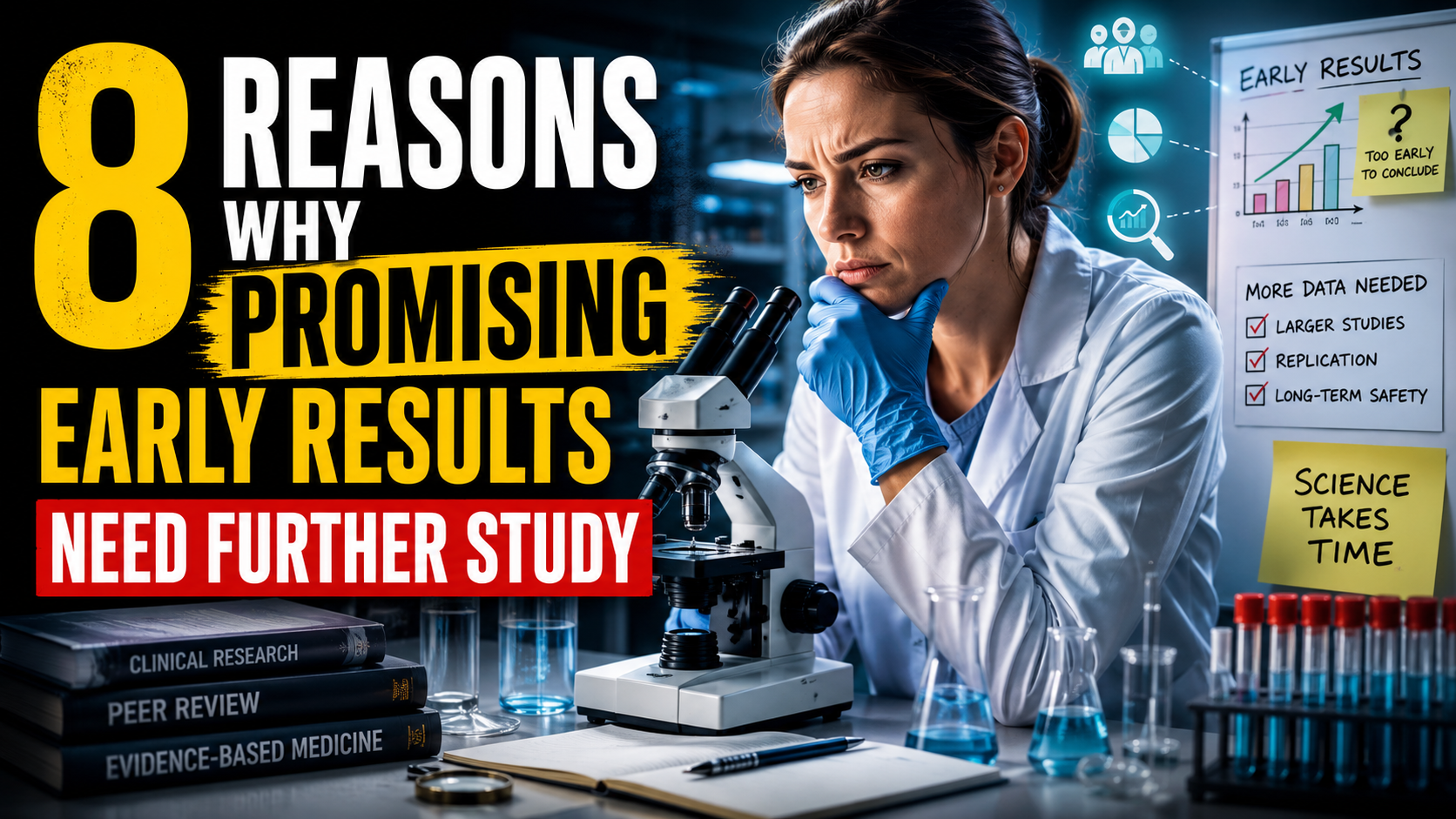
Every few weeks, a headline appears announcing a potential breakthrough. A new drug seems to shrink tumors. A dietary supplement appears linked to better health outcomes. A medical treatment shows encouraging results in a small group of patients. These stories often generate excitement because they offer hope, especially in areas where better solutions are desperately needed.
Yet scientists are usually much more cautious than headlines suggest.
When researchers discover something promising, they rarely consider the story finished. In fact, the first positive result is often just the beginning of a much longer process. Before a finding can influence medical guidelines, public policy, or everyday healthcare decisions, it must survive extensive testing, independent verification, and years of careful evaluation.
This cautious approach is one of the greatest strengths of science. Rather than accepting conclusions too quickly, researchers continually challenge findings to determine whether they truly hold up under scrutiny.
Understanding why promising early results require additional study can help people become more informed readers of science and less vulnerable to misleading claims.
Here are eight important reasons experts emphasize the need for further research before drawing strong conclusions.
1. Early Studies Often Involve Small Groups
Many initial studies are intentionally small.
Researchers frequently begin with a limited number of participants because early investigations are designed to explore possibilities rather than provide definitive answers.
A study involving 20, 50, or even 100 participants may reveal interesting patterns, but small sample sizes have limitations.
Smaller groups can sometimes produce results that appear stronger than they actually are. Random variation may influence outcomes, and findings may not accurately represent larger populations.
For example, a treatment that works well in a small study may not perform the same way when tested in thousands of people with different backgrounds, ages, lifestyles, and health conditions.
This is why larger studies are often necessary before researchers gain confidence in a finding.
2. Results Need to Be Reproduced
One study is rarely enough.
In science, replication is one of the most important standards for establishing credibility.
Replication means independent researchers repeat a study and obtain similar results.
If multiple teams working in different locations arrive at comparable conclusions, confidence in the findings increases significantly.
On the other hand, some early studies produce results that cannot be replicated later.
This does not necessarily mean the original researchers made mistakes. Sometimes differences in participant populations, study design, measurement techniques, or random variation can influence outcomes.
Replication helps separate truly reliable findings from observations that may have occurred by chance.
3. Correlation Does Not Always Mean Causation
One of the most common misunderstandings in research involves confusing association with cause and effect.
An early study may find that two things appear connected. However, that connection does not automatically prove that one caused the other.
For example, researchers might observe that people who follow a particular habit experience better health outcomes. While the habit may contribute to those outcomes, other factors could also play important roles.
Age, lifestyle, socioeconomic status, genetics, diet, exercise habits, and environmental influences can all affect results.
Further research helps scientists determine whether a relationship is truly causal or simply an interesting association.
4. Different Populations May Respond Differently
Human populations are incredibly diverse.
What works well for one group may not work the same way for another.
Early studies sometimes focus on specific populations, such as:
- Certain age groups
- Particular geographic regions
- One gender
- Specific health conditions
- Limited ethnic backgrounds
As research expands, scientists test whether findings remain consistent across broader populations.
This process is essential because healthcare recommendations need to work safely and effectively for diverse groups of people.
Further study helps identify who is most likely to benefit and whether any populations experience different outcomes.
5. Long-Term Effects Are Often Unknown
Many early studies examine short-term results.
A treatment may appear effective after a few weeks or months, but researchers often need years of follow-up data to fully understand its long-term impact.
Questions may include:
- Does the benefit persist over time?
- Are there delayed side effects?
- Does effectiveness decrease?
- Are there unexpected consequences?
History has shown that some interventions that initially appeared promising later revealed important limitations after longer observation periods.
Long-term research provides a more complete picture of both benefits and risks.
This is particularly important in medicine, where patient safety remains a top priority.
6. Study Design Matters
Not all studies provide the same level of evidence.
Some research designs are better suited for answering certain questions than others.
For example:
- Observational studies can identify patterns.
- Randomized controlled trials can evaluate cause and effect more effectively.
- Meta-analyses combine evidence from multiple studies.
- Systematic reviews assess broader scientific consensus.
An exciting result from a preliminary study may serve as a valuable starting point, but stronger evidence often requires more rigorous research methods.
Further investigation helps ensure conclusions are supported by high-quality data rather than isolated observations.
7. Science Advances Through Accumulated Evidence
Popular media often treats individual studies as major breakthroughs.
Scientists typically view research differently.
Most researchers understand that knowledge develops gradually through the accumulation of evidence from many independent studies.
Each new study contributes a piece of a much larger puzzle.
Rarely does a single experiment completely transform scientific understanding overnight.
Instead, confidence grows as multiple studies point toward similar conclusions over time.
This gradual process may seem slow, but it helps ensure that scientific knowledge remains reliable and trustworthy.
Further research strengthens the foundation upon which future discoveries are built.
8. Extraordinary Claims Require Extraordinary Evidence
Some findings attract attention because they appear unusually dramatic.
A treatment may seem to cure a disease unexpectedly. A nutritional intervention may appear to produce remarkable results. A new technology may promise major improvements over existing approaches.
While such possibilities deserve investigation, scientists apply particularly high standards to extraordinary claims.
The larger the claim, the stronger the evidence must be.
Researchers seek:
- Larger studies
- Independent verification
- Long-term follow-up
- Diverse populations
- Rigorous methodology
- Peer review
This careful evaluation helps prevent premature conclusions and protects both scientific integrity and public trust.
History contains many examples of exciting early findings that became less impressive after further investigation.
Additional research helps determine which discoveries truly represent meaningful advances.
Why Scientific Caution Is a Strength
Some people interpret scientific caution as uncertainty or weakness.
In reality, caution is one of science’s greatest strengths.
Researchers understand that knowledge evolves. New evidence can refine previous conclusions, challenge assumptions, or reveal complexities that were not initially obvious.
Rather than rushing to certainty, science prioritizes accuracy.
This approach helps reduce errors and improves the reliability of recommendations that ultimately affect millions of people.
When scientists call for more research, they are not dismissing promising findings. They are working to ensure those findings are as accurate and trustworthy as possible.
The Role of Peer Review
Before most scientific studies are published, they undergo peer review.
During this process, independent experts evaluate the research methods, data analysis, conclusions, and overall quality of the work.
Peer review does not guarantee perfection, but it serves as an important quality-control system.
Additional studies and ongoing evaluation continue after publication, creating multiple layers of scrutiny that strengthen scientific reliability over time.
Why Headlines Often Oversimplify Research
Media organizations face a challenge when reporting scientific findings.
Complex studies must often be summarized in a few sentences or a short headline.
As a result, important details may be lost.
Headlines may emphasize:
- Dramatic outcomes
- Unexpected discoveries
- Potential benefits
while giving less attention to:
- Study limitations
- Sample size
- Uncertainty
- Need for replication
Readers who understand the research process are better equipped to interpret these stories critically.
Questions to Ask About New Research Findings
Whenever you encounter an exciting scientific claim, consider asking:
- How many people participated?
- Has the study been replicated?
- Was it peer-reviewed?
- Were there control groups?
- How long did the study last?
- What limitations did researchers identify?
- Do other studies support similar conclusions?
These questions can provide valuable context and help separate strong evidence from preliminary findings.
The Bigger Picture
Scientific progress depends on curiosity, skepticism, and careful testing.
Many of today’s accepted medical treatments, technologies, and health recommendations began as promising early findings. However, they became trusted only after surviving years of investigation and validation.
The path from discovery to accepted knowledge is rarely straightforward. Researchers test ideas repeatedly, challenge assumptions, analyze new evidence, and refine conclusions as understanding grows.
This process may seem slow at times, but it is one of the reasons science remains such a powerful tool for uncovering reliable knowledge.
Final Thoughts
Promising early results are exciting because they often represent the first glimpse of new possibilities. They can inspire hope, generate fresh research directions, and lead to important breakthroughs. However, early findings are only the starting point of scientific discovery—not the final destination.
Further study is essential because it helps researchers confirm results, identify limitations, understand long-term effects, evaluate safety, and determine whether findings apply broadly across different populations.
Science works best when curiosity is balanced with careful verification. By understanding why additional research matters, readers can better interpret scientific news, appreciate the research process, and make more informed decisions based on evidence rather than excitement alone.
In the end, the goal of science is not simply to find answers quickly. It is to find answers that stand the test of time.







