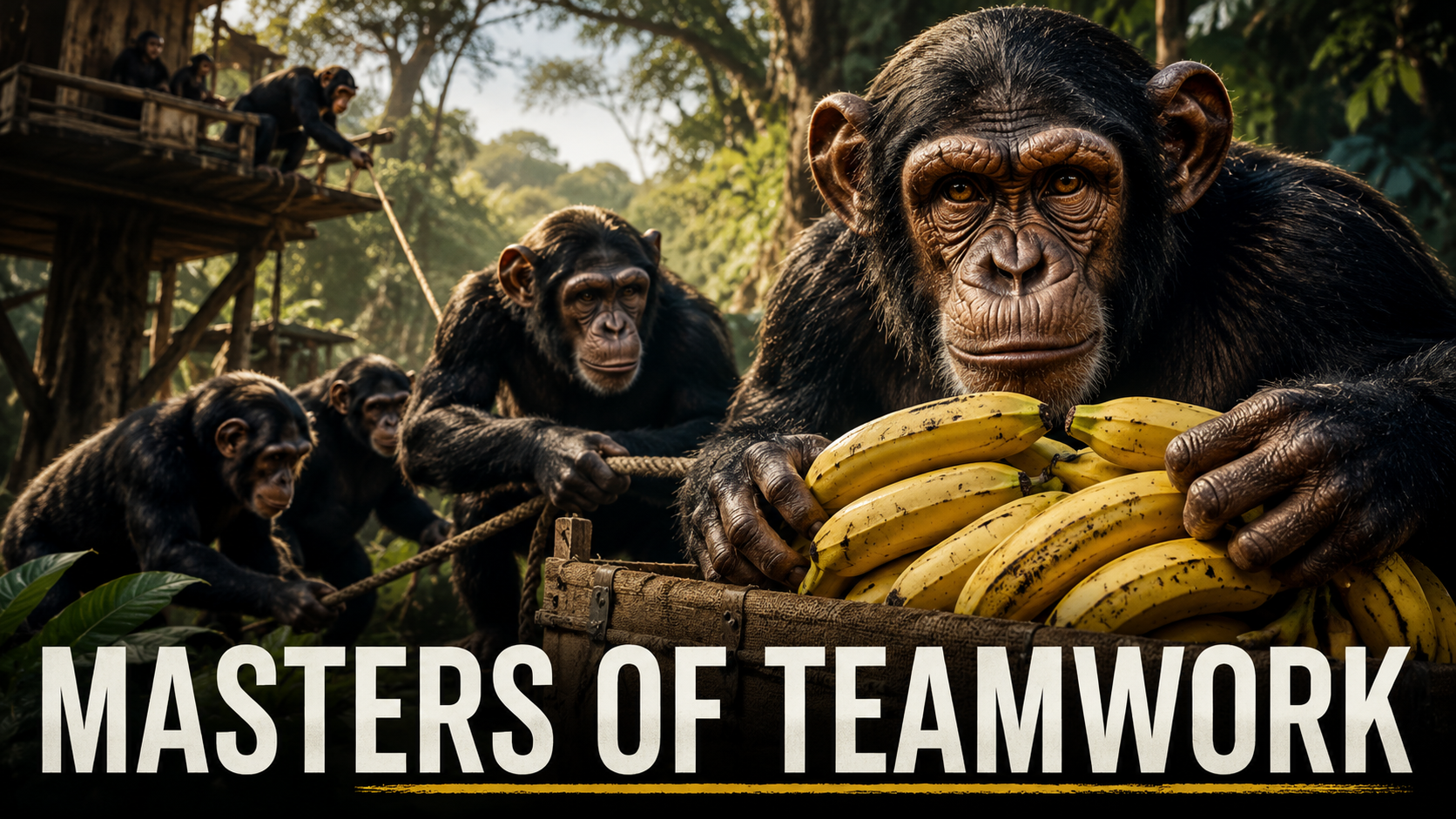
When people think about teamwork, they usually picture sports teams, military operations, or business organizations working toward a common goal. Rarely do they imagine a group of chimpanzees quietly coordinating a plan to secure a valuable food source.
Yet one fascinating incident involving chimpanzees in Uganda has prompted scientists and animal behavior experts to take a closer look at how our closest living relatives cooperate. What appeared on the surface to be a simple banana theft revealed something far more intriguing: signs of planning, communication, coordination, and social intelligence that rival some of the basic teamwork skills seen in humans.
Chimpanzees have long been recognized as highly intelligent animals. They use tools, form complex social groups, solve problems, and learn from one another. However, certain observations suggest they may also be capable of sophisticated cooperation when pursuing shared goals.
The so-called “banana heist” became a compelling example because it seemed to involve multiple individuals working together in ways that maximized success while minimizing risk.
Whether viewed as strategic cooperation or instinctive social behavior, the event offers valuable insights into the remarkable cognitive abilities of chimpanzees.
Here are eight signs that the Uganda chimp banana heist demonstrated advanced teamwork in action.
1. Different Individuals Appeared to Take on Different Roles
One of the most recognizable features of effective teamwork is role specialization.
In successful human teams, members often perform different tasks based on their strengths and responsibilities. Leaders coordinate, planners strategize, and others carry out specific actions.
Observers of chimpanzee groups have frequently noticed similar patterns.
During food-acquisition events, some individuals focus on accessing the resource while others monitor the surroundings or remain alert to potential threats.
In the Uganda incident, researchers noted behavior that suggested certain chimpanzees appeared to perform distinct functions within the group.
This division of labor improved efficiency and reduced confusion.
The presence of role differentiation is often considered an important indicator of coordinated group activity.
2. Timing Seemed Remarkably Coordinated
Successful cooperation depends heavily on timing.
Even the best plan can fail if participants act too early, too late, or without awareness of one another’s actions.
One of the most striking aspects of the banana heist was the apparent synchronization among group members.
Individuals appeared to move at moments that complemented the actions of others.
Rather than behaving randomly, they seemed to respond to ongoing events in ways that supported collective success.
This kind of coordinated timing suggests a level of social awareness that extends beyond simple individual decision-making.
It reflects the ability to monitor and adapt to group behavior in real time.
3. Communication Played a Key Role
Teamwork requires information sharing.
Humans communicate through language, but chimpanzees rely on a combination of vocalizations, gestures, facial expressions, and body movements.
Researchers have documented an impressive range of communicative behaviors among chimpanzees.
These signals help coordinate movement, indicate intentions, and manage social relationships.
During cooperative activities, communication becomes especially important.
Members of a group must understand what others are doing and respond appropriately.
The Uganda chimpanzees appeared highly attentive to one another’s signals, demonstrating how communication can facilitate successful collaboration.
Without information exchange, coordinated action becomes far more difficult.
4. The Group Demonstrated Shared Objectives
A collection of individuals does not automatically constitute a team.
True teamwork emerges when participants pursue a common objective.
In this case, the objective was obvious: gaining access to bananas.
What made the event remarkable was the apparent willingness of multiple chimpanzees to behave in ways that contributed to collective success rather than acting entirely independently.
Shared goals often encourage cooperation because individuals recognize that working together increases the likelihood of achieving a desired outcome.
The ability to align behavior around a common objective is a hallmark of advanced social species.
Chimpanzees repeatedly demonstrate this capacity in a variety of contexts.
5. Risk Was Managed Collectively
One of the advantages of teamwork is risk reduction.
Groups can distribute responsibilities, share information, and improve overall safety.
In wildlife settings, risk management is particularly important because poor decisions can have serious consequences.
Researchers have observed that chimpanzees often behave strategically when approaching uncertain situations.
Some individuals remain watchful while others focus on obtaining resources.
This pattern helps the group respond more effectively to potential threats.
The Uganda banana incident appeared to involve similar dynamics.
By coordinating actions and maintaining awareness, the chimpanzees improved their chances of success while reducing individual exposure to risk.
Such behavior reflects practical problem-solving at a group level.
6. Experience and Learning Likely Influenced Behavior
Advanced teamwork rarely develops overnight.
In human societies, effective cooperation often emerges through repeated interaction, shared experiences, and learning.
Chimpanzees also benefit from long-term social relationships.
They observe one another, remember past events, and adjust future behavior accordingly.
Researchers believe that social learning plays a major role in chimpanzee communities.
Individuals acquire knowledge by watching experienced group members and participating in cooperative activities.
The apparent sophistication of the Uganda banana heist suggests that previous experiences may have shaped the group’s approach.
This ability to learn from experience strengthens cooperative effectiveness over time.
7. Trust Appeared to Be Present
Trust is an essential ingredient in any successful team.
Without trust, cooperation becomes difficult because participants may prioritize personal interests over group objectives.
Chimpanzee societies are complex and often involve alliances, friendships, and long-term social bonds.
Individuals frequently rely on one another during conflicts, food-sharing events, and group activities.
The Uganda chimpanzees appeared comfortable coordinating actions in close proximity, suggesting a level of mutual confidence.
Trust does not eliminate competition, but it makes cooperation possible.
The ability to work alongside others toward a shared outcome reflects a social sophistication that continues to fascinate researchers.
8. The Outcome Benefited From Collective Action
Perhaps the strongest evidence of teamwork lies in the result itself.
When cooperation produces outcomes that would be difficult or impossible for individuals to achieve alone, the value of teamwork becomes clear.
The banana heist demonstrated how coordinated behavior can create advantages.
By working together, the chimpanzees improved efficiency, increased access to resources, and reduced challenges that a single individual might have faced.
This principle mirrors one of the most fundamental concepts in human teamwork: groups often accomplish more collectively than individuals can achieve independently.
The success of the operation highlighted the practical benefits of cooperation.
Why Chimpanzee Teamwork Fascinates Scientists
Chimpanzees occupy a unique place in scientific research because they are among humanity’s closest living relatives.
Humans and chimpanzees share a significant portion of their genetic makeup, making chimp behavior particularly valuable for understanding the evolution of intelligence and social cooperation.
Researchers study chimpanzees not simply because they are intelligent, but because their behavior often reveals clues about the origins of human social skills.
Cooperation, communication, planning, and problem-solving are central to both chimpanzee and human societies.
Observing these behaviors in wild chimp populations helps scientists explore how complex social systems develop and function.
Every new discovery adds another piece to the puzzle.
What Teamwork Looks Like in the Animal Kingdom
Many species cooperate in some form.
Wolves hunt in packs.
Dolphins coordinate feeding strategies.
Ants and bees operate within highly organized colonies.
Chimpanzees stand out because their cooperation appears unusually flexible.
Rather than relying solely on instinctive behaviors, they often adapt strategies to changing circumstances.
This flexibility suggests advanced cognitive abilities and strong social intelligence.
The Uganda banana heist serves as an example of how cooperation can emerge through observation, communication, and shared goals.
It demonstrates that teamwork is not exclusively human.
Nature has developed many different paths toward collaboration.
Lessons Humans Can Learn From Chimpanzees
Although human teamwork is far more complex, the principles underlying successful cooperation remain surprisingly similar.
Strong teams require communication.
They benefit from trust.
They perform better when members understand their roles.
They succeed when participants share common goals.
The chimpanzees involved in the banana heist appeared to demonstrate many of these same fundamentals.
Their behavior reminds us that cooperation is one of nature’s most powerful survival tools.
Whether in wildlife communities or modern workplaces, teamwork often provides advantages that individuals cannot achieve alone.
The Bigger Picture
Stories like the Uganda chimp banana heist capture public imagination because they challenge assumptions about animal intelligence.
Many people underestimate the cognitive abilities of nonhuman species.
Yet research continues to reveal remarkable examples of planning, learning, memory, and social awareness throughout the animal kingdom.
Chimpanzees, in particular, consistently surprise scientists with behaviors that appear strikingly sophisticated.
Each new observation encourages deeper questions about intelligence, cooperation, and the evolutionary roots of human behavior.
The more we learn, the more apparent it becomes that complex teamwork is not uniquely human.
Final Thoughts
The Uganda chimp banana heist may have seemed like a simple food-grabbing adventure at first glance, but a closer look reveals something much more fascinating.
The event showcased several characteristics commonly associated with advanced teamwork:
- Specialized roles.
- Coordinated timing.
- Effective communication.
- Shared objectives.
- Collective risk management.
- Learning through experience.
- Trust among participants.
- Success through cooperation.
Together, these behaviors paint a picture of a highly intelligent social species capable of working together in sophisticated ways.
While chimpanzees may never organize corporations or lead business meetings, their actions demonstrate that the foundations of teamwork—communication, trust, coordination, and shared purpose—extend far beyond humanity.
And that realization may be one of the most fascinating discoveries of all.