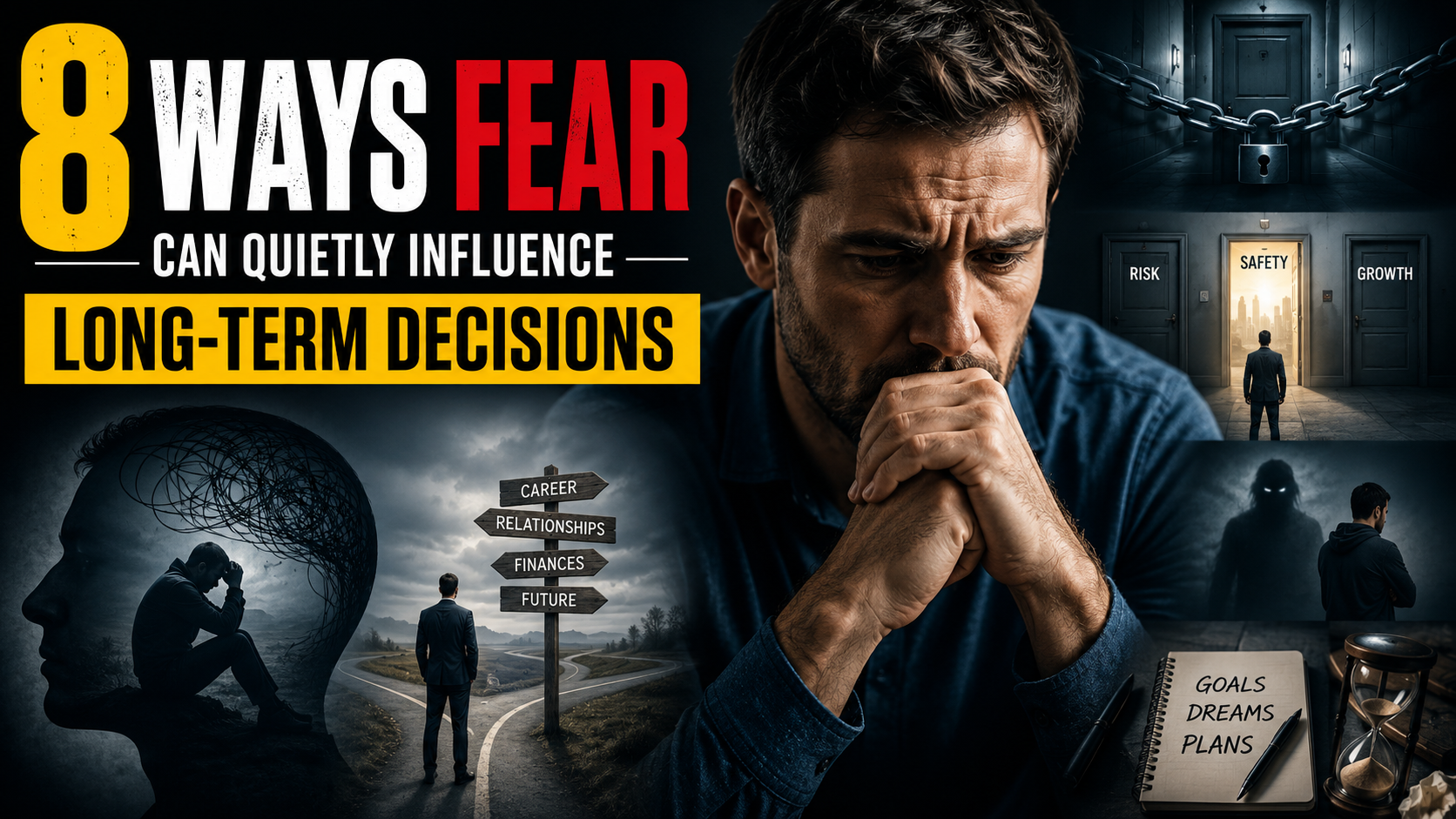
Fear is one of the most powerful emotions humans experience. It exists for a good reason: to protect us from danger. Throughout history, fear has helped people avoid threats, survive difficult situations, and make quick decisions when safety was at risk.
But in modern life, fear doesn’t always show up as a clear warning signal. Often, it operates quietly in the background, influencing choices without us fully realizing it. It can shape the careers we pursue, the relationships we enter, the risks we avoid, and even the goals we set for ourselves.
The challenge is that fear doesn’t always announce itself. Instead, it can disguise itself as caution, practicality, perfectionism, or “being realistic.” Over time, these subtle influences can affect the direction of our lives in ways we never intended.
Understanding how fear impacts long-term decision-making is an important step toward making choices that align with our values rather than our anxieties. Here are eight ways fear can quietly shape your future and what you can do about it.
1. Fear Can Keep You Stuck in Your Comfort Zone
Most people are familiar with the phrase “comfort zone,” but few realize how strongly fear helps maintain it.
Trying something new naturally creates uncertainty. Whether it’s changing careers, moving to a different city, starting a business, or pursuing a dream, unfamiliar situations trigger the brain’s threat-detection system.
The brain often interprets uncertainty as potential danger, even when no actual threat exists. As a result, staying in a familiar situation can feel safer than taking a chance on something better.
Over time, this tendency can limit personal growth. Opportunities for learning, advancement, and self-discovery are often found outside comfortable routines.
People frequently look back and regret the opportunities they didn’t take more than the mistakes they made. Fear encourages safety, but growth often requires calculated risk.
2. Fear Can Influence Career Choices
Career decisions are among the most significant choices people make, and fear often plays a larger role than expected.
Some individuals remain in jobs they dislike because they fear financial instability. Others avoid leadership positions because they worry about failure or criticism.
Even highly talented professionals may hesitate to pursue promotions, start businesses, or change industries because fear magnifies potential risks while minimizing potential rewards.
This doesn’t mean every career move should be impulsive. Thoughtful planning is important. However, decisions driven primarily by fear can prevent people from reaching their full potential.
When evaluating major career choices, it can be helpful to ask: “Am I making this decision based on genuine logic, or am I simply trying to avoid discomfort?”
3. Fear Can Affect Relationships
Relationships require vulnerability, and vulnerability often triggers fear.
Fear of rejection, abandonment, betrayal, or emotional pain can influence how people connect with others.
Some individuals avoid relationships altogether because they fear getting hurt. Others stay in unhealthy relationships because they fear being alone. In some cases, fear causes people to hold back emotionally, making it difficult to build trust and intimacy.
These patterns often develop gradually and may not be obvious at first.
Long-term happiness is closely linked to meaningful human connections. Recognizing how fear affects relationship decisions can help people create healthier and more fulfilling bonds.
4. Fear Can Lead to Overthinking
The human brain is remarkably good at imagining future possibilities.
Unfortunately, fear often directs this ability toward worst-case scenarios.
When facing an important decision, fearful thinking can generate endless questions:
- What if I fail?
- What if I make the wrong choice?
- What if things don’t work out?
- What if people judge me?
While considering potential consequences is useful, excessive analysis can become paralyzing.
Overthinking creates the illusion of productivity while delaying action. In reality, some decisions can only be evaluated through experience.
Fear often convinces people that they need complete certainty before moving forward. The truth is that certainty rarely exists in life.
5. Fear Can Make Short-Term Comfort More Attractive
Many important goals require temporary discomfort.
Improving health may require changing habits. Building a business may require financial sacrifices. Learning a new skill often involves mistakes and frustration.
Fear naturally pushes people toward immediate comfort instead.
The brain tends to prioritize avoiding present discomfort over achieving future rewards. This psychological tendency can influence countless daily decisions.
Choosing immediate comfort may feel harmless in the moment, but repeated choices accumulate over time. Small decisions made consistently often have a larger impact than dramatic life-changing events.
Long-term success frequently depends on the willingness to tolerate short-term uncertainty and discomfort.
6. Fear Can Distort Risk Perception
One of fear’s most interesting effects is its ability to change how people evaluate risk.
Fear often exaggerates unlikely negative outcomes while ignoring probable positive outcomes.
For example, someone considering a new opportunity may spend weeks worrying about everything that could go wrong while barely thinking about what could go right.
Psychologists refer to this as a negativity bias. The brain evolved to pay close attention to potential threats because survival depended on it.
While this bias once offered protection, it can become problematic in modern decision-making. Fear sometimes causes people to avoid opportunities that carry reasonable risks and substantial potential benefits.
Learning to assess risk objectively rather than emotionally can lead to more balanced decisions.
7. Fear Can Influence Self-Identity
The stories people tell themselves have tremendous power.
Over time, repeated fears can become part of a person’s identity.
Someone who experiences repeated fear around public speaking may start believing, “I’m not confident.”
A person who fears failure may begin thinking, “I’m not capable of success.”
These beliefs often feel like facts, but they are usually interpretations shaped by past experiences and emotional responses.
The danger is that self-limiting beliefs can influence future behavior.
People often make decisions that align with their self-image, even when that self-image is inaccurate. Fear-based identities can quietly shape life choices for years.
Recognizing these internal narratives is an important step toward change.
8. Fear Can Prevent Future Opportunities
Perhaps the most significant way fear affects decision-making is by preventing action altogether.
Many opportunities have expiration dates.
A business idea may never move beyond the planning stage. A meaningful conversation may never happen. A dream job application may never be submitted.
Fear rarely announces itself by saying, “Don’t pursue your goals.”
Instead, it offers seemingly reasonable excuses:
- Wait until you’re more prepared.
- Start next year.
- Learn a little more first.
- Maybe it’s not the right time.
While preparation is valuable, fear often disguises procrastination as preparation.
Months can become years, and opportunities can quietly disappear.
The cost of fear is not always immediate. Sometimes it appears later in the form of missed experiences and unrealized potential.
Why the Brain Gives Fear So Much Power
To understand fear’s influence, it’s helpful to understand the brain’s priorities.
The human brain evolved primarily for survival, not happiness.
From an evolutionary perspective, avoiding danger was often more important than pursuing opportunity. As a result, the brain naturally pays greater attention to threats, uncertainty, and possible losses.
This protective system served our ancestors well when physical dangers were common.
Today, however, many fears involve social situations, career choices, financial risks, or personal growth opportunities rather than immediate threats to survival.
The brain may react to these situations with the same intensity it once reserved for genuine physical danger.
Understanding this tendency helps explain why fear can feel so convincing even when there is little actual risk involved.
How to Make Decisions Without Letting Fear Take Control
Fear itself is not the enemy.
In many situations, fear provides useful information and encourages caution. The goal isn’t to eliminate fear but to prevent it from becoming the sole decision-maker.
Some helpful strategies include:
Separate Facts From Assumptions
Ask yourself what evidence supports your fears and what assumptions you’re making.
Consider Both Risks and Rewards
Fear naturally focuses on what could go wrong. Deliberately consider what could go right as well.
Think Long-Term
Imagine how today’s decision might affect your life five or ten years from now.
Take Small Steps
Big changes can feel overwhelming. Breaking goals into smaller actions reduces anxiety and builds confidence.
Focus on Growth
Instead of asking, “What if I fail?” consider asking, “What might I learn?”
This shift in perspective can reduce fear’s influence and encourage healthier decision-making.
Final Thoughts
Fear is a natural and necessary part of life, but it often exerts more influence over long-term decisions than people realize. It can shape careers, relationships, personal growth, and future opportunities while remaining largely invisible.
The most impactful decisions are rarely made in moments of complete certainty. Growth often requires moving forward despite uncertainty, not waiting for fear to disappear.
By recognizing how fear operates behind the scenes, people gain the ability to make more intentional choices—choices based on values, goals, and possibilities rather than limitations.
In the end, fear will always have a voice. The key is making sure it doesn’t have the final say.