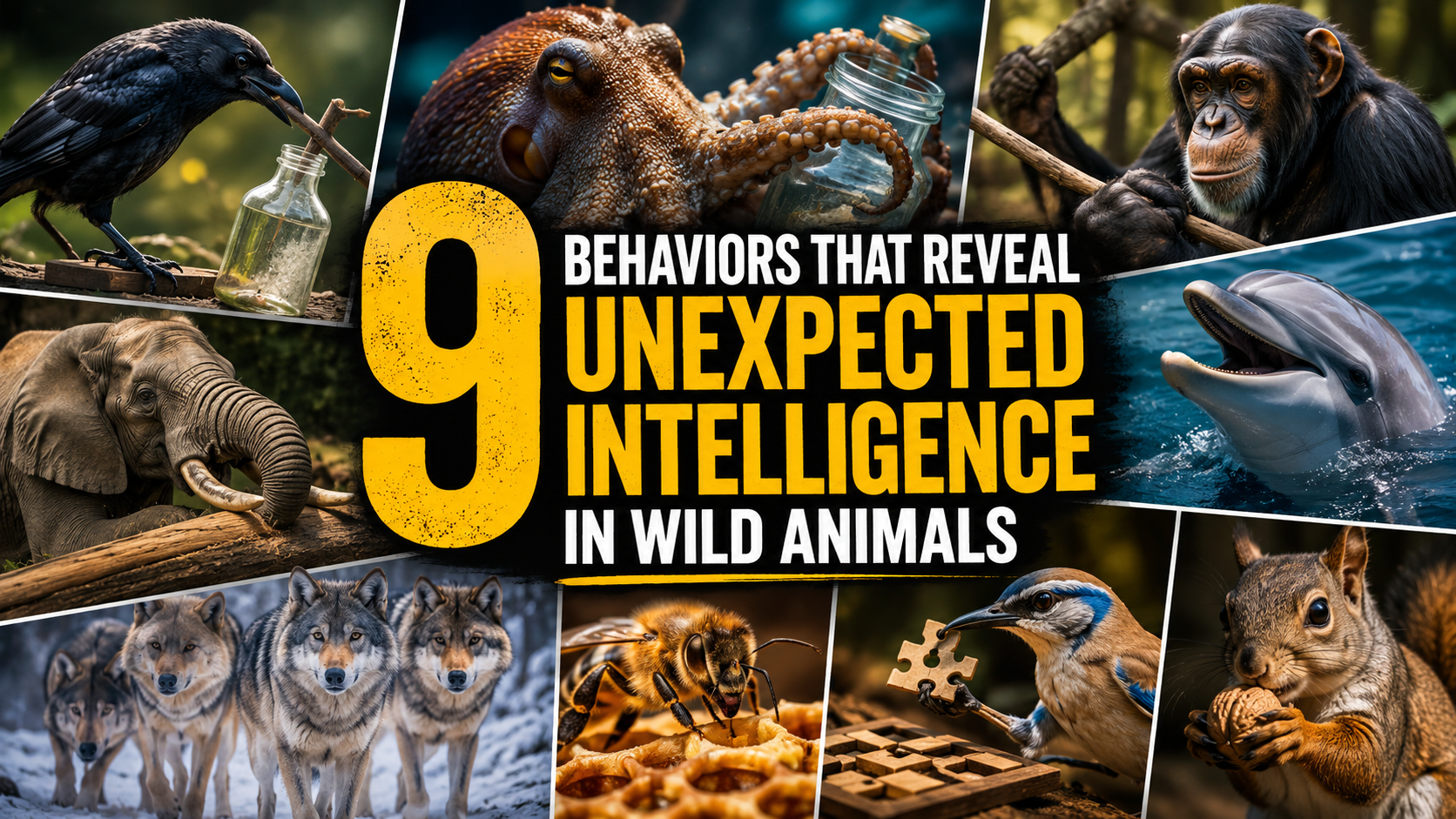
For a long time, humans viewed intelligence as a trait that set us apart from the rest of the animal kingdom. While people have always admired the strength of a lion, the speed of a cheetah, or the memory of an elephant, many assumed that complex thinking was largely a human ability. Modern research, however, is telling a different story.
Scientists studying wildlife around the world continue to uncover behaviors that suggest many animals are capable of far more sophisticated thinking than previously believed. From solving problems and using tools to forming social strategies and adapting to changing environments, animals demonstrate intelligence in ways that often go unnoticed.
Of course, animal intelligence does not look exactly like human intelligence. A crow isn’t solving algebra equations, and a dolphin isn’t writing novels. Instead, each species has evolved cognitive abilities that help it survive and thrive within its unique environment.
The more researchers observe wildlife, the clearer it becomes that intelligence takes many forms. Here are nine fascinating behaviors that reveal just how smart wild animals can be.
1. Using Tools to Solve Problems
One of the clearest signs of intelligence is the ability to use tools.
For decades, scientists believed humans were the only species capable of creating and using tools for specific purposes. That assumption changed dramatically when researchers observed wild chimpanzees using sticks to extract termites from mounds. Since then, dozens of species have joined the growing list of animal tool users.
Crows are among the most impressive examples. These birds have been seen bending twigs into hooks to retrieve food from narrow spaces. Some even use multiple tools in sequence, demonstrating an understanding of cause and effect.
Sea otters use rocks to crack open shellfish, while certain dolphins protect their snouts with marine sponges while searching for food on the ocean floor.
Tool use requires planning, flexibility, and an understanding of how objects can be manipulated to achieve a goal. That’s a remarkable level of problem-solving for any species.
2. Learning Through Observation
Many wild animals don’t rely solely on instinct. They learn by watching others.
This ability, known as observational learning, allows younger animals to acquire valuable skills without having to discover everything through trial and error.
Young chimpanzees spend years watching older group members use tools, forage for food, and navigate social relationships. Dolphins teach hunting techniques to their offspring, while birds often learn songs and migration routes from experienced adults.
Observational learning is important because it allows knowledge to spread through populations. In some species, behaviors can become traditions passed down from one generation to the next.
This kind of cultural learning demonstrates a level of cognitive sophistication that was once considered uniquely human.
3. Remembering Important Information for Years
Memory is one of the most powerful tools in the animal kingdom.
Many species rely on exceptional memory to survive. Elephants are famous for remembering migration routes, water sources, and social connections over long periods of time.
Research has shown that dolphins can recognize the signature whistles of former companions decades after being separated. Certain birds remember thousands of food storage locations months after hiding seeds.
Strong memory allows animals to make better decisions, avoid danger, and take advantage of past experiences.
When an animal remembers useful information and applies it later, it demonstrates a level of intelligence that extends beyond simple instinctive behavior.
4. Adapting to New Challenges
Life in the wild is unpredictable.
Weather patterns change, food sources disappear, predators emerge, and human development alters natural habitats. Animals that can adapt quickly often have the best chance of survival.
Urban foxes, raccoons, and coyotes provide excellent examples of adaptability. These animals have learned how to navigate city environments, locate new food sources, and avoid threats that did not exist in their ancestral habitats.
Some birds have even altered their nesting habits to accommodate modern structures and changing landscapes.
The ability to adjust behavior when circumstances change is a strong indicator of intelligence because it requires flexibility rather than rigid responses.
5. Communicating Complex Information
Communication is often associated with intelligence, and many animals possess surprisingly sophisticated ways of sharing information.
Honeybees perform intricate “waggle dances” to communicate the location of food sources to other members of the hive. Dolphins use unique whistles that help identify individual members within their social groups.
Elephants communicate using low-frequency sounds that can travel long distances across open landscapes. Certain primates use distinct vocal calls to warn others about specific types of predators.
Effective communication requires the ability to send, receive, and interpret information accurately. In social species, these communication systems can become incredibly advanced.
The complexity of these interactions reveals that many animals possess a much deeper understanding of their environment than people often assume.
6. Planning for Future Needs
For many years, researchers believed only humans could plan ahead for future situations.
Recent discoveries have challenged that belief.
Some animals appear capable of anticipating future needs and taking action before a problem arises. Certain birds store food in multiple locations for later use. Octopuses have been observed collecting coconut shells and carrying them across the ocean floor before assembling them into protective shelters.
Great apes have demonstrated behaviors suggesting they can select tools that may be useful later rather than immediately.
Planning ahead requires an animal to think beyond the present moment. This ability represents a significant cognitive achievement because it involves imagining future circumstances and preparing for them.
7. Forming Strategic Social Relationships
Intelligence isn’t only about solving physical problems. It also plays a major role in social interactions.
Many highly social animals must navigate complex relationships within their groups.
Chimpanzees often form alliances that help them gain access to resources or improve their social standing. Dolphins cooperate with specific partners during hunting activities. Wolves coordinate group efforts when pursuing prey.
These relationships require individuals to remember past interactions, evaluate trustworthiness, and adjust behavior based on changing circumstances.
Social intelligence is particularly valuable because success often depends on cooperation rather than competition alone.
Researchers increasingly recognize that managing social relationships may require cognitive skills just as sophisticated as those used in tool-making or problem-solving.
8. Displaying Curiosity and Exploration
Curiosity is frequently linked to intelligence because it encourages learning.
Many animals actively explore unfamiliar objects, environments, and situations. Rather than avoiding everything new, they investigate and gather information.
Crows are known for examining unusual objects. Elephants often inspect unfamiliar items using their trunks. Dolphins engage in playful exploration and appear eager to investigate new experiences.
Curiosity helps animals discover food sources, understand potential threats, and develop new problem-solving strategies.
Scientists believe exploratory behavior plays a critical role in innovation because it allows animals to learn beyond their immediate needs.
The willingness to investigate the unknown is often a sign of advanced cognitive flexibility.
9. Demonstrating Play Beyond Survival Needs
At first glance, play may seem unimportant.
However, researchers increasingly view play as a sign of intelligence because it helps animals develop physical, social, and cognitive skills.
Young lions wrestle and chase each other long before they become skilled hunters. Ravens engage in aerial games that appear to have no immediate survival purpose. Dolphins are famous for playful interactions involving objects, waves, and other animals.
Play often requires creativity, experimentation, and adaptability.
Some scientists believe it serves as a form of practice, allowing animals to develop skills they may need later in life.
The fact that many intelligent species devote time and energy to play suggests it offers significant developmental benefits.
Why Animal Intelligence Matters
Understanding animal intelligence isn’t simply about satisfying curiosity. It also changes how we view our relationship with the natural world.
For centuries, humans tended to place themselves at the top of a strict intelligence hierarchy. While people remain unique in many respects, modern science reveals that cognitive abilities are far more widespread than once believed.
Different species have evolved different forms of intelligence based on their ecological needs.
A dolphin’s social intelligence differs from a crow’s problem-solving ability. An elephant’s memory differs from an octopus’s adaptability. Yet each represents an impressive solution to the challenges of survival.
Recognizing these differences helps us appreciate the incredible diversity of life on Earth.
What Science Continues to Discover
Advances in technology are giving researchers unprecedented opportunities to study animal behavior.
GPS tracking, underwater cameras, drones, and artificial intelligence systems allow scientists to observe wildlife in ways that were impossible just a few decades ago.
As a result, discoveries continue to emerge.
Animals once thought to be guided entirely by instinct are demonstrating learning, planning, communication, and innovation. Researchers are uncovering new examples of problem-solving and social intelligence every year.
Many experts believe we are only beginning to understand the true extent of animal cognition.
Future discoveries may reveal even more surprising abilities hiding within the natural world.
Final Thoughts
Wild animals are far more intelligent than many people realize. Their intelligence may not mirror human thinking, but it is every bit as fascinating.
Whether they’re using tools, remembering complex information, forming alliances, planning for the future, or exploring their surroundings with curiosity, animals demonstrate remarkable cognitive abilities that continue to surprise scientists.
These behaviors remind us that intelligence comes in many forms. It isn’t defined by language, technology, or academic achievement alone. Instead, intelligence is the ability to learn, adapt, solve problems, and navigate life’s challenges successfully.
The more we study wildlife, the more we discover that nature is filled with minds working in extraordinary ways. And perhaps the greatest lesson of all is that intelligence is not something humans possess alone—it is woven throughout the living world in countless unexpected forms.







