Deep in the fossil record of human evolution lies a discovery that continues to reshape what we understand about survival, adaptation, and early human life. A 1.8 million-year-old skull—belonging to one of our ancient ancestors—offers a rare and unsettling glimpse into the challenges faced by early hominins.
Unlike written history, fossils do not tell stories directly. Instead, scientists must interpret bone structure, damage patterns, and anatomical features to reconstruct what life might have been like. This particular skull has become a key piece of evidence in understanding how early human relatives survived in a harsh and unpredictable world.
From injuries to evolutionary adaptations, the skull reveals more than just anatomy—it tells a story of endurance.
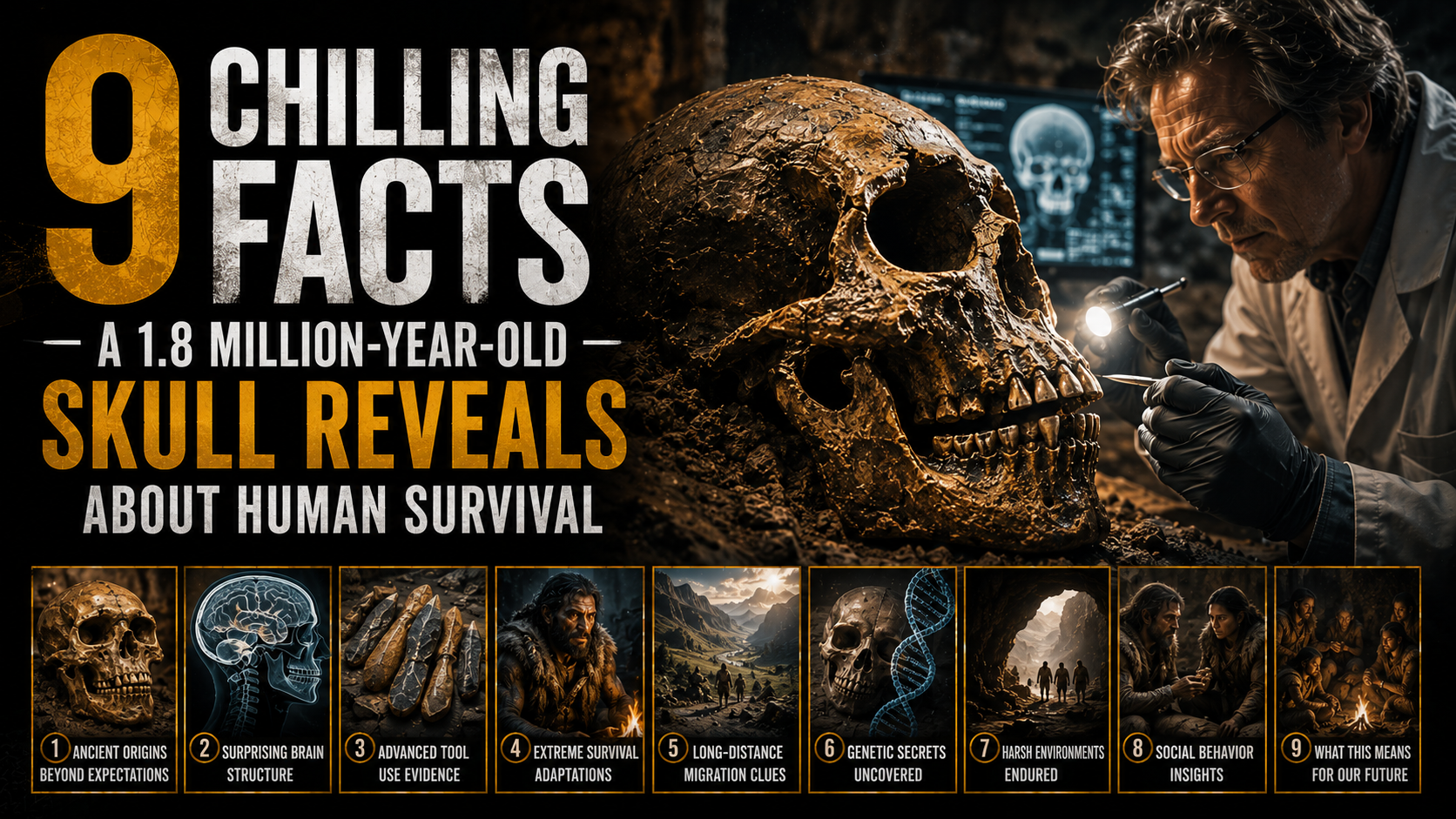
Here are nine chilling facts this 1.8 million-year-old skull reveals about human survival.
1. The Skull Shows Evidence of Extreme Environmental Pressure
One of the most striking findings is how the skull reflects survival under intense environmental stress.
Early humans lived in unstable climates with shifting temperatures and limited resources.
Bone structure suggests adaptation to physically demanding conditions.
These pressures shaped both survival strategies and physical evolution.
2. Signs of Trauma Suggest Frequent Physical Danger
The skull contains markings consistent with injuries or trauma sustained during life.
While not all damage can be precisely interpreted, patterns suggest exposure to dangerous environments.
This may include falls, animal encounters, or conflicts with other early humans.
Such evidence highlights how risky daily survival once was.
3. Braincase Structure Indicates Early Cognitive Development
The size and shape of the skull provide clues about brain evolution.
Although smaller than modern humans, the braincase shows gradual expansion compared to earlier species.
This suggests increasing cognitive abilities over time.
It marks an important step in human evolutionary history.
4. Jaw Strength Reflects a Tough, Unprocessed Diet
The skull’s jaw structure is robust and heavily built.
This indicates a diet consisting of raw, unprocessed foods such as roots, meat, and fibrous plants.
Chewing required significant physical strength.
This dietary pattern reflects survival before the development of cooking technology.
5. Bone Density Suggests a Physically Demanding Lifestyle
The skull’s thickness and density are unusually strong compared to later human species.
This likely reflects constant physical activity and environmental adaptation.
Early humans needed strong skeletal structures for survival tasks like hunting and migration.
Such durability was essential in harsh environments.
6. Evidence Points to Limited Medical or Social Care
Healed injuries on the skull suggest survival after physical trauma.
However, the nature of the healing indicates limited medical intervention.
Early humans may have relied on basic care from group members.
This offers insight into early forms of social cooperation.
7. The Skull Reveals Early Migration Patterns
Anatomical comparisons with other fossils suggest movement across regions.
These early humans were likely not stationary and adapted to changing environments.
Migration played a key role in survival and resource access.
This helped shape the spread of human ancestors across continents.
8. Environmental Conditions Were Likely Highly Unstable
The time period associated with the skull was marked by dramatic environmental shifts.
Ice ages, droughts, and resource scarcity would have been common challenges.
Such instability forced early humans to adapt quickly or perish.
The skull serves as a physical record of these survival conditions.
9. It Represents One of the Earliest Steps Toward Modern Humans
Perhaps the most important insight is evolutionary significance.
The skull belongs to a period when early human species were diverging and evolving rapidly.
It reflects traits that would eventually lead to modern Homo sapiens.
This makes it a crucial piece in the long story of human evolution.
Why This Ancient Skull Matters
This 1.8 million-year-old skull is more than a fossil—it is a record of survival under extreme conditions.
Each feature, from bone density to jaw strength, reveals how early humans adapted to a world far more dangerous than today.
It helps scientists understand not only where we came from, but how resilience shaped human evolution.
Fossils like this remind us that survival was never guaranteed—it was earned through adaptation, cooperation, and endurance.
The Role of Modern Science in Decoding Ancient Lives
Advances in archaeology and imaging technology allow researchers to study fossils in extraordinary detail.
3D scanning, microscopic analysis, and comparative anatomy help reconstruct behavior and environment.
These tools transform ancient bones into detailed historical records.
Without them, much of what we know about early human survival would remain hidden.
Final Thoughts
The 1.8 million-year-old skull offers a chilling yet fascinating glimpse into early human life.
It reveals a world defined by danger, adaptation, and slow but powerful evolutionary change.
From physical trauma to dietary habits and migration patterns, every detail contributes to a larger understanding of human survival.
In the end, this ancient skull is not just a remnant of the past—it is a reminder of the extraordinary journey that led to modern humanity.







