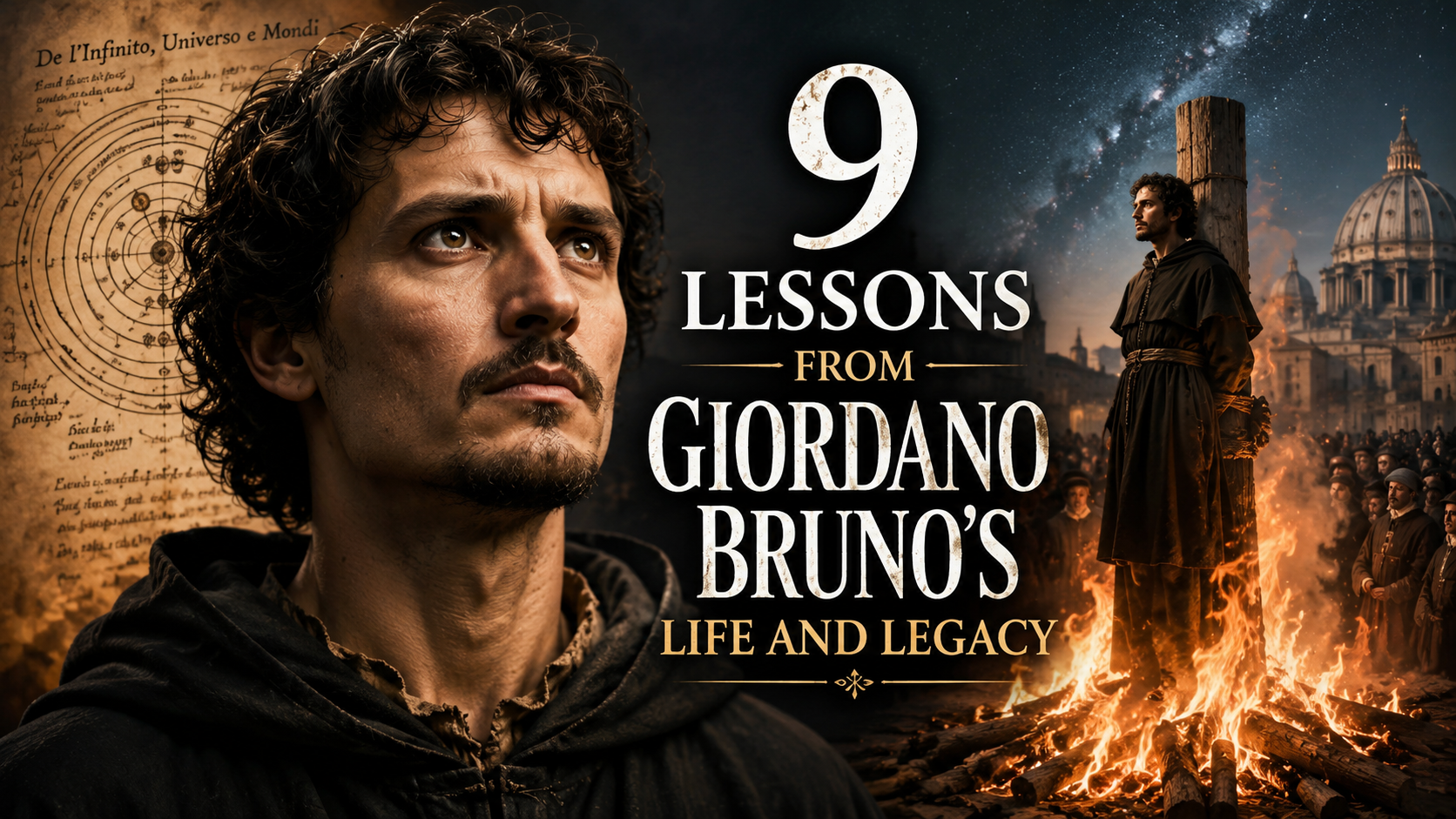
History remembers certain individuals not only for what they achieved during their lifetimes but also for the ideas they dared to defend. Giordano Bruno is one such figure. A philosopher, writer, and former Dominican friar, Bruno lived during one of the most turbulent intellectual periods in European history. His unconventional views about the universe, religion, and human knowledge placed him at odds with many of the powerful institutions of his time.
More than four centuries after his death, Bruno remains a symbol of intellectual courage, independent thinking, and the relentless pursuit of truth. Although many details of his life continue to be debated by historians, his willingness to challenge accepted beliefs has secured his place in the history of ideas.
Bruno’s story is not simply about conflict and controversy. It is also a powerful reminder of the value of curiosity, open-mindedness, and the freedom to explore new possibilities. Here are nine important lessons that can be drawn from Giordano Bruno’s life and enduring legacy.
1. Curiosity Can Change the Course of History
One of Bruno’s defining traits was an insatiable curiosity.
At a time when many people accepted traditional explanations without question, Bruno sought deeper answers about the nature of reality. He studied philosophy, theology, astronomy, and classical literature, constantly expanding the boundaries of his knowledge.
His curiosity led him to explore ideas that were considered radical for his era, including the possibility that the universe was far larger than most people imagined.
Bruno’s example reminds us that progress often begins with a simple willingness to ask questions others are afraid to consider.
2. Independent Thinking Requires Courage
Throughout his life, Bruno demonstrated a remarkable commitment to independent thought.
Rather than accepting prevailing opinions solely because they were widely held, he evaluated ideas on their merits and formed his own conclusions. This approach often brought him into conflict with authorities and institutions that expected conformity.
Independent thinking is rarely easy. It can involve criticism, resistance, and uncertainty. Yet Bruno’s life illustrates the importance of intellectual honesty and the courage to think for oneself.
Many of the advances that shape modern society began with individuals willing to challenge conventional wisdom.
3. Great Ideas Often Face Resistance
History is filled with examples of groundbreaking ideas that initially encountered opposition.
Bruno’s proposals about the cosmos challenged long-established assumptions about humanity’s place in the universe. While some of his views were speculative, they encouraged broader discussions about astronomy and the structure of reality.
New ideas frequently disrupt established systems and beliefs. As a result, they are often met with skepticism or outright hostility before gaining acceptance.
Bruno’s experiences serve as a reminder that resistance does not automatically mean an idea lacks value. Sometimes it reflects the difficulty of changing deeply rooted perspectives.
4. The Search for Knowledge Is a Lifelong Journey
Bruno never limited himself to a single field of study.
He explored philosophy, memory systems, religion, cosmology, literature, and natural science. His intellectual interests crossed disciplinary boundaries long before such an approach became common.
This broad pursuit of learning highlights the value of intellectual versatility. Knowledge often grows when ideas from different fields interact and inspire one another.
Bruno’s life encourages us to remain lifelong learners, continuously seeking new insights rather than assuming we already know enough.
5. Imagination Plays a Role in Discovery
Many people associate discovery exclusively with facts and evidence. However, imagination often serves as the first step toward understanding something new.
Bruno envisioned a universe that extended far beyond the limits recognized by many scholars of his day. He speculated that countless stars might be distant suns and that other worlds could exist throughout the cosmos.
While not all of his ideas were scientifically verified during his lifetime, his willingness to imagine possibilities beyond accepted boundaries reflected an important aspect of human progress.
Innovation frequently begins when someone dares to imagine what others consider impossible.
6. Freedom of Thought Matters
One of the most enduring aspects of Bruno’s legacy is his association with intellectual freedom.
His life raises important questions about society’s treatment of unconventional ideas and the importance of allowing open inquiry. The ability to explore, debate, and examine competing viewpoints is fundamental to intellectual and scientific advancement.
Modern academic and scientific institutions depend heavily on principles of free investigation and open discussion.
Bruno’s story continues to be cited as a reminder that restricting ideas can hinder the growth of knowledge and understanding.
7. Reputation Can Change Over Time
During his lifetime, Bruno was a controversial figure. Today, many people view him very differently.
Historical reputations often evolve as societies reassess past events through new perspectives. Individuals once criticized or misunderstood may later be recognized for their contributions or influence.
Bruno’s legacy demonstrates that public opinion is not fixed. The significance of a person’s ideas may become clearer long after their lifetime.
This lesson encourages humility when evaluating new concepts or unconventional thinkers in the present day.
8. Intellectual Legacy Can Outlive Physical Life
Although Bruno died in 1600, discussions about his ideas continue more than four centuries later.
Books, speeches, debates, and historical studies still examine his contributions to philosophy and intellectual history. His influence extends far beyond the circumstances of his own era.
This illustrates a powerful truth: ideas can outlast generations.
The impact of a thinker is not measured solely by immediate success but also by the ability of their work to inspire future inquiry and discussion.
Bruno’s continued relevance highlights the lasting power of intellectual contributions.
9. The Universe Is Bigger Than We Imagine
Perhaps the most famous aspect of Bruno’s thought was his belief that the universe was vastly larger and more complex than many people assumed.
He envisioned an immense cosmos filled with countless stars and potentially innumerable worlds. While modern astronomy has advanced far beyond the knowledge available in the sixteenth century, discoveries over the past several centuries have revealed a universe far larger than anyone of Bruno’s era could directly observe.
Today, astronomers know that our galaxy contains billions of stars and that the observable universe contains billions of galaxies.
Bruno’s willingness to think beyond accepted limits reminds us that human understanding is always evolving. There may still be discoveries awaiting us that will transform our view of reality.
Who Was Giordano Bruno?
Giordano Bruno was born in 1548 near Naples, Italy. He entered the Dominican Order as a young man and received extensive education in philosophy and theology.
Over time, his intellectual interests expanded beyond traditional religious studies. He traveled extensively throughout Europe, teaching, writing, and engaging in philosophical debates.
Bruno became known for his unconventional ideas regarding cosmology, metaphysics, and religion. His writings explored subjects ranging from memory techniques to the nature of the universe.
His life came to a tragic end in 1600, but his story continued to resonate through subsequent centuries, particularly during periods emphasizing scientific inquiry and freedom of thought.
Why Bruno Still Matters Today
In the modern world, Bruno’s legacy remains relevant because many of the issues he confronted continue to exist in different forms.
Questions about intellectual freedom, scientific exploration, independent thinking, and the willingness to challenge established assumptions remain central to education and innovation.
Bruno is often remembered not because every idea he proposed was correct, but because he exemplified a determination to pursue understanding despite significant obstacles.
His story encourages individuals to remain curious, question assumptions, and engage thoughtfully with new ideas.
Conclusion
Giordano Bruno’s life offers lessons that extend far beyond the historical circumstances of the Renaissance. His commitment to curiosity, imagination, lifelong learning, and intellectual independence continues to inspire people across disciplines and generations.
From the importance of free inquiry to the value of thinking beyond accepted boundaries, Bruno’s legacy serves as a reminder that progress often begins with a question. Whether in science, philosophy, education, or everyday life, his story highlights the enduring power of ideas and the human desire to understand the universe more deeply.
More than four centuries after his death, Giordano Bruno remains a symbol of courage in the pursuit of knowledge—a legacy that continues to resonate in an age still driven by discovery.







