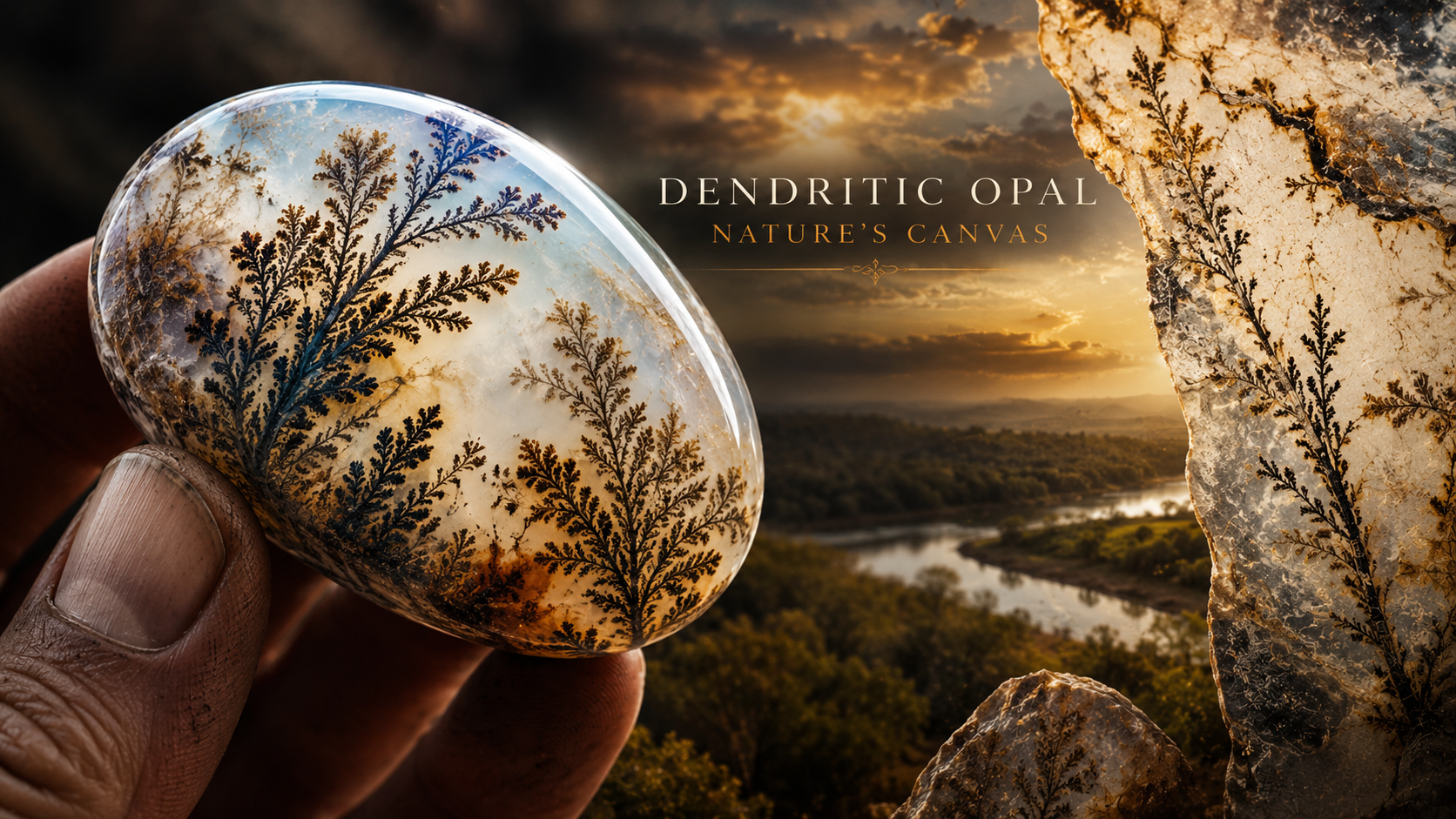
Among the many fascinating gemstones found in nature, dendritic opal stands out for its artistic appearance and mysterious formations. Often described as “nature’s canvas,” this stone is admired not only for its beauty but also for the intricate patterns that seem to form naturally within it.
Unlike traditional opals known for their rainbow-like play of color, dendritic opal is more subtle in tone but visually striking in design. Its signature feature is the dark, tree-like or fern-like inclusions that appear to grow inside the stone, almost like miniature landscapes frozen in time.
These natural patterns have made dendritic opal a favorite among collectors, jewelers, and mineral enthusiasts who appreciate the idea of art created entirely by geological processes.
Here are nine reasons why dendritic opal is often called nature’s canvas.
1. Its Tree-Like Patterns Resemble Natural Art
The most defining feature of dendritic opal is its branching, tree-like inclusions.
These patterns form delicate shapes that look like forests, roots, or underwater scenes trapped inside stone.
Because of their organic appearance, they are often compared to brushstrokes on a painting.
This natural artistry is one of the main reasons the stone is associated with creative expression.
2. The “Dendrites” Are Created by Mineral Growth
The intricate patterns inside dendritic opal are not actually plant material, despite their appearance.
They are formed by manganese or iron oxide minerals that crystallize in branching structures.
As these minerals seep into the stone over time, they create fine, tree-like formations.
This geological process gives the stone its signature artistic look.
3. No Two Stones Are Ever Identical
One of the most appealing qualities of dendritic opal is its uniqueness.
Because the patterns form naturally and randomly, each stone has a completely different design.
Some resemble forests, while others look like abstract ink paintings or frozen landscapes.
This individuality makes every piece feel like a one-of-a-kind artwork.
4. It Combines Simplicity With Intricate Detail
Unlike brightly colored gemstones, dendritic opal often has a neutral or milky background.
This simplicity allows the dark inclusions to stand out clearly.
The contrast between the background and the patterns creates a visually balanced composition.
This combination of simplicity and complexity is what gives the stone its artistic appeal.
5. It Forms Through Slow Geological Processes
Dendritic opal develops over thousands or even millions of years.
Silica-rich water slowly deposits minerals into rock cavities, while trace elements create branching patterns.
This extremely gradual process contributes to the stone’s detailed and delicate appearance.
The long formation time adds to its sense of natural artistry.
6. It Often Resembles Miniature Landscapes
Many people describe dendritic opal as looking like tiny landscapes trapped inside stone.
Some specimens resemble snowy forests, while others look like rivers, plants, or aerial views of terrain.
This resemblance to natural scenery strengthens its reputation as a “canvas” created by the Earth.
It encourages viewers to interpret each stone as a unique natural painting.
7. It Has Long Been Associated With Symbolism
Throughout history, dendritic opal has been linked to growth, grounding, and connection to nature.
The tree-like patterns are often interpreted as symbols of life, stability, and expansion.
While these meanings are not scientific, they contribute to the stone’s cultural and spiritual appeal.
This symbolic layer adds emotional depth to its visual beauty.
8. It Is Popular in Jewelry for Its Artistic Appeal
Dendritic opal is frequently used in jewelry such as pendants, rings, and earrings.
Its unique patterns make each piece feel like wearable art.
Designers often highlight the natural inclusions rather than hiding them, allowing the stone’s “canvas-like” appearance to take center stage.
This makes it especially popular among those who prefer organic, nature-inspired designs.
9. It Encourages Appreciation of Natural Creativity
Perhaps the most important reason dendritic opal is called nature’s canvas is the way it changes how people view geology.
Instead of seeing stone as something static and lifeless, viewers begin to recognize the dynamic processes that shape it.
The patterns encourage appreciation for the complexity and creativity of natural systems.
In this way, the stone becomes a reminder that nature itself is an artist.
Why Dendritic Opal Captivates Collectors and Artists
Beyond its scientific formation, dendritic opal appeals strongly to human imagination.
Its patterns invite interpretation, much like abstract art.
Some see forests, others see galaxies or rivers—each interpretation is personal and subjective.
This open-ended visual storytelling is part of what makes the stone so captivating.
The Intersection of Science and Art
Dendritic opal sits at a unique intersection between geology and artistic expression.
Scientifically, it is a product of mineral deposition and chemical processes.
Artistically, it resembles a carefully composed painting created without human intervention.
This blend of science and aesthetics is what makes it especially fascinating.
Final Thoughts
Dendritic opal earns its nickname “nature’s canvas” because it embodies the beauty of natural creativity.
From its tree-like inclusions and geological origins to its resemblance to miniature landscapes, every aspect of the stone reflects artistic complexity formed by the Earth itself.
It reminds us that nature does not just create structure—it also creates art.
In the end, dendritic opal stands as a quiet but powerful example of how time, chemistry, and geology can combine to produce something truly extraordinary.







