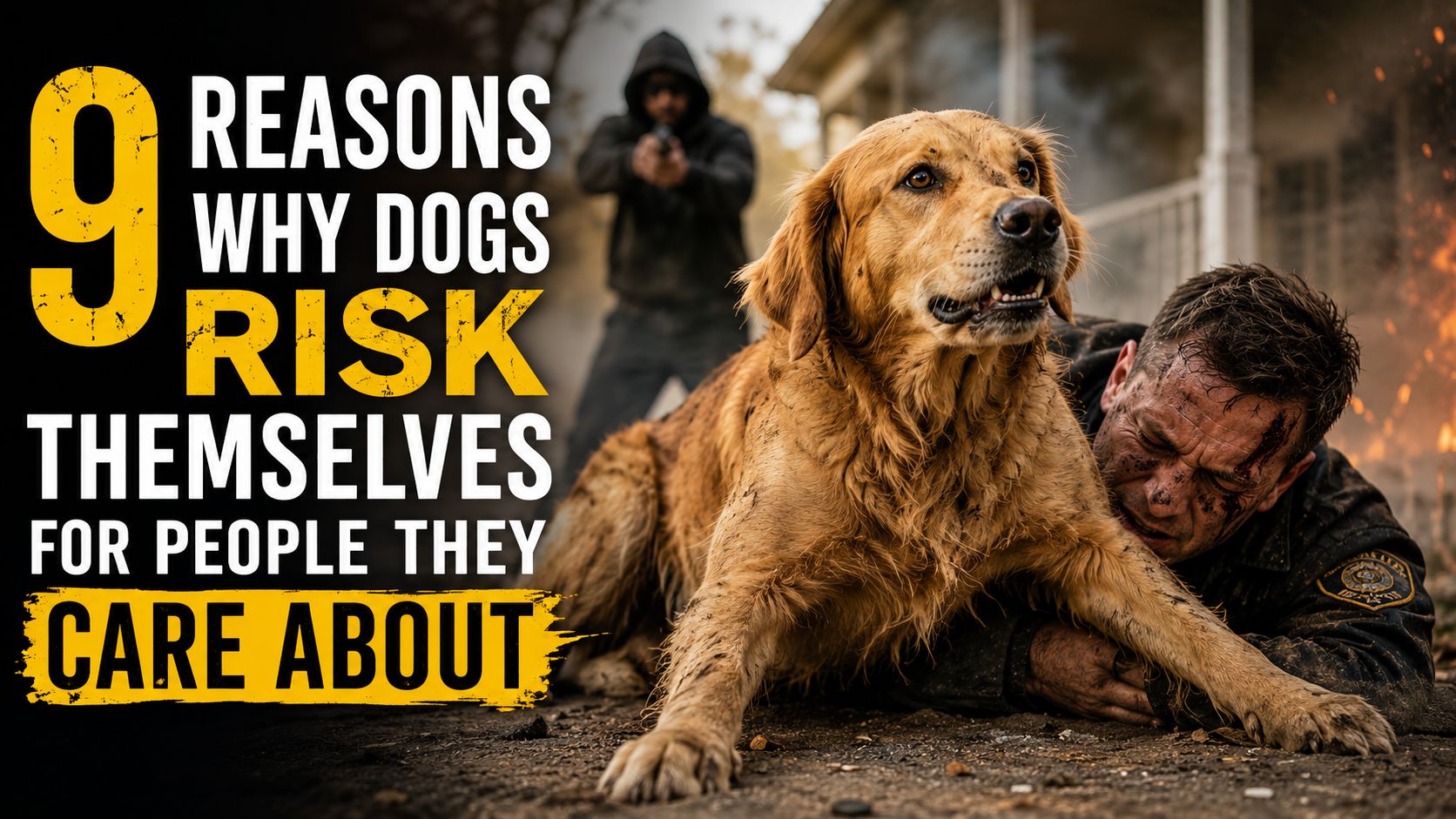
Few stories capture the human heart quite like tales of canine loyalty. Time and time again, reports emerge of dogs stepping into dangerous situations, alerting families to emergencies, protecting children from harm, or refusing to leave the side of someone in need.
To many people, these acts seem almost unbelievable. Why would an animal willingly place itself in danger for a human being?
The answer lies in a unique combination of biology, emotion, instinct, and thousands of years of shared history between dogs and humans. While dogs may not understand risk in the same way people do, their behavior often reflects deep social bonds and an extraordinary capacity for attachment.
Researchers continue to study canine behavior, and the findings consistently reveal that dogs are far more emotionally aware than many people once believed. They recognize human emotions, respond to distress signals, and form meaningful relationships with the people they trust.
So what drives a dog to act bravely when someone they care about is in trouble? Here are nine powerful reasons dogs sometimes put themselves at risk for the humans they love.
1. Dogs Form Deep Emotional Attachments
One of the strongest explanations is also the simplest: dogs become emotionally attached to people.
For dogs, family isn’t defined by species. Once a bond is established, many dogs view their owners as part of their social group.
Studies have shown that dogs can experience emotional responses similar to those seen in close human relationships. They often seek comfort from their owners when stressed and show signs of excitement when reunited after a separation.
Because these bonds run so deep, a dog’s response to danger often mirrors what we see among close family members. When someone important appears threatened, many dogs instinctively react.
Their actions may not be the result of calculated heroism. Instead, they stem from a powerful emotional connection that motivates them to stay close and intervene when necessary.
2. Protective Instincts Are Part of Their Evolution
Dogs are descendants of wolves, highly social animals that survived through cooperation and group protection.
Although modern dogs differ significantly from their wild ancestors, many protective instincts remain.
Throughout history, humans also selectively bred dogs for guarding homes, livestock, and communities. As a result, certain breeds may display particularly strong protective tendencies.
However, protective behavior isn’t limited to traditional guard dogs.
Even small companion breeds often show a desire to shield family members from perceived threats.
When dogs sense danger, they may bark, position themselves between a person and the threat, or move toward the source of concern.
These reactions reflect instincts that have been reinforced over countless generations.
3. Dogs Can Sense Human Distress
Many dog owners have experienced moments when their pet seemed to know something was wrong before a word was spoken.
This isn’t simply imagination.
Dogs are remarkably skilled at reading human body language, facial expressions, tone of voice, and even scent changes associated with stress.
Research suggests dogs can detect shifts in human emotional states, including fear, anxiety, sadness, and excitement.
When a person is frightened or injured, a dog may recognize subtle signals that indicate distress.
In response, many dogs become more attentive, stay close, or attempt to provide comfort.
In urgent situations, this heightened awareness may contribute to actions that appear courageous or self-sacrificing.
4. Loyalty Is Built Through Daily Experiences
Loyalty doesn’t develop overnight.
Every walk, feeding, play session, and moment of affection helps strengthen the relationship between a dog and its owner.
Over time, these repeated positive interactions create trust.
A dog learns who provides safety, care, and companionship. In return, many dogs develop a strong desire to remain connected to that person.
This loyalty becomes especially visible during difficult moments.
When danger arises, a dog isn’t responding to a stranger. They’re responding to someone who has become an important part of their daily life.
The stronger the relationship, the stronger the motivation to stay close when challenges appear.
5. Dogs Often Prioritize Their Social Group
In the animal world, survival frequently depends on cooperation.
Dogs are social creatures by nature. They evolved to live and work within groups where members relied on one another.
Because of this, many dogs naturally prioritize the well-being of those they consider part of their pack.
While the term “pack” is sometimes oversimplified, the underlying concept remains important.
Dogs form social bonds and often behave in ways that support those relationships.
This can include guarding, alerting others to danger, remaining nearby during illness, or attempting to intervene when they perceive a threat.
From a dog’s perspective, helping a trusted companion may simply feel like the natural thing to do.
6. They Respond Instinctively in Emergencies
Not every act of canine bravery is carefully thought out.
In many cases, dogs react immediately to a situation without hesitation.
A loud noise, sudden movement, aggressive stranger, or apparent threat can trigger an instinctive response.
Unlike humans, who often pause to evaluate risks and consequences, dogs frequently act based on immediate perception.
This rapid decision-making can sometimes place them directly in harm’s way.
While their actions may look heroic from a human perspective, the dog may simply be responding to an urgent situation as their instincts dictate.
Their willingness to react quickly is one reason so many remarkable stories of canine courage exist.
7. Dogs Have an Extraordinary Capacity for Empathy
Scientists continue to debate the exact nature of empathy in animals, but there is growing evidence that dogs possess a remarkable ability to respond to human emotions.
Dogs often approach crying individuals, offer physical contact when someone appears upset, and adjust their behavior in response to emotional cues.
Many pet owners describe their dogs as seeming to “know” when comfort is needed.
While dogs may not fully understand the complexities of human experiences, they are highly sensitive to emotional changes.
This sensitivity helps explain why some dogs stay close to injured people, refuse to leave someone who is sick, or appear determined to provide support during difficult situations.
Their response may be driven by a genuine emotional connection rather than simple training.
8. Thousands of Years of Partnership Shaped Their Behavior
The relationship between dogs and humans is unlike any other partnership in the animal kingdom.
For an estimated 15,000 to 30,000 years, humans and dogs have lived, worked, and evolved alongside one another.
Throughout that time, dogs that cooperated effectively with humans were more likely to thrive.
Over generations, this partnership helped shape many of the traits we admire today.
Dogs became increasingly skilled at understanding human signals, anticipating behavior, and responding to our needs.
This long history created a unique bond that continues to influence how dogs interact with people.
In many ways, modern dogs are biologically and socially wired to pay close attention to the humans around them.
9. Love May Be Simpler Than We Think
Sometimes scientific explanations only tell part of the story.
Anyone who has shared life with a dog understands that their affection often feels genuine, uncomplicated, and unwavering.
Dogs don’t care about social status, career achievements, or material possessions.
They care about connection.
They celebrate your return home.
They sit beside you during difficult days.
They offer companionship without judgment.
When a dog places itself between danger and a loved one, part of the explanation may simply be that the relationship matters deeply to them.
While researchers can identify instincts, emotional responses, and evolutionary influences, many dog owners would describe the motivation in one word: love.
What Can Humans Learn From Canine Loyalty?
Stories of brave dogs resonate because they highlight qualities people admire.
Loyalty, courage, compassion, and devotion are traits that strengthen relationships and communities.
Dogs demonstrate these qualities in remarkably straightforward ways.
They show up consistently.
They remain loyal through challenges.
They offer support without expecting recognition.
These behaviors remind us that meaningful relationships are built through trust, care, and presence.
In a world often focused on individual achievement, dogs provide a powerful example of connection and commitment.
The Science Behind the Human-Dog Bond
Modern research continues to uncover fascinating insights into why dogs and humans connect so deeply.
Studies have found that positive interactions between dogs and owners can increase oxytocin levels in both species. Often called the “bonding hormone,” oxytocin plays an important role in social attachment and trust.
This biological response helps explain why relationships with dogs can feel so emotionally significant.
The connection isn’t only psychological. It has measurable physiological effects as well.
This shared chemistry may strengthen the emotional bonds that motivate dogs to remain close and protective during challenging situations.
Final Thoughts
Stories of dogs risking themselves for people capture our attention because they reveal something extraordinary about the bond between humans and animals.
Whether driven by instinct, loyalty, empathy, social attachment, or a combination of all four, dogs repeatedly demonstrate a willingness to stand beside the people they care about.
Their actions remind us that courage often comes from connection.
A dog doesn’t calculate fame, recognition, or reward before acting. Instead, many simply respond to the relationships that matter most to them.
That unwavering devotion is one of the reasons dogs have earned their reputation as humanity’s most loyal companions—and why stories of canine bravery continue to inspire people around the world.







