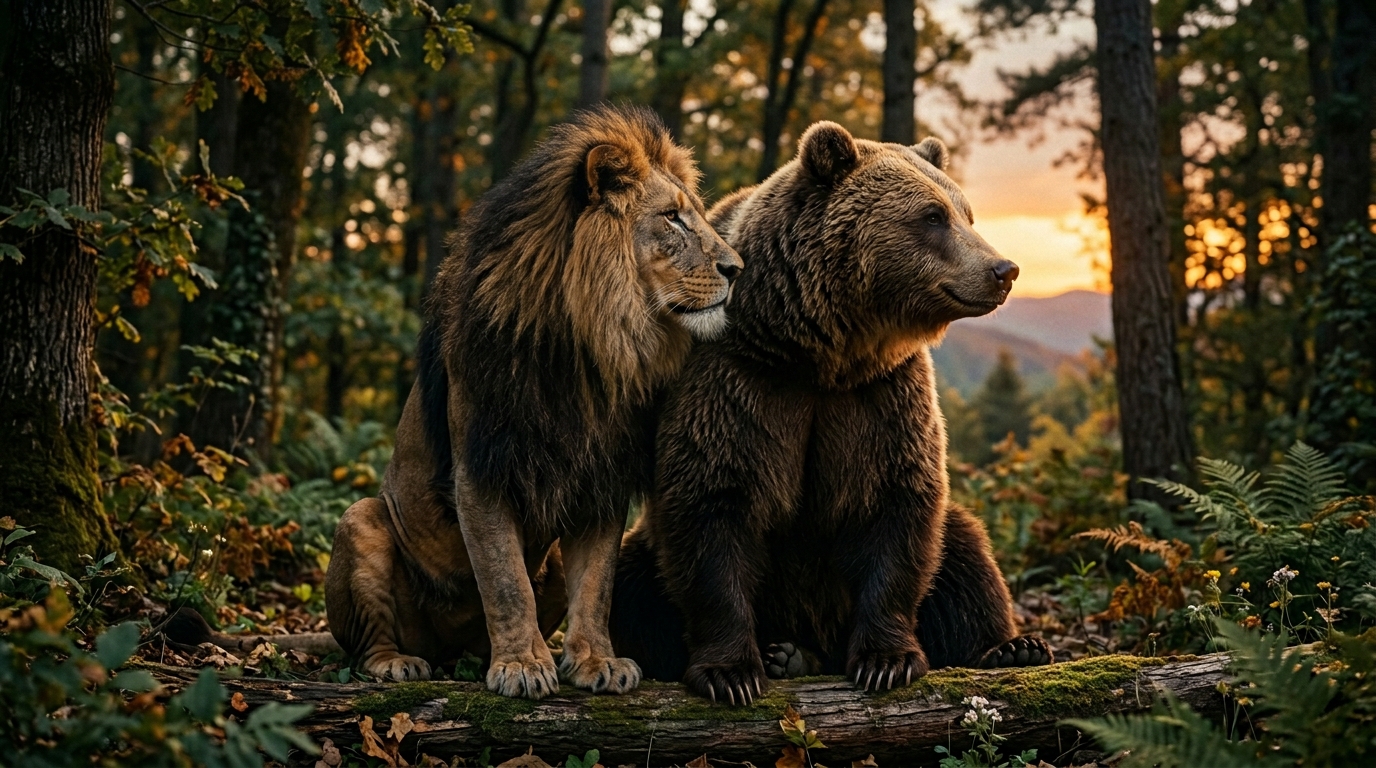
When most people think about lions and bears, they imagine two powerful predators living in entirely different parts of the world. Lions are often associated with the grasslands and savannas of Africa, while bears are found across forests, mountains, and Arctic regions in North America, Europe, and Asia. Because their natural habitats rarely overlap, few people would ever expect these animals to form meaningful relationships.
Yet in wildlife sanctuaries, rescue centers, and zoological settings, there have been remarkable cases where lions and bears developed bonds that captured global attention. These unusual friendships have fascinated animal lovers and researchers alike, offering a glimpse into the complexity of animal behavior and social adaptation.
While scientists remain careful about interpreting animal relationships through human emotions, these interactions demonstrate that animals can sometimes behave in ways that challenge expectations. Here are nine surprising facts about lions and bears forming unlikely friendships.
1. Lions and Bears Rarely Meet in the Wild
One reason these friendships attract so much attention is that lions and bears typically live in completely different environments.
Modern lion populations are found primarily in Africa, with a small population existing in India. Bears, meanwhile, inhabit regions across the Northern Hemisphere, including forests, tundra, and mountain ecosystems.
Because their natural ranges rarely overlap, opportunities for interaction are extremely limited.
This makes every documented friendship between the two species particularly unusual and fascinating.
2. Many Famous Friendships Began Through Rescue Efforts
Some of the most well-known lion-bear friendships originated in animal rescue situations.
Young animals rescued from neglect, illegal ownership, or difficult conditions occasionally grow up together in sanctuaries. Sharing early experiences can create strong social connections that persist into adulthood.
These relationships often develop because the animals view one another as familiar companions during critical developmental periods.
The shared environment plays an important role in shaping their behavior.
3. Social Bonds Can Extend Beyond Species Boundaries
Scientists have long known that many animals form strong social bonds within their own species.
What makes lion-bear friendships remarkable is that these connections appear to cross species lines. Researchers studying animal behavior have documented numerous examples of interspecies relationships involving mammals, birds, and even reptiles.
While the motivations behind these interactions are not always fully understood, they demonstrate that social behavior can be surprisingly flexible.
Animals sometimes develop companionships in unexpected ways.
4. Early Life Experiences Can Influence Relationships
For many animals, experiences during youth significantly affect future social behavior.
When young animals grow up together, they often become accustomed to one another’s presence. Familiarity can reduce fear and encourage cooperative interactions.
In rescue environments, lions and bears may spend months or years sharing space under careful supervision. These prolonged periods of contact can contribute to the formation of strong social bonds.
Researchers frequently emphasize the importance of developmental experiences when studying animal relationships.
5. Both Species Possess Complex Social and Cognitive Abilities
Although lions and bears differ in many ways, both are intelligent mammals capable of sophisticated behavior.
Lions live in social groups known as prides and engage in cooperative activities such as hunting and territory defense. Bears are generally more solitary, but they demonstrate impressive learning abilities, memory, and problem-solving skills.
These cognitive strengths may help explain why individuals from both species can adapt to unusual social situations.
Their behavioral flexibility continues to interest scientists.
6. Friendship Stories Help Change Public Perceptions of Animals
Stories involving unlikely animal companions often capture public imagination because they challenge stereotypes.
People tend to view large predators primarily through the lens of competition and aggression. While these traits are important aspects of their behavior, they do not tell the entire story.
Observing lions and bears resting together, playing, or showing tolerance toward one another reveals a different side of animal life.
Such stories encourage people to appreciate the complexity of wildlife behavior.
7. Animal Personalities May Play a Role
Research increasingly suggests that individual animals possess distinct personalities.
Some animals appear more curious, tolerant, playful, or social than others. These personality differences can influence how individuals respond to members of their own species and to other animals.
In cases involving lion-bear friendships, certain individuals may simply be more inclined toward social interaction.
Personality is becoming an increasingly important area of study in animal behavior science.
8. These Relationships Are Rare Rather Than Typical
While stories of lion-bear friendships are inspiring, it is important to recognize that they are unusual exceptions.
Lions and bears have different ecological roles, behavioral patterns, and natural histories. Most individuals would never encounter one another under natural conditions.
Researchers caution against assuming that all animals of different species can or should be housed together.
Successful interspecies relationships depend on specific circumstances, careful management, and the characteristics of the animals involved.
Their rarity is part of what makes them so memorable.
9. They Remind Us That Animal Behavior Is More Complex Than We Realize
Perhaps the most important lesson from these friendships is that animal behavior often defies simple explanations.
Nature is filled with examples of unexpected cooperation, curiosity, and companionship. While scientists continue studying the factors that contribute to such relationships, observations of lions and bears interacting peacefully highlight the remarkable adaptability of living creatures.
The more researchers learn about animals, the clearer it becomes that behavior exists along a spectrum far more complex than once believed.
These friendships offer valuable opportunities to explore that complexity.
Why Unlikely Animal Friendships Fascinate People
Stories about unexpected animal companions consistently attract global attention.
Part of the appeal comes from surprise. People naturally expect animals with different lifestyles, appearances, and evolutionary histories to remain separate. When those expectations are challenged, curiosity follows.
Another factor is the emotional resonance of companionship itself.
Whether between humans or animals, strong social connections are universally understood and appreciated. Observing such bonds in unexpected places often inspires feelings of wonder and optimism.
What Scientists Say About Interspecies Relationships
Researchers approach animal friendships carefully.
Rather than assuming human-like emotions, scientists focus on observable behaviors such as proximity, grooming, play, cooperation, and repeated social interaction. These behaviors can provide valuable insights into how animals form and maintain relationships.
Interspecies interactions are influenced by numerous factors, including:
- Early social experiences
- Environmental conditions
- Individual personality
- Resource availability
- Learning opportunities
Each relationship is unique and must be evaluated within its specific context.
Famous Examples of Unlikely Animal Companions
Lions and bears are not the only animals known to form surprising relationships.
Researchers and caretakers have documented:
- Dogs bonding with deer.
- Cats raising orphaned squirrels.
- Elephants interacting gently with smaller species.
- Dolphins assisting injured marine animals.
- Primates caring for unrelated young animals.
These examples illustrate the diversity of social behavior found throughout the animal kingdom.
Each case provides opportunities to learn more about cognition, communication, and adaptability.
The Role of Sanctuaries and Rescue Centers
Many unusual animal friendships emerge in environments where rescued animals receive long-term care.
Sanctuaries and rehabilitation facilities often provide opportunities for animals from different backgrounds to encounter one another under controlled conditions. Careful observation allows staff to monitor compatibility and ensure welfare remains the top priority.
In some cases, animals develop strong social preferences that persist for years.
These settings have contributed significantly to our understanding of interspecies relationships.
What These Friendships Teach Us
The story of lions and bears forming friendships highlights several important lessons.
First, animal behavior is often more flexible than people assume. Second, social bonds can develop under circumstances that challenge conventional expectations. Third, individual experiences matter.
No two animals are exactly alike.
Understanding these realities helps researchers build a more accurate picture of how animals navigate their social worlds.
Final Thoughts
The idea of lions and bears forming friendships may sound like something from a storybook, yet real-world examples have demonstrated that such relationships can occur under the right circumstances. These unusual bonds have fascinated scientists, animal caretakers, and wildlife enthusiasts because they challenge traditional assumptions about animal behavior.
The nine facts explored here reveal why these friendships continue to capture attention. From their rarity and origins in rescue environments to the role of intelligence, personality, and social flexibility, each factor contributes to a deeper understanding of animal relationships.
Most importantly, these stories remind us that nature remains full of surprises. The more we learn about animals, the more we discover that their lives are often richer, more complex, and more unpredictable than we once imagined. In a world where lions and bears can sometimes become companions, there is always something new waiting to be understood.







