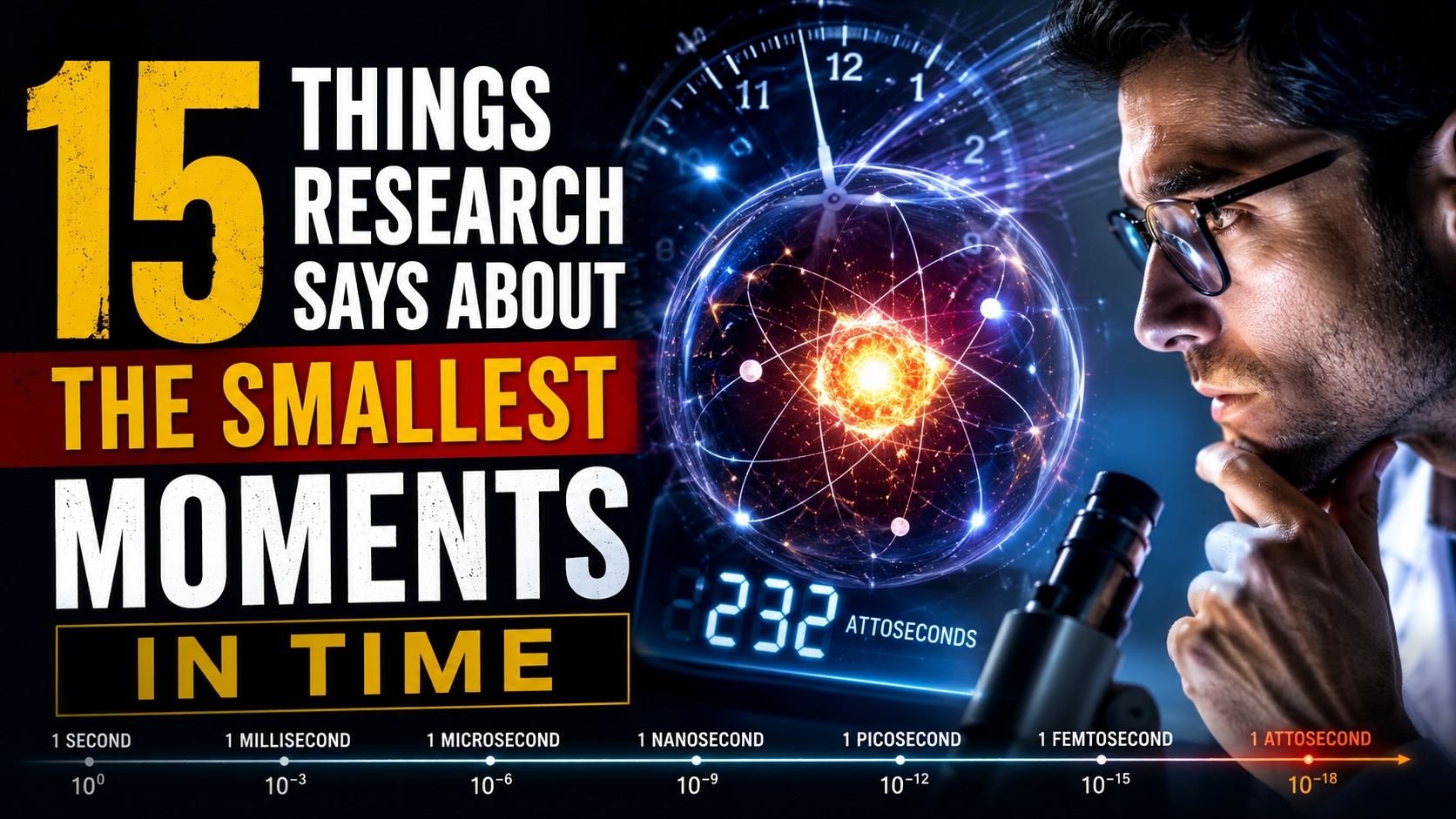
Time feels simple in everyday life. We wake up, check the clock, plan our day, and watch minutes turn into hours. Yet when scientists look closely at time, they discover something far more mysterious. Beneath the seconds we can count lies a world of incredibly tiny intervals—moments so brief that they challenge our understanding of reality itself.
Modern physics has revealed that some of the most important events in the universe happen in unimaginably small fractions of a second. Electrons move, atoms interact, light travels, and quantum particles exchange information at speeds that seem impossible to comprehend.
Recent breakthroughs have even allowed researchers to measure events lasting only attoseconds—one quintillionth of a second. To appreciate how small that is, there are more attoseconds in a single second than there are seconds in the age of the universe.
These discoveries are changing how scientists think about time, matter, energy, and the fundamental laws of nature. Here are 15 fascinating things research has revealed about the smallest moments in time.
1. A Second Is Far Larger Than We Tend to Think
Most people view a second as a tiny unit of time.
From a scientific perspective, however, a second is enormous.
Within a single second, light can travel around Earth more than seven times. Trillions upon trillions of atomic events occur. Countless chemical reactions begin and end.
What feels instantaneous to us contains an astonishing amount of activity.
In many ways, a second is less like a moment and more like an entire universe of microscopic events.
2. Scientists Can Measure Attoseconds
For centuries, measuring extremely short intervals seemed impossible.
Today, advanced laser technology allows researchers to study events occurring within attoseconds.
An attosecond equals:
0.000000000000000001 seconds.
Written another way, it is one-billionth of a billionth of a second.
This level of precision has opened entirely new fields of scientific research, allowing scientists to observe electron behavior directly for the first time.
3. Electrons Move on Attosecond Timescales
Electrons are among the fastest-moving components of matter.
When electrons shift positions around atomic nuclei, their movements often occur within attoseconds.
For many years, scientists could only infer these movements through indirect observations.
Today, attosecond laser pulses make it possible to capture snapshots of electron motion, creating what some researchers describe as movies of atomic activity.
This capability has transformed our understanding of chemistry and physics.
4. The Fastest Events Often Shape Everything Else
Many of nature’s most important processes begin with extremely brief events.
Photosynthesis, vision, chemical reactions, and energy transfer all start with interactions occurring at astonishing speeds.
Although these initial moments are tiny, they influence everything that follows.
Researchers have learned that understanding the earliest stages of a process often reveals insights that cannot be discovered later.
The smallest moments frequently have the largest consequences.
5. Light Travels Surprisingly Far in Tiny Fractions of Time
Light moves incredibly fast, but even light requires time to travel.
In one nanosecond—a billionth of a second—light travels about one foot (30 centimeters).
In one attosecond, however, light travels only a fraction of a nanometer.
At these scales, distances become almost unimaginably small.
Scientists studying ultrafast events must account for even the tiniest movements of light itself.
6. Human Perception Has Limits
Our brains are remarkable, but they cannot directly perceive extremely short intervals.
Most people cannot consciously distinguish events separated by only a few milliseconds.
Everything faster blends together into what feels like a single experience.
This limitation explains why many processes occurring at atomic scales seem instantaneous to us, even though measurable sequences of events are unfolding.
Reality is often far more detailed than our senses can detect.
7. Quantum Events Challenge Traditional Ideas of Time
In everyday life, events appear to happen in a straightforward order.
Cause comes before effect.
Quantum physics introduces situations that are not always so simple.
Certain experiments suggest that at microscopic scales, the relationships between events may be more complex than classical intuition predicts.
Researchers continue exploring how time behaves within quantum systems, and some findings challenge long-held assumptions about sequence and causality.
8. Atomic Clocks Depend on Tiny Time Intervals
The most accurate clocks ever built operate by measuring atomic vibrations.
These oscillations occur at extraordinarily high frequencies.
Modern atomic clocks are so precise that they would lose less than a second over millions of years.
Their accuracy depends on the ability to measure incredibly small intervals of time with extraordinary consistency.
Without such precision, technologies like GPS would not function properly.
9. The Universe Has Natural Speed Limits
One of the most important discoveries in physics is that nothing can travel faster than light in a vacuum.
This universal speed limit influences every event in the cosmos.
Even at the smallest timescales, information cannot move instantaneously across space.
Researchers studying ultrafast phenomena must account for these limits when analyzing atomic and subatomic processes.
The structure of reality itself is shaped by finite speeds.
10. Tiny Moments Reveal Hidden Details About Matter
When scientists observe slower processes, important information can be lost.
Ultrafast measurements reveal details that remain invisible at longer timescales.
Researchers studying electron movement, energy transfer, and molecular behavior often discover patterns that would otherwise remain hidden.
In science, slowing down the fastest events often leads to entirely new discoveries.
11. Chemical Reactions Begin Faster Than Most People Realize
Many chemical reactions appear immediate.
In reality, they unfold through a series of microscopic steps.
The earliest stages often involve electron rearrangements occurring within femtoseconds and attoseconds.
Scientists studying these ultrafast transitions are learning how reactions start, evolve, and eventually produce observable results.
This research may lead to more efficient technologies and materials in the future.
12. Time Measurement Has Improved Dramatically
Ancient civilizations measured time using shadows, water clocks, and mechanical devices.
Modern science measures intervals billions of times shorter than anything early civilizations could imagine.
Advances in lasers, electronics, and quantum technologies have revolutionized timekeeping.
Each improvement allows scientists to investigate increasingly subtle aspects of nature.
The quest to measure smaller moments continues pushing technological innovation forward.
13. Ultrafast Science Could Improve Future Technology
Research into extremely short timescales is not merely academic.
Understanding electron motion may contribute to:
- Faster computers
- Improved solar panels
- Better batteries
- More efficient electronics
- Advanced communication systems
Many future technological breakthroughs may emerge from insights gained by studying the smallest measurable moments.
Fundamental science often leads to practical applications years later.
14. The Smallest Moments Help Explain the Largest Structures
It may seem surprising, but understanding tiny timescales helps scientists explain massive cosmic phenomena.
Stars, galaxies, planets, and even life itself depend on interactions occurring at atomic levels.
The universe is built from countless microscopic events happening continuously.
By understanding the smallest moments, researchers gain insight into the larger systems they create.
Small-scale physics and large-scale astronomy are deeply connected.
15. We Still Have Much to Learn About Time
Despite centuries of scientific progress, time remains one of the greatest mysteries in physics.
Researchers understand how to measure time with extraordinary precision, yet fundamental questions remain unanswered.
For example:
- Why does time appear to move forward?
- What is the true relationship between time and space?
- Does time behave differently at quantum scales?
- Are there limits to how precisely time can be measured?
Future discoveries may transform our understanding of one of the most familiar yet mysterious aspects of existence.
Why Studying Tiny Moments Matters
At first glance, measuring attoseconds may seem disconnected from everyday life.
Yet many scientific revolutions began with investigations into seemingly obscure phenomena.
Understanding electricity eventually transformed civilization.
Studying atoms led to modern chemistry.
Exploring quantum mechanics produced technologies that power today’s digital world.
Research into ultrafast events could have similarly profound effects in the future.
The smallest moments often reveal the deepest truths.
The Human Perspective on Time
One reason these discoveries are so fascinating is that they highlight the gap between human experience and physical reality.
Our perception of time is shaped by biological processes occurring relatively slowly.
We experience seconds, minutes, and hours.
Nature operates across a far wider range of timescales.
Some events unfold over billions of years.
Others occur in less than a trillionth of a second.
Both extremes are part of the same universe.
Looking Ahead
Scientists continue developing more sophisticated tools capable of probing increasingly smaller intervals.
Future technologies may allow researchers to observe processes that remain hidden today.
Each improvement brings new opportunities to answer fundamental questions about matter, energy, and time itself.
What seems impossible to measure today may become routine tomorrow.
The history of science repeatedly demonstrates that technological progress often reveals entirely new layers of reality.
Final Thoughts
The smallest moments in time may be invisible to human senses, but they play a crucial role in shaping the universe around us. From electron movements and chemical reactions to quantum interactions and atomic vibrations, countless events occur within intervals so brief that they challenge imagination.
Research into attoseconds and other ultrafast timescales is expanding humanity’s understanding of nature in remarkable ways. These discoveries remind us that reality is far richer and more complex than our everyday experience suggests.
As scientists continue exploring the fastest processes in existence, they are uncovering secrets hidden within the tiniest fractions of time—secrets that may ultimately reshape how we understand the universe itself.







