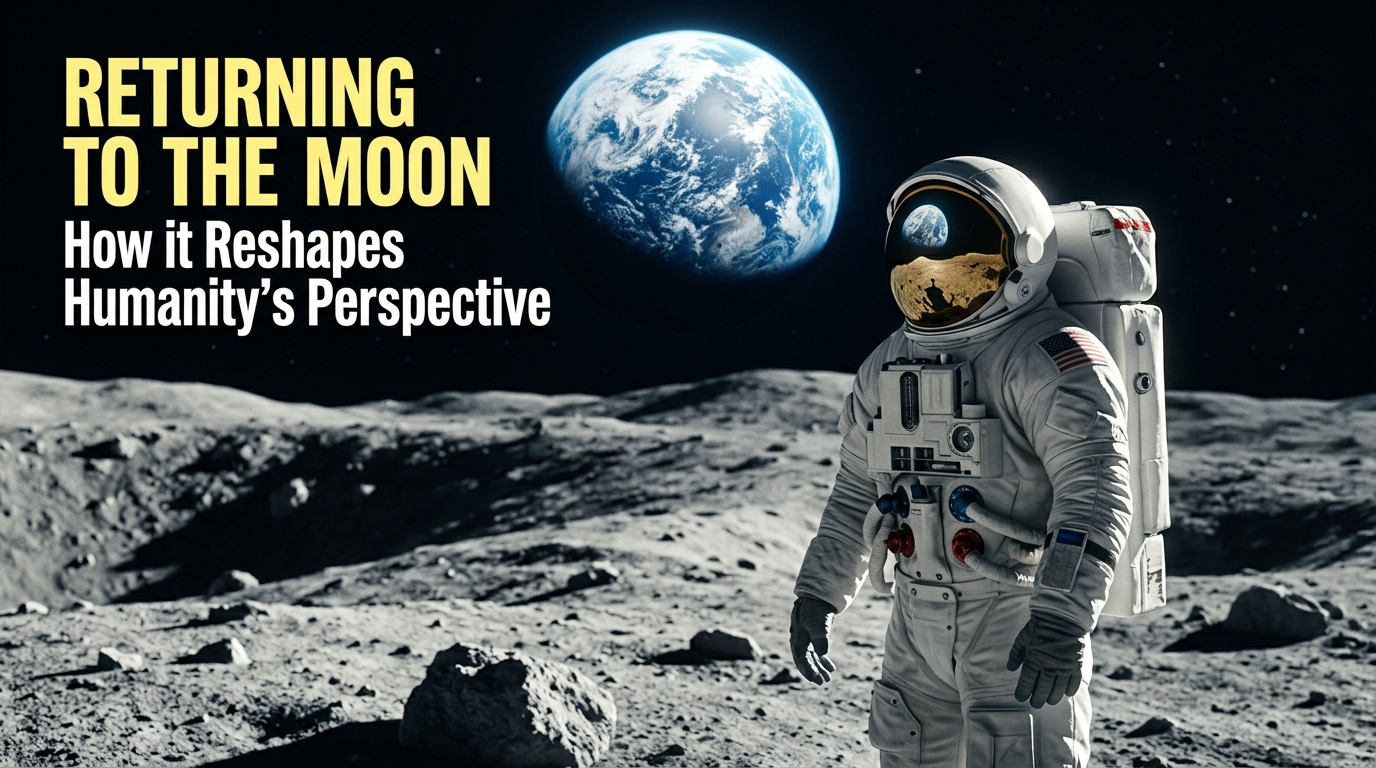
For many people, the Moon feels like a destination we’ve already conquered. After all, astronauts first walked on its surface more than half a century ago. Yet as governments and private space companies prepare for a new era of lunar exploration, it’s becoming increasingly clear that returning to the Moon is about much more than revisiting history.
This new chapter of space exploration is different from the Apollo era. Instead of brief visits focused primarily on proving technological capability, modern lunar missions aim to establish a long-term human presence, conduct advanced scientific research, and prepare for future journeys deeper into the solar system.
But perhaps the most interesting impact of returning to the Moon won’t be technological at all. It may be psychological. Just as the first Moon landing transformed how humanity viewed itself and its place in the universe, a renewed lunar presence could reshape the way we think about exploration, innovation, sustainability, and even our own planet.
Here are nine ways returning to the Moon could fundamentally change our perspective on the world and beyond.
1. It Could Make Earth Feel Smaller—and More Precious
One of the most powerful outcomes of the Apollo missions was the perspective astronauts gained when looking back at Earth.
Photographs such as the famous “Earthrise” image revealed our planet as a small, fragile sphere floating in the darkness of space. Those images helped inspire environmental awareness and gave millions of people a new appreciation for Earth’s uniqueness.
A new generation of astronauts returning to the Moon could once again provide perspectives that resonate worldwide.
High-definition cameras, live broadcasts, and immersive technologies would allow people everywhere to experience views of Earth from hundreds of thousands of miles away. Seeing our planet from that distance can be a powerful reminder that national borders disappear from space and that humanity shares a single home.
As climate challenges and environmental concerns continue to grow, this perspective may become more valuable than ever.
2. It Could Redefine What Exploration Means
Historically, exploration involved crossing oceans, mapping continents, or venturing into unknown regions of Earth.
Today, many of those frontiers have been charted. Returning to the Moon shifts the concept of exploration beyond our planet and into the broader solar system.
Future lunar missions may encourage society to view exploration not as something completed in the past but as an ongoing human endeavor.
The Moon can become a symbol of curiosity and discovery for a new generation, demonstrating that there are still vast mysteries waiting to be investigated.
This shift in mindset could inspire people to think bigger about science, innovation, and the possibilities of the future.
3. It Could Change How We View Technology
Major space missions often produce technological breakthroughs that extend far beyond their original purpose.
Developing systems capable of supporting humans on the Moon requires advances in energy production, robotics, communications, life-support systems, materials science, and autonomous operations.
As these technologies evolve, many will likely find applications here on Earth.
More importantly, returning to the Moon reminds us that ambitious goals often drive innovation. When societies pursue bold challenges, they frequently create tools and solutions that improve everyday life.
The Moon may once again become a catalyst for technological progress that benefits millions of people.
4. It Could Encourage Long-Term Thinking
Modern life often revolves around short timelines—daily news cycles, quarterly earnings reports, and immediate concerns.
Space exploration operates on a completely different scale.
Building sustainable lunar missions requires years of planning, international cooperation, and investments that may not produce immediate results. Success depends on thinking decades ahead rather than weeks ahead.
This approach offers an important lesson.
Returning to the Moon could encourage broader conversations about long-term planning in areas such as infrastructure, education, environmental stewardship, and scientific research.
The ability to think beyond the present moment may become one of the most valuable skills humanity develops.
5. It Could Transform Our Understanding of Resources
The Moon is increasingly being viewed not only as a scientific destination but also as a potential source of valuable resources.
Researchers are studying the possibility of extracting water ice from permanently shadowed lunar craters. Water could provide drinking supplies, breathable oxygen, and even rocket fuel through chemical processing.
The idea of using local resources rather than transporting everything from Earth represents a major shift in thinking.
Instead of viewing space as an empty void requiring constant support from Earth, future explorers may learn to live using the materials available around them.
This concept of resource efficiency could also influence how we manage resources on our own planet.
6. It Could Inspire a New Generation of Scientists and Engineers
The Apollo Moon landings inspired countless young people to pursue careers in science, technology, engineering, and mathematics.
Many of today’s leading researchers, engineers, and astronauts grew up watching those historic missions unfold.
A renewed human presence on the Moon could have a similar effect.
Children who witness astronauts building habitats, conducting experiments, or exploring previously unseen regions of the lunar surface may be inspired to become the innovators of tomorrow.
Inspiration is difficult to measure, but its impact can be enormous. One televised lunar mission could influence career choices and scientific breakthroughs for decades to come.
7. It Could Strengthen International Cooperation
Space exploration has increasingly become a global effort.
Future lunar missions are expected to involve partnerships between multiple countries, research institutions, and private companies. These collaborations require shared goals, communication, and mutual trust.
The Moon offers an opportunity to demonstrate what humanity can achieve when working together toward common objectives.
At a time when many global challenges require international solutions, successful cooperation in space could serve as a powerful example.
Returning to the Moon may remind us that some achievements are simply too large for any single nation to accomplish alone.
8. It Could Prepare Humanity for Mars and Beyond
For many scientists and space agencies, the Moon is not the final destination.
Instead, it serves as a testing ground for future missions to Mars and other deep-space destinations.
Living and working on the Moon allows researchers to develop technologies, procedures, and survival strategies needed for longer journeys. Lunar habitats, resource extraction systems, and advanced spacecraft can all be tested relatively close to Earth before being deployed farther into space.
This practical role changes how we think about the Moon.
Rather than viewing it as an endpoint, we begin to see it as a stepping stone—a crucial bridge between Earth and the wider solar system.
That perspective transforms the Moon from a historical landmark into a gateway for future exploration.
9. It Could Expand Our Sense of What’s Possible
Perhaps the most profound impact of returning to the Moon is the way it can influence human imagination.
Throughout history, major achievements have often changed perceptions of what is achievable. Crossing oceans, flying across continents, and reaching orbit all seemed impossible until they were accomplished.
A sustained human presence on the Moon could have a similar effect.
When people see astronauts living, working, and conducting research on another world, it expands the boundaries of what feels realistic.
The Moon becomes evidence that ambitious goals can be achieved through persistence, creativity, and collaboration.
This mindset can influence far more than space exploration. It can encourage innovation in science, medicine, education, environmental solutions, and countless other fields.
Why This Return Is Different from Apollo
While the Apollo missions were extraordinary achievements, they were relatively short visits.
Astronauts landed, conducted experiments, collected samples, and returned home. Modern plans envision something much more ambitious.
Future lunar exploration focuses on sustainability. The goal is not merely to visit the Moon but to establish a lasting presence that supports scientific discovery and technological development.
This difference is significant because long-term habitation requires solving challenges that temporary missions could avoid.
Power generation, resource management, habitat construction, and human health become central concerns. Addressing these issues may lead to innovations that benefit both space exploration and life on Earth.
The Moon as a Laboratory for the Future
The lunar surface offers unique opportunities for scientific research.
Its lack of atmosphere allows for clearer observations of the universe. Its geological history preserves clues about the early solar system. Its environment provides an ideal setting for testing technologies that may eventually support deep-space missions.
Scientists view the Moon as more than a destination—it is a laboratory where humanity can learn how to operate beyond Earth.
Each experiment conducted there has the potential to expand our understanding of science, engineering, and planetary evolution.
A Shift in Human Perspective
Throughout history, certain moments have fundamentally changed how people see themselves.
The discovery that Earth orbits the Sun transformed our understanding of the cosmos. The first photographs of Earth from space reshaped our perception of the planet. The Apollo landings demonstrated what human ingenuity could accomplish.
A return to the Moon may create another such moment.
By establishing a permanent presence beyond Earth, humanity crosses an important threshold. We move from being a species confined to one world toward becoming a species capable of living and working on multiple worlds.
That transition carries enormous symbolic significance.
Final Thoughts
Returning to the Moon is about far more than rockets, spacecraft, or scientific experiments. It represents an opportunity to rethink our relationship with technology, exploration, resources, and even each other.
The lessons learned from future lunar missions could influence everything from environmental awareness and education to international cooperation and long-term planning. Most importantly, they may encourage people to think beyond immediate limitations and imagine possibilities that once seemed out of reach.
As humanity prepares to set foot on the Moon once again, the greatest transformation may not occur on the lunar surface itself. It may happen here on Earth, in the way we view our planet, our future, and our potential as a species.
The next giant leap could begin not with a footprint in lunar dust, but with a new way of thinking about what humanity can achieve together.







