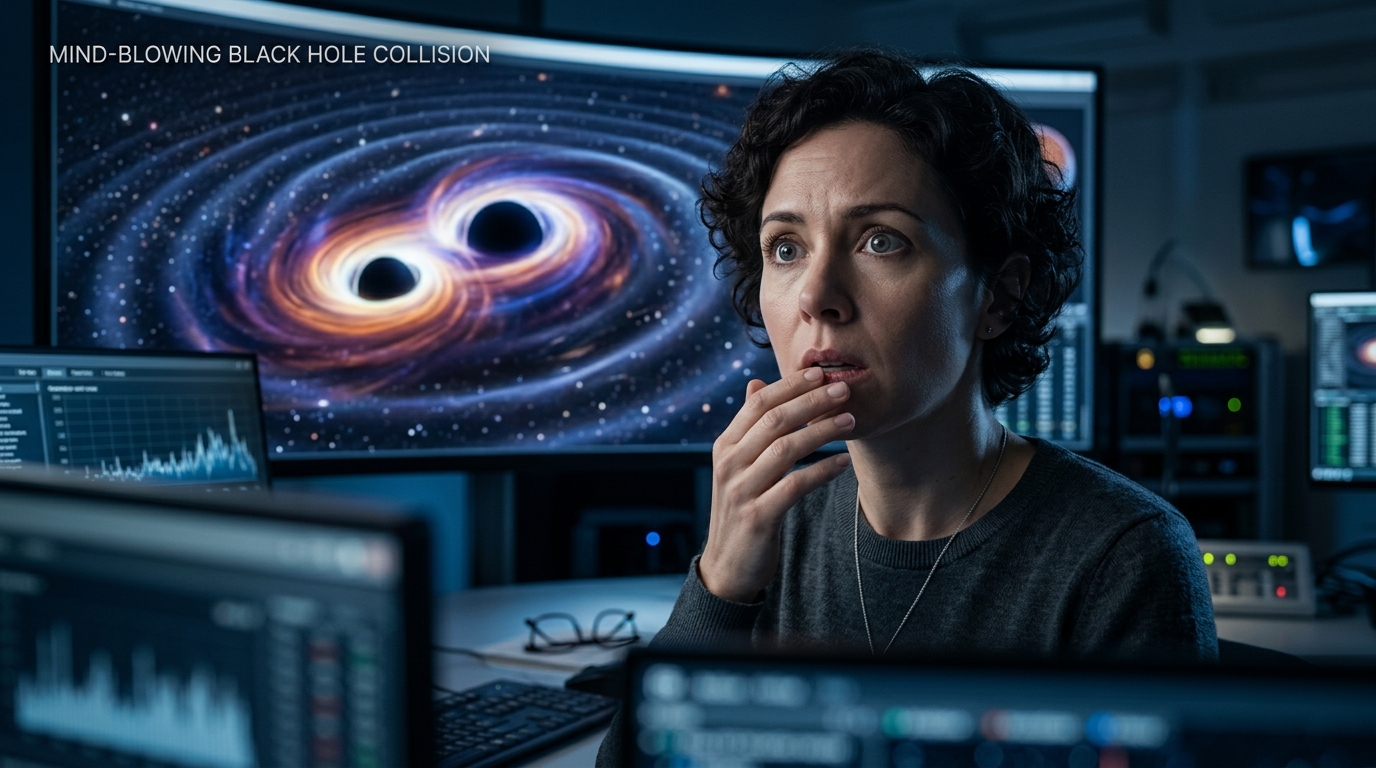
The universe is filled with extraordinary events, but few discoveries have captured the imagination of scientists and space enthusiasts quite like the detection of a black hole collision. For the first time in human history, researchers were able to “hear” the faint echoes of two black holes merging billions of light-years away. This groundbreaking achievement not only confirmed a major prediction made by Albert Einstein over a century ago but also opened an entirely new way of exploring the cosmos.
Black holes are among the most mysterious objects in existence. They are regions of space where gravity is so powerful that nothing—not even light—can escape. When two of these cosmic giants collide, they create one of the most energetic events known to science. The resulting disturbance sends ripples through the fabric of space and time, allowing astronomers to detect the event even from unimaginable distances.
Here are 12 astonishing facts about the black hole collision that changed our understanding of the universe forever.
1. Scientists Literally “Heard” the Collision
Although sound cannot travel through the vacuum of space, scientists often describe the detection of the black hole merger as “hearing” the event. The collision produced gravitational waves—tiny ripples in space-time—that were captured by highly sensitive instruments on Earth.
When researchers converted these signals into audio frequencies, they produced a brief chirping sound. That tiny chirp represented two black holes spiraling into each other and merging in a fraction of a second. It was the first direct detection of gravitational waves in history.
2. The Event Happened Over a Billion Years Ago
One of the most incredible aspects of the discovery is how long the signal traveled before reaching Earth. The collision occurred approximately 1.3 billion light-years away.
This means the black holes merged long before complex life appeared on our planet. The gravitational waves spent more than a billion years crossing the universe before finally reaching Earth in 2015, where scientists detected them using advanced technology.
In a sense, astronomers were observing a cosmic event from the distant past.
3. The Black Holes Were Enormous
The two black holes involved in the collision were far larger than the black holes typically formed from dying stars.
One had a mass roughly 36 times greater than the Sun, while the other was about 29 times the Sun’s mass. Together, they created a new black hole with a mass approximately 62 times that of the Sun.
The numbers may seem confusing at first, but they reveal something extraordinary: not all of the mass remained in the final black hole.
4. Three Suns’ Worth of Mass Disappeared
During the merger, around three solar masses were converted directly into energy.
According to Einstein’s famous equation, E = mc², mass and energy are interchangeable. The enormous energy released during the collision briefly exceeded the combined power output of every star in the observable universe.
That makes black hole mergers among the most powerful events ever observed.
5. The Discovery Confirmed Einstein Was Right
Back in 1916, Albert Einstein predicted the existence of gravitational waves as part of his General Theory of Relativity.
For decades, scientists believed these waves existed, but detecting them proved incredibly difficult because they are extraordinarily weak by the time they reach Earth.
The successful observation of the black hole collision provided direct evidence that gravitational waves are real, validating one of Einstein’s most important predictions a full century later.
6. Detecting the Signal Required Extraordinary Precision
The instruments used to detect the gravitational waves belong to the Laser Interferometer Gravitational-Wave Observatory, commonly known as LIGO.
These detectors are so sensitive that they can measure changes thousands of times smaller than the width of a proton. To put that into perspective, it’s like measuring a change in distance between Earth and the nearest star that is smaller than the width of a human hair.
Without this remarkable level of precision, the signal would have gone completely unnoticed.
7. The Collision Lasted Less Than a Second
The entire merger event that scientists detected occurred extremely quickly.
For millions of years, the two black holes orbited each other while gradually moving closer together. However, the final stages unfolded in just fractions of a second.
As they spiraled inward, their speed increased dramatically until they collided and merged into a single, larger black hole. The final burst of gravitational waves was what reached Earth and revealed the event to researchers.
8. It Opened a New Era of Astronomy
Before the discovery of gravitational waves, astronomers primarily studied the universe through electromagnetic radiation, including visible light, radio waves, X-rays, and infrared signals.
The detection of gravitational waves introduced an entirely new method of observing the cosmos.
Instead of looking at light, scientists can now study the movement of massive objects through the distortions they create in space-time itself. This breakthrough effectively gave humanity a brand-new sense for exploring the universe.
9. Black Hole Mergers Were Once Theoretical
For many years, scientists suspected that pairs of black holes might orbit one another and eventually collide. However, there was little direct evidence to prove such systems existed.
The detected merger provided undeniable confirmation that binary black hole systems are real and that these cosmic collisions occur naturally throughout the universe.
Since that first discovery, astronomers have identified many more black hole mergers, proving that these events are far more common than previously believed.
10. The Signal Was Smaller Than an Atomic Nucleus
The gravitational wave that reached Earth produced an incredibly tiny distortion.
At its peak, the wave altered the length of LIGO’s four-kilometer detector arms by only a tiny fraction of the size of an atomic nucleus.
Imagine trying to detect a movement smaller than the smallest building block of matter while surrounded by environmental noise, earthquakes, traffic vibrations, and atmospheric disturbances. Achieving such precision represents one of the greatest technological accomplishments in modern science.
11. The Discovery Earned a Nobel Prize
The significance of the breakthrough was quickly recognized across the scientific community.
In 2017, the Nobel Prize in Physics was awarded to key researchers responsible for the development of LIGO and the groundbreaking detection of gravitational waves.
The award acknowledged decades of research, engineering innovation, and scientific dedication that made the discovery possible.
It also highlighted the importance of international collaboration in solving some of humanity’s biggest scientific challenges.
12. We’re Only Beginning to Explore This New Frontier
The first detected black hole collision was just the beginning.
Today, gravitational-wave observatories continue to identify new cosmic events, including collisions involving black holes and neutron stars. Each detection provides valuable information about the behavior of extreme objects and the evolution of galaxies.
Future observatories, both on Earth and in space, are expected to be even more sensitive. They may reveal hidden populations of black holes, uncover clues about the origins of the universe, and potentially lead to discoveries that scientists have not yet imagined.
The possibilities are virtually limitless.
Why This Discovery Matters
The detection of a black hole collision was much more than a scientific milestone. It transformed our understanding of the universe and demonstrated humanity’s ability to observe phenomena once thought impossible to detect.
For centuries, people relied on light to explore the cosmos. Gravitational waves have now given scientists a completely new way to investigate the hidden workings of the universe. Events that emit little or no light can suddenly become observable through the ripples they create in space-time.
This achievement represents a turning point in astronomy, comparable to the invention of the telescope itself.
As technology advances and more gravitational-wave detectors come online, researchers expect to uncover countless new mysteries. Every signal detected from deep space carries information about some of the most extreme environments in existence, from colliding black holes to exploding stars and perhaps even echoes from the earliest moments after the Big Bang.
Final Thoughts
The black hole collision heard across space stands as one of the most remarkable scientific discoveries of the modern era. It confirmed Einstein’s century-old prediction, revealed the immense power of black hole mergers, and launched a new age of gravitational-wave astronomy.
What makes the event truly extraordinary is not just its scale, but what it represents. A tiny ripple created by two black holes billions of years ago traveled across the universe and was detected by humanity on a small planet orbiting an ordinary star.
That achievement reminds us how far science has come—and how much of the universe still remains to be explored. As researchers continue listening to the cosmos, the next revolutionary discovery may already be on its way toward Earth, carried by waves that began their journey millions or even billions of years ago.







