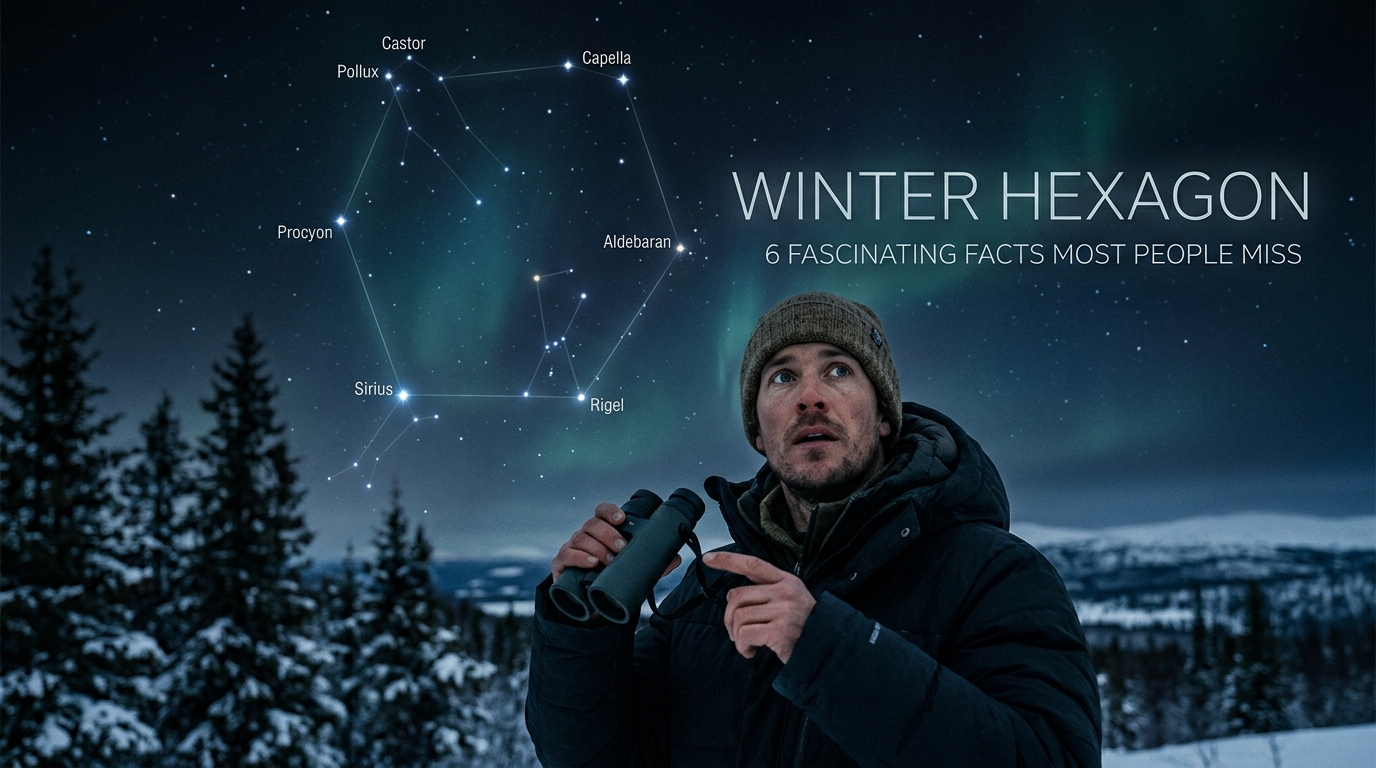
When winter arrives in the Northern Hemisphere, stargazers are treated to one of the most impressive sights in the night sky: the Winter Hexagon. While many people recognize famous constellations like Orion or the Big Dipper, far fewer are familiar with this enormous celestial pattern that dominates winter evenings.
The Winter Hexagon isn’t an official constellation. Instead, it’s an asterism—a recognizable shape formed by bright stars belonging to different constellations. Stretching across a large portion of the sky, this giant six-sided figure connects some of the brightest stars visible from Earth, creating a spectacular cosmic landmark that is easy to spot even from areas with moderate light pollution.
Despite its beauty and accessibility, the Winter Hexagon often goes unnoticed by casual observers. Most people focus on individual constellations and miss the larger pattern connecting them. Yet this stellar formation offers a fascinating glimpse into the scale, history, and diversity of our galaxy.
Whether you’re an experienced astronomer or simply enjoy looking up on a clear winter night, these six fascinating facts about the Winter Hexagon may change the way you see the sky.
1. The Winter Hexagon Is One of the Largest Patterns in the Night Sky
One reason the Winter Hexagon often escapes attention is because of its enormous size.
Unlike smaller constellations that occupy a relatively compact area, the Winter Hexagon stretches across a vast section of the sky. It is formed by six exceptionally bright stars: Capella, Aldebaran, Rigel, Sirius, Procyon, and Pollux. Together, these stars create a giant geometric shape that surrounds several well-known constellations.
Because the pattern is so large, many observers focus on individual stars or constellations without realizing they are part of a much bigger arrangement. In fact, the hexagon spans such a wide area that it can dominate nearly the entire southern sky on winter evenings.
This impressive scale is one of the reasons amateur astronomers consider it a perfect guide for navigating the winter heavens. Once you identify one of its bright stars, the others become much easier to locate.
2. It Contains the Brightest Star Visible From Earth
One of the most remarkable features of the Winter Hexagon is that it includes Sirius, the brightest star in Earth’s night sky.
Located in the constellation Canis Major, Sirius shines with extraordinary brilliance. On clear winter nights, it often appears to sparkle with flashes of blue, white, and even red due to atmospheric effects. Its intense brightness makes it almost impossible to miss.
Sirius is located approximately 8.6 light-years from Earth, making it one of our relatively close stellar neighbors. Although many stars are intrinsically brighter, Sirius appears so brilliant because of its combination of high luminosity and proximity.
Ancient civilizations paid close attention to Sirius. The ancient Egyptians, for example, associated its appearance with the annual flooding of the Nile River, an event crucial to their agriculture and survival.
Within the Winter Hexagon, Sirius serves as a dazzling anchor point and often becomes the first star observers identify when tracing the shape.
3. The Stars of the Hexagon Are Vastly Different From One Another
At first glance, the six stars of the Winter Hexagon may seem similar because they all appear bright in the night sky. In reality, they represent an incredible variety of stellar types.
Some are massive supergiants nearing the end of their lives, while others are smaller and more stable stars.
For example, Rigel, located in Orion, is a blue supergiant that shines tens of thousands of times brighter than the Sun. Its immense energy output makes it one of the most luminous stars visible to the naked eye.
Aldebaran, found in Taurus, is a red giant star. Its reddish-orange glow stands out clearly against the darker sky and signals a much cooler surface temperature compared to blue stars like Rigel.
Pollux, part of Gemini, is an orange giant that has already exhausted much of the hydrogen fuel in its core. Meanwhile, Procyon is a relatively nearby star that is transitioning into a later stage of stellar evolution.
Together, these stars provide a remarkable snapshot of the different stages stars experience throughout their lifetimes. Observing the Winter Hexagon is like looking at a collection of stellar biographies written across the sky.
4. It Serves as a Roadmap to Several Famous Constellations
One reason astronomy enthusiasts love the Winter Hexagon is its usefulness as a celestial navigation tool.
Each corner of the hexagon belongs to a different constellation, making the pattern an excellent starting point for exploring the winter sky.
By locating Sirius, observers can easily find Canis Major. Following the shape upward leads to Procyon in Canis Minor. Pollux marks one of the twin stars of Gemini, while Capella highlights the constellation Auriga.
Aldebaran helps identify Taurus, famous for its V-shaped star cluster known as the Hyades. Rigel anchors Orion, perhaps the most recognizable winter constellation of all.
Inside the boundaries of the Winter Hexagon, skywatchers can discover numerous additional treasures, including star clusters, nebulae, and double stars.
For beginners, the hexagon functions almost like a giant roadmap. Instead of memorizing dozens of separate constellations, observers can learn a single pattern that naturally guides them to many of the sky’s most famous objects.
5. The Winter Hexagon Contains a Hidden Winter Triangle
Many people don’t realize that another well-known asterism exists inside the Winter Hexagon.
This smaller shape is called the Winter Triangle and is formed by Sirius, Procyon, and Betelgeuse. While the Winter Hexagon outlines a massive area of the sky, the Winter Triangle creates a striking geometric figure within its boundaries.
Betelgeuse, the red supergiant located in Orion, serves as the triangle’s northern point. Its reddish hue contrasts beautifully with the brilliant white glow of Sirius and the softer light of Procyon.
The Winter Triangle is often easier for beginners to identify because it involves only three stars. Once observers become familiar with it, they can expand their search outward and trace the larger Winter Hexagon.
This nested arrangement makes the winter sky especially rewarding. A simple triangle becomes a gateway to a much larger and more complex celestial pattern.
It’s a perfect example of how the night sky contains layers of structure waiting to be discovered.
6. You’re Looking Across Hundreds of Light-Years of Space
Perhaps the most mind-blowing fact about the Winter Hexagon is that its stars only appear close together from our perspective on Earth.
In reality, these stars are separated by enormous distances.
When we look at the hexagon, we’re viewing a two-dimensional projection of objects scattered throughout three-dimensional space. Some stars are relatively nearby, while others lie hundreds of light-years away.
Procyon is located roughly 11 light-years from Earth, making it one of our closest stellar neighbors. Sirius sits about 8.6 light-years away. Pollux is approximately 34 light-years distant.
Rigel, however, is much farther away—located hundreds of light-years from Earth. Despite this immense distance, its tremendous luminosity allows it to remain one of the brightest stars in our sky.
This means the Winter Hexagon is not a true physical structure. The stars are not connected, orbiting one another, or grouped together in space. They simply align from our viewpoint, creating a pattern that exists only from Earth’s perspective.
Understanding this fact can dramatically change how we think about the night sky. Every star we see occupies its own location, history, and journey within the Milky Way.
Why the Winter Hexagon Deserves More Attention
The Winter Hexagon is often overshadowed by more famous constellations, but it deserves recognition as one of the most spectacular seasonal sights visible to the naked eye.
Unlike many astronomical objects that require telescopes or specialized equipment, the Winter Hexagon can be enjoyed by virtually anyone. On a dark, clear evening, its brightest stars stand out even in suburban environments.
The pattern also offers an excellent introduction to astronomy. By learning to identify the six stars that form the hexagon, observers naturally become familiar with multiple constellations and some of the most important stars in the sky.
For families, educators, and beginning stargazers, it provides an engaging way to explore the cosmos without complicated charts or advanced knowledge.
Tips for Finding the Winter Hexagon
If you’d like to see the Winter Hexagon for yourself, choose a clear winter evening and head to a location with minimal light pollution.
Start by locating Orion, which is usually easy to identify thanks to its distinctive three-star belt. From there, find bright Rigel at Orion’s lower corner and brilliant Sirius farther below. Continue tracing the remaining stars around the sky until the giant six-sided pattern becomes visible.
The best viewing period typically occurs between December and March, when the hexagon reaches its highest position in the evening sky.
Bringing along a stargazing app or star chart can make identification even easier, especially for first-time observers.
Final Thoughts
The Winter Hexagon is much more than a collection of bright stars. It is a breathtaking reminder of the scale and beauty of our universe. From the dazzling brilliance of Sirius to the immense distances separating its stars, every corner of the hexagon tells a unique cosmic story.
Although millions of people see these stars every winter, many never realize they form one of the sky’s most impressive patterns. Once you learn to recognize it, however, the Winter Hexagon becomes impossible to ignore.
The next time you step outside on a crisp winter night, take a moment to look up. Hidden among the familiar constellations is a giant celestial hexagon connecting some of the brightest stars in the heavens—a remarkable sight that most people miss but few ever forget once they’ve found it.







