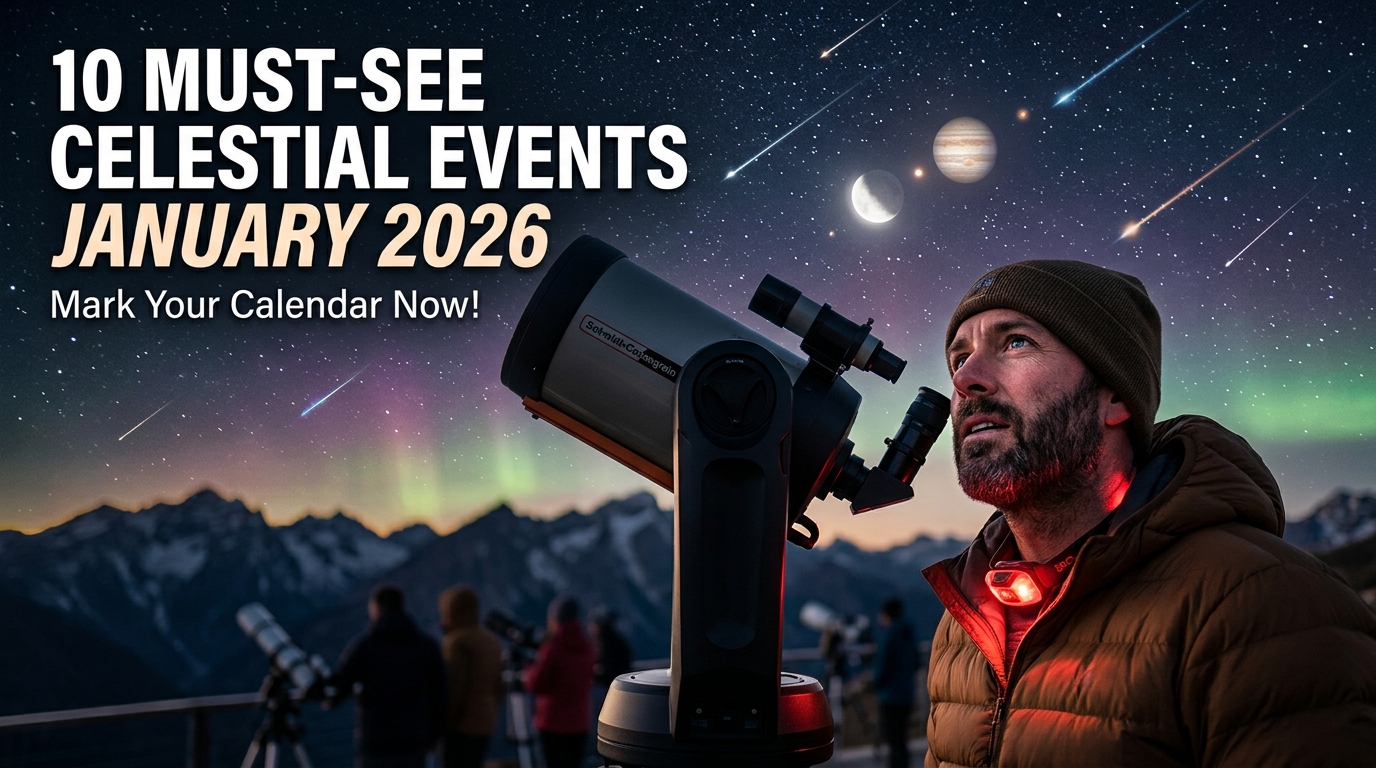
A new year always brings fresh opportunities to explore the night sky, and January 2026 is no exception. Despite the cold temperatures in many parts of the world, the first month of the year offers an impressive lineup of astronomical events that make bundling up well worth the effort.
From dazzling meteor showers and a brilliant supermoon to Jupiter’s brightest appearance of the year, January provides plenty of reasons to step outside after sunset and look upward. Whether you’re a seasoned amateur astronomer with a telescope or someone who simply enjoys watching the stars from the backyard, this month has something special to offer.
The best part? Many of these celestial sights can be enjoyed without expensive equipment. In fact, some of the month’s highlights are visible with nothing more than your eyes and a clear sky.
Here are ten exciting celestial events in January 2026 that deserve a spot on every skywatcher’s calendar.
1. The Wolf Supermoon Lights Up the Sky on January 3
January begins with one of the most eye-catching lunar events of the year: the Wolf Moon. In 2026, this full moon is also classified as a supermoon, meaning it occurs when the Moon is relatively close to Earth in its orbit. As a result, it appears slightly larger and brighter than an average full moon.
The Wolf Moon gets its name from traditional folklore, where the howling of wolves during the harsh winter months inspired its title. While the difference in size compared to a regular full moon may be subtle, many observers notice its impressive brightness when it rises above the horizon.
Photographers will find this event especially rewarding, particularly during moonrise when the Moon appears largest due to an optical illusion created by the landscape.
2. The Quadrantid Meteor Shower Reaches Its Peak
One of the first major meteor showers of the year arrives almost immediately after New Year’s celebrations.
The Quadrantid meteor shower peaks during the night of January 3 and the early hours of January 4, producing some of the brightest meteors seen all year. Under ideal conditions, the shower can generate dozens—or even over a hundred—shooting stars per hour.
Unlike many meteor showers that remain active for several days, the Quadrantids have an unusually short peak window. This means timing is critical.
Unfortunately, the bright Wolf Supermoon will reduce visibility in 2026, washing out many of the fainter meteors. However, the brightest fireballs should still be visible, making the event worth watching.
For the best experience, find a dark location away from city lights and look toward the northeastern sky before dawn.
3. Jupiter Reaches Opposition on January 10
If there’s one event planetary observers should not miss this month, it’s Jupiter’s opposition.
On January 10, Earth will pass directly between Jupiter and the Sun. This alignment places Jupiter at its closest approach to Earth for the year, making it brighter and more visible than at any other time in 2026.
The giant planet will rise around sunset and remain visible all night long.
Even a small telescope can reveal Jupiter’s cloud bands and its four largest moons, first observed by Galileo more than 400 years ago. Binocular users may also spot these moons as tiny points of light lined up beside the planet.
For many astronomers, Jupiter’s opposition is the highlight of the entire month.
4. Enjoy Prime Viewing of Jupiter Throughout Mid-January
While opposition occurs on January 10, the weeks surrounding that date offer excellent viewing opportunities as well.
Throughout mid-January, Jupiter remains exceptionally bright in the evening sky. Because the planet rises early and stays visible for many hours, observers have plenty of opportunities to study it.
The steady winter air in some regions can provide surprisingly sharp telescope views. Under favorable conditions, details within Jupiter’s atmosphere become easier to observe, including its famous cloud belts and occasional storms.
Anyone interested in planetary astronomy should take advantage of this rare period of optimal visibility.
5. The New Moon Creates Perfect Dark-Sky Conditions
On January 18, the Moon reaches its new phase, disappearing from the night sky.
While a new moon may not sound exciting compared to meteor showers or planetary events, it creates some of the best observing conditions of the entire month.
Without moonlight brightening the sky, faint celestial objects become much easier to see. Galaxies, star clusters, nebulae, and distant stars suddenly stand out against a darker background.
For astrophotographers, this is often the most productive period of the month. Long-exposure images reveal details that would otherwise be hidden by lunar glare.
If you’ve been waiting for the ideal night to use a telescope, the days surrounding the January new moon may be your best opportunity.
6. The Orion Nebula Shines in Winter Skies
January is widely regarded as one of the best months for viewing the famous Orion Nebula.
Located within the constellation Orion, this massive cloud of gas and dust is one of the nearest stellar nurseries to Earth. It serves as a birthplace for young stars and remains one of the most photographed deep-sky objects in the night sky.
The nebula is visible even with binoculars and appears as a faint glowing patch beneath Orion’s Belt. Through a telescope, observers can begin to see intricate structures and subtle details.
The dark-sky period after the new moon provides ideal conditions for observing this spectacular object.
7. The Beehive Cluster Takes Center Stage
Another beautiful target throughout January is the Beehive Cluster, also known as Messier 44.
This open star cluster contains hundreds of stars and is visible in the constellation Cancer. Under dark skies, some observers can even detect it without optical aid.
Binoculars provide the best view for most people, transforming the cluster into a stunning collection of sparkling stars scattered across the field of view.
The Beehive Cluster is particularly easy to locate during January evenings and reaches favorable viewing positions throughout the month.
8. Watch the Moon and Saturn Meet in the Evening Sky
One of the most attractive sky pairings of the month occurs around January 23, when the Moon appears close to Saturn in the evening sky.
These planetary conjunctions don’t involve the objects physically approaching one another. Instead, they simply appear near each other from Earth’s perspective.
Even so, the visual effect can be striking.
Shortly after sunset, observers looking toward the western horizon may spot Saturn positioned near the crescent Moon, creating an attractive sight for casual stargazers and photographers alike.
Events like these help beginners learn their way around the night sky while providing beautiful photo opportunities.
9. Winter Constellations Dominate the Night
January offers some of the year’s finest constellation viewing.
Famous star patterns such as Orion, Taurus, Gemini, Auriga, and Canis Major occupy prominent positions in the evening sky. Together they form one of astronomy’s richest seasonal displays.
Bright stars including Sirius, Betelgeuse, Rigel, Aldebaran, and Capella create a brilliant backdrop visible even from suburban locations.
These constellations also contain numerous deep-sky treasures, making January an ideal month for exploring the heavens with binoculars or a telescope.
Even casual observers can enjoy identifying familiar shapes and learning more about the stories and mythology behind them.
10. January Delivers One of the Year’s Best Astrophotography Seasons
Beyond any single event, January itself is a remarkable month for astrophotography.
The long nights provide extended observing sessions, while crisp winter air often produces clearer skies than other seasons. Between the Wolf Supermoon, the Quadrantid meteor shower, Jupiter’s opposition, the Orion Nebula, and multiple planetary alignments, photographers have no shortage of subjects to capture.
Whether you’re using a smartphone, DSLR camera, or advanced telescope setup, January presents countless opportunities to create memorable images of the cosmos.
Many astrophotographers consider winter one of the most rewarding seasons for capturing celestial beauty.
Tips for Making the Most of January’s Skywatching Opportunities
To enjoy these events fully, a little preparation goes a long way.
Choose locations away from city lights whenever possible. Allow your eyes at least 20 minutes to adjust to darkness, and avoid looking at bright screens during observing sessions.
Dress warmly, especially if you’re spending extended periods outdoors. Even in regions with mild winters, nighttime temperatures can become surprisingly cold.
A simple pair of binoculars can dramatically enhance many celestial sights, making them one of the best investments for beginner skywatchers.
Finally, check local weather forecasts ahead of time. Clear skies are every astronomer’s best friend.
Final Thoughts
January 2026 offers an impressive mix of lunar events, planetary displays, meteor activity, and deep-sky treasures. From the brilliant Wolf Supermoon and the fast-moving Quadrantids to Jupiter’s brightest appearance of the year, the month provides something for every level of skywatcher.
Whether you’re observing from a remote dark-sky location or simply stepping outside your front door, these celestial events offer a reminder of the beauty and wonder that exists above us every night.
So grab a blanket, bring a pair of binoculars, and mark your calendar now—January 2026 is shaping up to be a memorable month for anyone who loves the night sky.