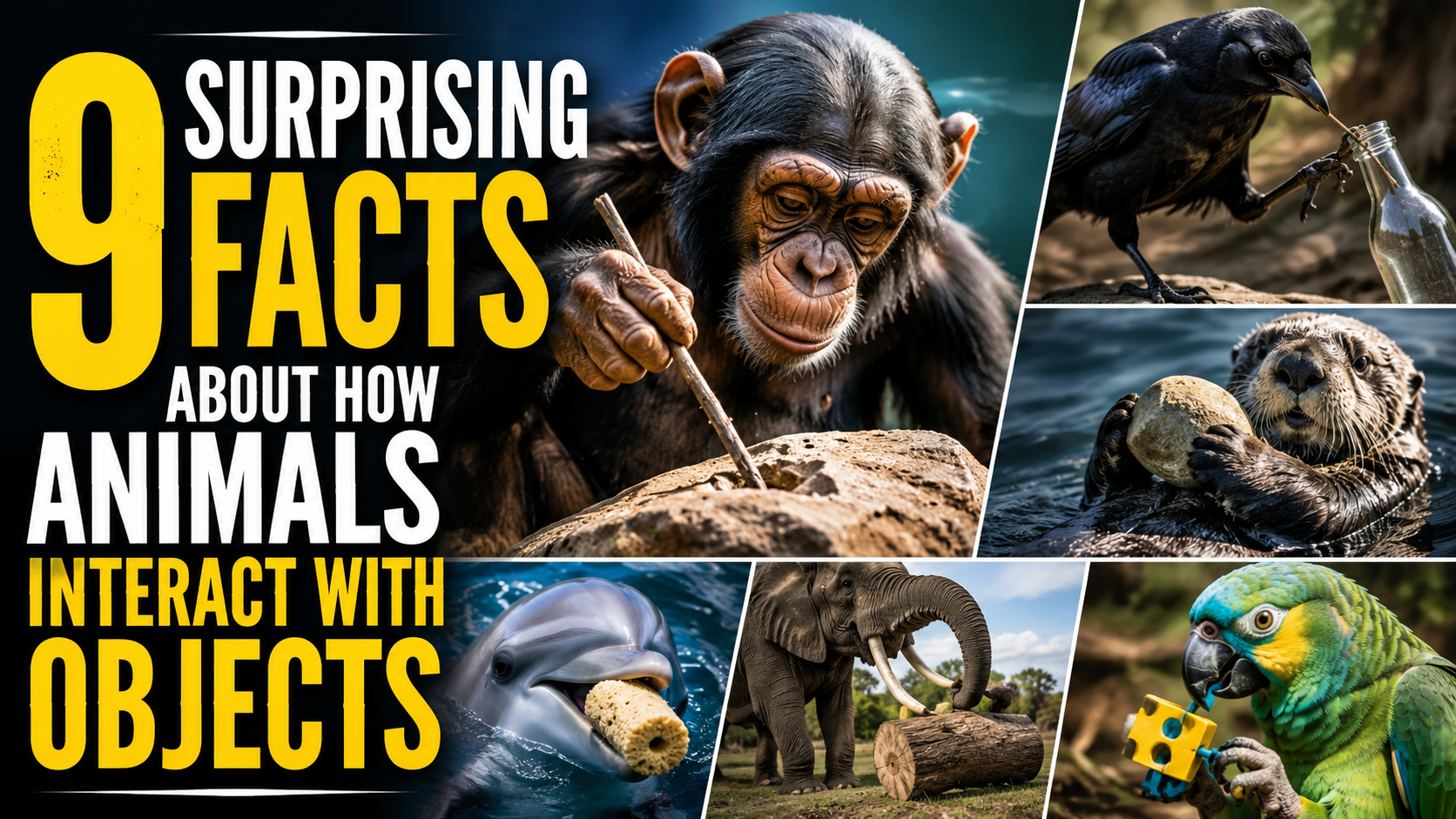
When most people think about intelligence, they often picture humans solving puzzles, building tools, or inventing technology. Yet the natural world is filled with remarkable examples of animals interacting with objects in ways that continue to surprise scientists.
From crows crafting tools to octopuses carrying portable shelters, animals regularly demonstrate problem-solving abilities that challenge traditional assumptions about intelligence. While human cognition remains unique in many ways, research increasingly shows that many species are capable of far more sophisticated behavior than previously believed.
Animals don’t simply react to their environments. In many cases, they actively manipulate objects, experiment with new solutions, and adapt their behavior based on experience. These interactions offer fascinating insights into how different species think, learn, and survive.
Here are nine surprising facts about how animals interact with objects—and what those behaviors reveal about the natural world.
1. Some Animals Create and Use Tools
For many years, scientists believed tool use was a trait that separated humans from other species. That idea has long been disproven.
One of the most famous examples comes from crows and ravens. These highly intelligent birds have been observed bending twigs, shaping sticks, and using them to retrieve insects from hard-to-reach places. In laboratory experiments, some crows have even solved multi-step puzzles requiring the use of several different tools in sequence.
Chimpanzees provide another impressive example. Wild chimpanzees use sticks to “fish” for termites, crack nuts with stones, and modify branches to access food sources.
What’s remarkable isn’t simply that these animals use objects. It’s that they often select, modify, and improve those objects for specific purposes.
This ability suggests planning, problem-solving, and a deeper understanding of cause and effect than many people realize.
2. Octopuses Carry Portable Shelters
Among the most fascinating object users in the animal kingdom are octopuses.
Unlike animals protected by shells or thick hides, octopuses have soft bodies that leave them vulnerable to predators. To compensate, some species collect coconut shells, discarded objects, and other materials from the ocean floor.
Researchers have documented octopuses carrying shell halves across long distances before assembling them into makeshift shelters when needed.
What’s especially interesting is that the objects may not provide immediate benefits at the time they’re collected. Instead, the octopus appears to transport them for future use.
This behavior suggests a level of foresight that scientists once thought was limited to only a handful of highly intelligent species.
3. Dolphins Turn Objects Into Hunting Tools
Dolphins are widely recognized for their intelligence, but their use of objects continues to impress researchers.
In some regions, bottlenose dolphins have been observed placing marine sponges over their snouts while searching for food on the seafloor. The sponge acts like protective equipment, shielding sensitive skin from rocks, sharp shells, and other hazards.
This behavior is particularly fascinating because it appears to be passed down through generations.
Young dolphins learn by observing older family members, demonstrating a form of cultural transmission. Rather than relying solely on instinct, they acquire specialized knowledge from their social groups.
This discovery has changed how scientists think about animal learning and tradition.
4. Birds Often Solve Problems Through Experimentation
Many birds display an unexpected willingness to experiment with unfamiliar objects.
Parrots, crows, and certain other species have demonstrated the ability to investigate new situations through trial and error. Instead of giving up when faced with obstacles, they often test multiple approaches until they discover a solution.
Researchers have observed birds moving objects, stacking items, pulling strings, and manipulating mechanisms to access food rewards.
This kind of exploratory behavior resembles how young children learn about the world.
Rather than blindly following instincts, these animals appear capable of learning through experience and adapting their strategies when circumstances change.
5. Some Animals Collect Objects for Display
Not every object interaction revolves around survival.
Certain species gather items for social purposes, particularly during courtship.
One of the most famous examples is the bowerbird. Male bowerbirds construct elaborate display structures and decorate them with colorful objects such as flowers, berries, shells, and even human-made items.
The goal is to attract potential mates.
Some birds carefully arrange objects by size, color, or visual effect, creating displays that resemble works of art.
While these behaviors are driven by evolutionary pressures, they reveal an extraordinary ability to recognize patterns and manipulate environments in sophisticated ways.
6. Animals Sometimes Show Curiosity About Human Objects
Humans aren’t the only creatures fascinated by unusual items.
Many animals display strong curiosity when encountering unfamiliar objects.
Raccoons investigate containers and mechanisms. Monkeys inspect tools and equipment. Elephants often explore objects using their trunks, turning them over and examining them from different angles.
This curiosity serves an important purpose.
Exploration helps animals learn about potential threats, food sources, and opportunities within their environments.
Scientists believe curiosity may play a key role in intelligence because it encourages experimentation and learning.
In many species, curiosity acts as a driving force behind innovation and adaptation.
7. Memory Helps Animals Use Objects More Effectively
Object interaction often requires memory.
An animal must remember where useful items are located, how they can be used, and whether previous attempts were successful.
Studies have shown that many species possess impressive memory abilities.
Clark’s nutcrackers, for example, can remember thousands of seed storage locations for months at a time. Certain primates remember tool-use techniques learned years earlier.
Even squirrels demonstrate remarkable spatial memory when recovering hidden food caches.
These memory skills allow animals to interact with objects more strategically and efficiently.
Rather than approaching every situation as entirely new, they build upon previous experiences.
8. Social Learning Shapes Object Use
Many object-related behaviors are learned socially rather than inherited genetically.
Young animals often acquire skills by watching experienced individuals.
Chimpanzees learn tool techniques from older group members. Dolphins observe hunting methods. Birds watch others solve feeding challenges.
This process creates behavioral traditions that can spread within communities.
In some populations, one group may develop a specific tool-use technique while another group of the same species relies on different methods.
The existence of these traditions suggests that animal behavior is often influenced by culture-like learning systems, not just instinct.
This finding has transformed our understanding of intelligence across species.
9. Object Interaction Reveals Hidden Intelligence
Perhaps the most important lesson from these observations is that object interaction often reveals abilities we might otherwise overlook.
Animals cannot explain their thoughts through language, so researchers must infer cognitive abilities through behavior.
When a crow fashions a hook from a twig, an octopus stores materials for future shelter, or a dolphin uses a sponge as protective equipment, these actions provide clues about how animals process information.
Object use demonstrates flexibility.
It shows adaptation.
It reveals creativity.
And it highlights the fact that intelligence exists on a spectrum rather than within a single species.
The more scientists study these behaviors, the more they discover that many animals possess surprisingly advanced cognitive skills.
Why These Discoveries Matter
Understanding how animals interact with objects isn’t just interesting—it also has broader implications.
For decades, intelligence was often viewed through a human-centered lens. Researchers focused heavily on language, mathematics, and other abilities that humans excel at.
Modern science takes a more balanced approach.
Instead of asking whether animals think exactly like humans, scientists ask how different species solve problems within their own environments.
This shift has revealed extraordinary diversity in the ways intelligence can evolve.
A crow’s tool-making abilities, an elephant’s memory, or an octopus’s adaptability may differ from human cognition, but each represents an impressive solution to the challenges of survival.
The Future of Animal Cognition Research
Advances in technology are helping researchers learn more than ever before about animal behavior.
Motion-tracking systems, underwater cameras, drones, and artificial intelligence tools now allow scientists to observe animals in greater detail and in more natural settings.
As a result, new discoveries continue to emerge.
Behaviors once considered impossible are becoming increasingly documented. Species previously thought to rely entirely on instinct are demonstrating flexibility, learning, and innovation.
Many experts believe we’re only beginning to understand the full extent of animal intelligence.
Future research may uncover even more surprising examples of how animals interact with the world around them.
Final Thoughts
The way animals interact with objects offers a fascinating window into their minds. Whether it’s a bird using tools, an octopus carrying shelter materials, or a dolphin employing protective equipment, these behaviors reveal problem-solving skills that continue to challenge old assumptions.
Far from being simple creatures driven solely by instinct, many animals demonstrate curiosity, memory, adaptability, and learning abilities that rival expectations.
Their interactions with objects remind us that intelligence takes many forms. It isn’t defined by one species, one skill, or one way of thinking.
Instead, intelligence appears throughout nature in countless creative and surprising ways.
The more we observe the animal kingdom, the more we realize that the world around us is filled with minds working in extraordinary ways—often hidden in plain sight.







