When we think about heroes, many of us imagine firefighters rushing into burning buildings, soldiers risking their lives on the battlefield, or highly trained rescue workers responding to disasters. While these individuals certainly deserve recognition for their bravery, some of the most inspiring acts of courage come from people who never expected to become heroes.
Every year, stories emerge of everyday individuals stepping into dangerous situations to help strangers, rescue animals, or protect loved ones. They are teachers, parents, office workers, students, and retirees—people who often describe themselves as completely ordinary. Yet when faced with a critical moment, they choose action over hesitation.
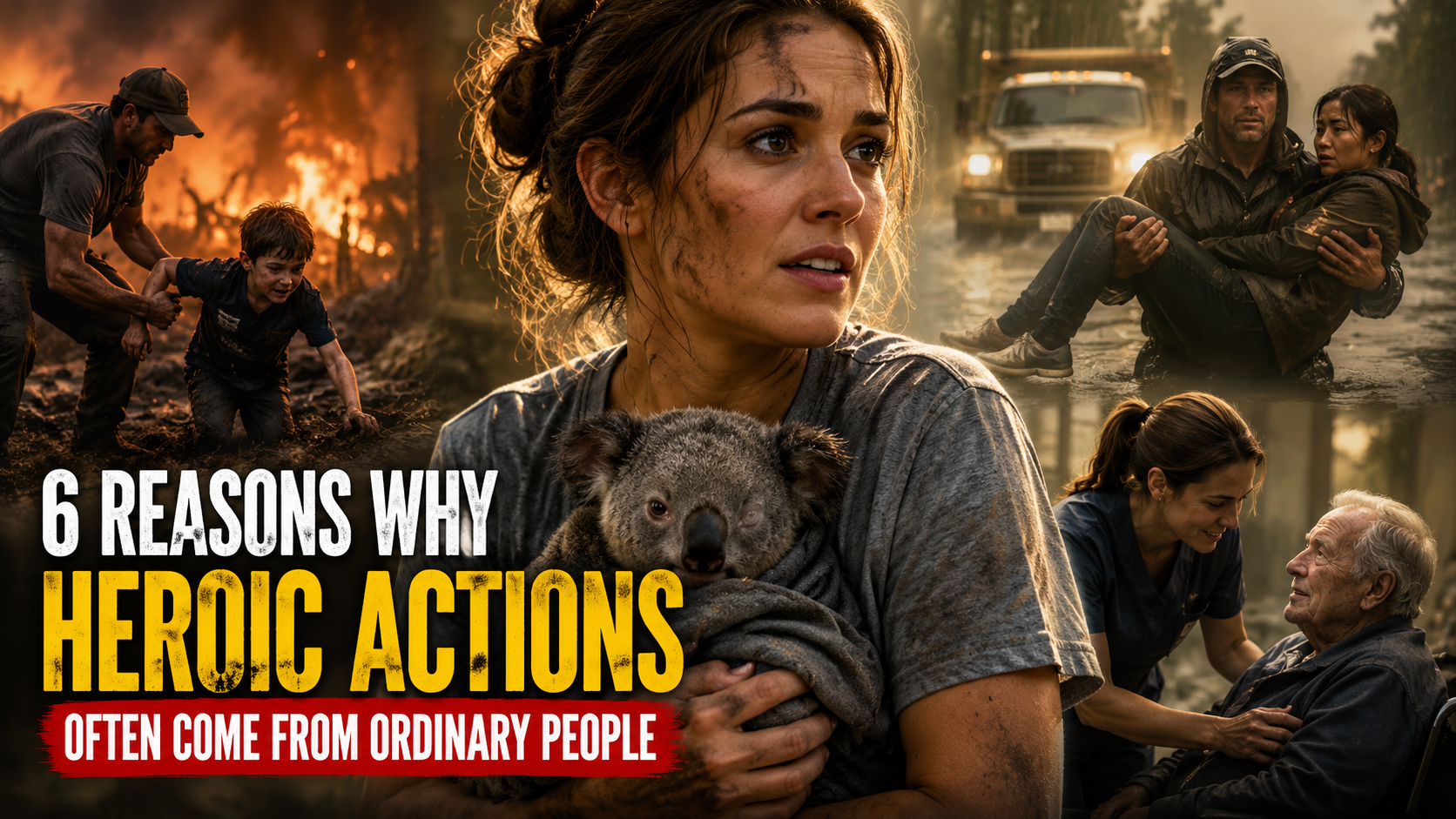
One remarkable example involved a woman who saved a badly injured koala during devastating wildfires. Without special equipment or training, she wrapped the frightened animal in her shirt and poured water over it to protect it from the flames. Her quick thinking and compassion captured attention around the world and reminded people that heroism can appear in unexpected places.
But what drives ordinary people to perform extraordinary acts? Why do some individuals rush toward danger while others freeze? Psychology and behavioral science offer several fascinating explanations.
Here are six reasons heroic actions often come from ordinary people.
1. Empathy Creates an Immediate Need to Help
At the heart of many heroic actions is empathy—the ability to understand and share another person’s or animal’s suffering.
When people witness someone in distress, they often experience an emotional response that motivates them to act. In some situations, the urge to help becomes so powerful that concerns about personal risk temporarily fade into the background.
Researchers have found that empathy can trigger areas of the brain associated with emotional processing and social connection. In simple terms, seeing another living being suffer can feel deeply personal. The stronger the emotional connection, the stronger the motivation to help.
This is particularly true when vulnerable individuals are involved, such as children, elderly people, or animals. Many rescuers later explain that they simply could not stand by and do nothing.
In those critical moments, helping feels less like a choice and more like an instinctive response.
2. Most People Underestimate Their Own Courage
Many people believe they would panic during an emergency. Surprisingly, real-life situations often reveal strengths individuals never knew they possessed.
Human beings are highly adaptable. When confronted with unexpected danger, the brain quickly shifts into problem-solving mode. Adrenaline increases alertness, sharpens focus, and prepares the body for action.
Because emergencies happen suddenly, there is often little time for overthinking. Instead of analyzing every possible consequence, people react to what needs to be done in the moment.
Afterward, many heroes express disbelief about their actions. They frequently say things like:
“I wasn’t thinking.”
“Anyone would have done the same thing.”
“I just reacted.”
These responses highlight an important truth: courage is not always a personality trait. Sometimes it emerges only when circumstances demand it.
3. Strong Values Guide Split-Second Decisions
People carry deeply held beliefs about right and wrong throughout their lives. These values often shape behavior during emergencies.
Individuals who strongly value kindness, responsibility, compassion, or protecting others may be more likely to intervene when someone needs help.
Interestingly, heroic actions are often linked to years of everyday behavior rather than a sudden transformation. People who regularly help neighbors, volunteer in their communities, or care for others tend to develop a stronger sense of social responsibility.
When faced with a crisis, their actions align with values they have practiced for years.
This explains why many heroes don’t see themselves as extraordinary. From their perspective, helping was simply the right thing to do.
4. Emotional Connection Can Override Fear
Fear is a natural and necessary survival mechanism. It helps us recognize danger and avoid unnecessary risks.
However, fear does not always control behavior.
When people feel a strong emotional connection to another person or living creature, that connection can become more powerful than fear itself.
Parents often risk their lives to protect their children. Friends may rush into dangerous situations to help one another. Animal lovers frequently put themselves at risk to save pets or wildlife.
In these situations, emotional bonds shift attention away from personal safety and toward the immediate need to help.
The woman who rescued the injured koala during the wildfire likely experienced this kind of emotional response. Instead of focusing on the danger surrounding her, she focused on the suffering animal in front of her.
That emotional connection became stronger than the fear of the situation.
5. Heroic Moments Often Begin With Small Decisions
Movies often portray heroism as a single dramatic act. Real life is usually different.
Many heroic actions develop through a series of small choices.
A person notices someone in danger.
They decide to move closer.
They assess the situation.
They offer assistance.
They continue helping despite obstacles.
Each decision builds upon the previous one.
Psychologists sometimes refer to this as the “foot-in-the-door” effect. Once individuals commit to helping in a small way, they are more likely to continue helping as the situation unfolds.
As a result, what appears to be a sudden act of bravery is often the outcome of several smaller decisions made within seconds or minutes.
Understanding this process helps explain why ordinary people can find themselves performing extraordinary actions. They rarely start by thinking, “I’m going to be a hero today.”
Instead, they simply take the next helpful step.
6. Human Nature Is More Compassionate Than We Often Assume
News headlines frequently focus on conflict, crime, and tragedy. As a result, many people develop a pessimistic view of human nature.
Yet history repeatedly shows that people are capable of remarkable generosity during difficult times.
Natural disasters, accidents, and emergencies often reveal countless stories of strangers helping strangers. Communities come together, volunteers offer assistance, and individuals make sacrifices to support those in need.
Research suggests that cooperation and compassion are deeply rooted human traits. Throughout history, survival often depended on people working together and supporting one another.
This cooperative instinct still exists today.
While selfish behavior receives significant attention, acts of kindness happen every day—often without recognition or publicity.
Heroic actions remind us that compassion remains a powerful force in society.
The Hidden Hero Inside Everyday People
One of the most inspiring aspects of heroism is its unpredictability. Heroes do not always wear uniforms, hold positions of authority, or possess specialized training.
Often, they are ordinary people responding to extraordinary circumstances.
A parent shielding a child from danger. A stranger helping someone after an accident. A neighbor rescuing a trapped animal. A passerby offering assistance during a crisis.
These individuals rarely set out to become heroes. They simply encounter a moment that requires action and choose to respond.
Their stories remind us that courage is not limited to a select few. It exists within people from all walks of life.
Most of us may never face a dramatic life-or-death situation. However, heroism is not defined solely by grand gestures. It can also be found in everyday acts of kindness, compassion, and selflessness.
Helping someone who is struggling, standing up for another person, supporting a friend through difficult times, or showing care for vulnerable animals all reflect the same qualities that drive larger acts of courage.
The next time you hear about an ordinary person performing an extraordinary rescue, remember that their actions may not be as unusual as they seem. Human beings possess a remarkable capacity for empathy, bravery, and compassion.
And sometimes, when circumstances demand it, those qualities emerge in ways that inspire the world.
Final Thoughts
Heroic actions often capture our attention because they reveal the very best of human nature. While courage may appear extraordinary, the motivations behind it are surprisingly common: empathy, strong values, emotional connection, quick decision-making, and a natural desire to help others.
The truth is that heroes are not always born—they are often ordinary people who choose to act when it matters most.
Their stories serve as powerful reminders that compassion can thrive even in the most difficult situations. And perhaps most importantly, they remind us that each of us may be capable of far more courage than we realize.