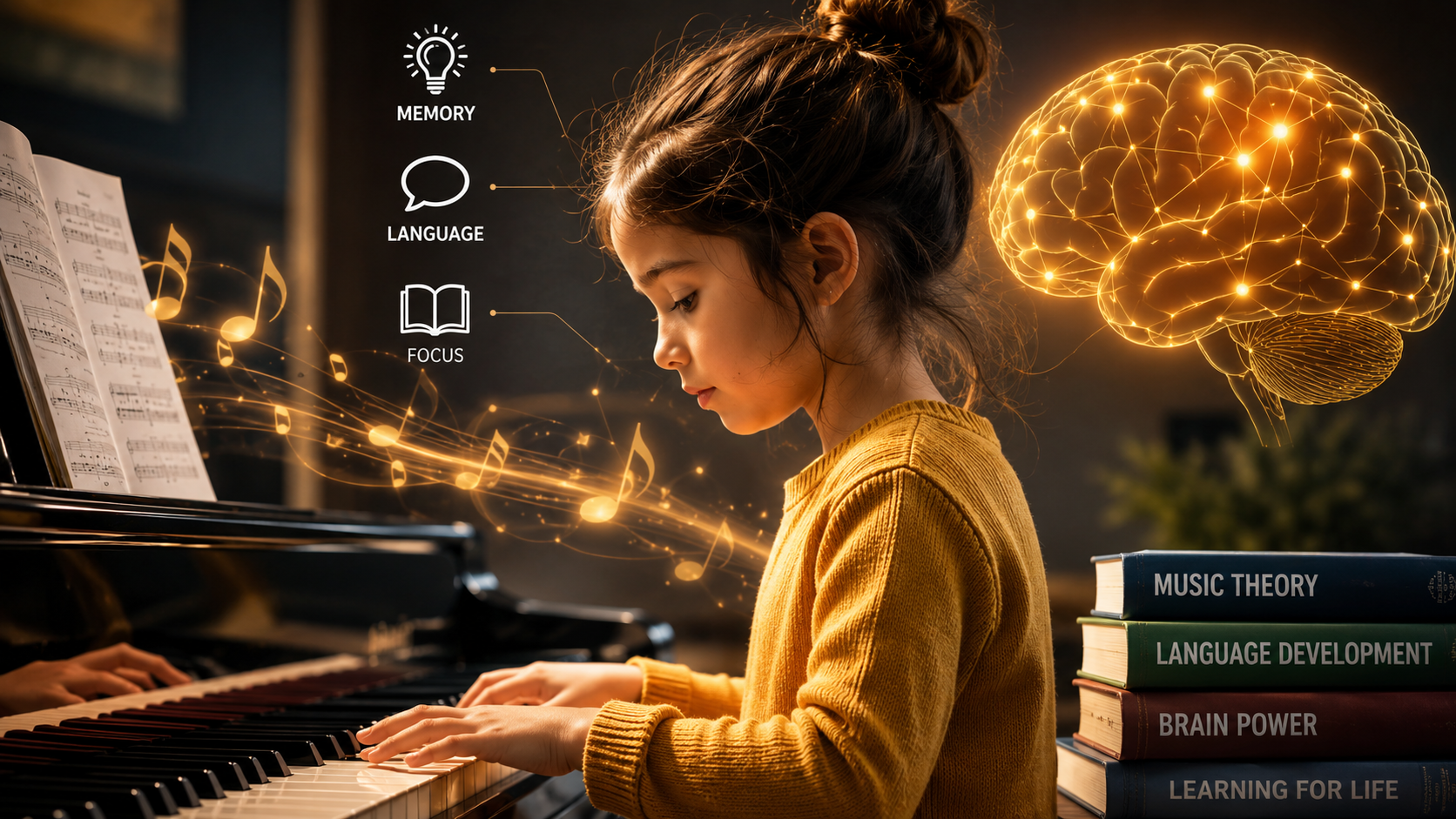
Music is often viewed as a form of entertainment, a creative outlet, or a way to relax after a busy day. But beyond its artistic value, learning music can have a profound impact on the brain. Researchers have found that playing an instrument, singing, or studying music engages multiple areas of the brain simultaneously, creating powerful cognitive benefits that extend far beyond the practice room.
One of the most fascinating discoveries is the connection between music education, memory improvement, and language development. The skills required to learn and perform music closely overlap with those involved in speaking, reading, listening, and remembering information. As a result, people who study music often develop stronger communication abilities and enhanced mental performance.
Whether you’re a child learning your first instrument or an adult exploring music later in life, the benefits can be significant. Here are eight ways learning music can strengthen memory and language skills.
1. Music Trains the Brain to Remember Complex Information
Learning music requires the brain to store and recall large amounts of information. Musicians must remember notes, rhythms, finger placements, dynamics, and timing while performing.
This constant mental exercise strengthens memory systems in much the same way physical exercise strengthens muscles. Over time, musicians become skilled at organizing and retrieving information quickly and accurately.
The process of memorizing songs and musical patterns can also improve overall memory performance, helping individuals retain information in other areas of life, including academics, work, and everyday tasks.
2. It Enhances Listening Skills
Successful musicians learn to listen carefully and pay attention to subtle details in sound.
When practicing music, students must distinguish differences in pitch, tone, rhythm, and timing. This heightened auditory awareness helps train the brain to process sounds more efficiently.
These improved listening abilities often transfer to language comprehension. People who study music may become better at recognizing speech patterns, understanding conversations in noisy environments, and identifying subtle differences in pronunciation.
Strong listening skills form the foundation of effective communication, making this benefit particularly valuable.
3. Music Strengthens Language Processing
Music and language share many similarities. Both involve patterns, structure, timing, and the interpretation of sounds.
When learning music, the brain develops neural pathways that help process complex auditory information. These same pathways are often used when understanding spoken language.
Research suggests that musical training can improve phonological awareness—the ability to recognize and manipulate the sounds within words. This skill plays a crucial role in language development, reading proficiency, and effective communication.
Because of this connection, music education is often associated with stronger language abilities in both children and adults.
4. Learning Music Improves Reading Skills
The relationship between music and reading is stronger than many people realize.
Reading musical notation requires decoding symbols and translating them into meaningful actions. This process is similar to reading written language, where letters and words are interpreted and understood.
Students who learn music often develop stronger pattern-recognition skills, improved concentration, and better auditory processing. These abilities can contribute to reading fluency and comprehension.
Many educators have found that music instruction can complement literacy development by strengthening the underlying cognitive skills involved in reading.
5. It Encourages Better Focus and Concentration
Learning an instrument demands sustained attention.
Musicians must concentrate on rhythm, pitch, technique, and expression while often coordinating both hands and monitoring their performance. This level of mental engagement strengthens attention control and focus.
Improved concentration can have a direct impact on memory formation. When individuals pay closer attention to information, they are more likely to store and recall it later.
As a result, music students often develop stronger study habits and greater ability to maintain focus during challenging tasks.
6. Music Helps Develop Pattern Recognition
Music is built on patterns.
Melodies, rhythms, harmonies, and song structures all rely on recognizing recurring sequences. As students learn music, they become increasingly skilled at identifying these patterns and predicting what comes next.
Pattern recognition is also essential in language. Understanding grammar, sentence structure, and word relationships requires the brain to recognize patterns within communication.
By strengthening this cognitive ability, music education can support language development and improve overall learning efficiency.
7. It Boosts Verbal Memory
Verbal memory refers to the ability to remember words, phrases, and language-based information.
Studies have shown that individuals with musical training often perform better on tasks involving verbal recall. This may be because music requires the brain to process and remember sequences of sounds, a skill closely related to remembering spoken information.
Singers, in particular, frequently memorize lyrics, which combines musical and linguistic processing. This dual engagement can strengthen the brain’s capacity for storing and retrieving verbal information.
Enhanced verbal memory can benefit everything from classroom learning to professional communication.
8. Music Supports Lifelong Brain Health
The cognitive benefits of music are not limited to childhood.
Research suggests that musical activity can help keep the brain active and engaged throughout life. Learning new pieces, practicing techniques, and performing music provide ongoing mental stimulation that challenges memory and cognitive function.
For older adults, music may help maintain mental sharpness and support healthy brain aging. The combination of memory, attention, coordination, and auditory processing involved in music creates a comprehensive workout for the mind.
Even individuals who begin learning music later in life can experience meaningful cognitive benefits.
Why Music and Language Are So Closely Connected
Scientists believe the relationship between music and language exists because both rely on many of the same brain networks. Each requires the interpretation of sounds, recognition of patterns, memory storage, and precise timing.
When people learn music, they repeatedly exercise these shared systems, strengthening the neural connections that support communication and learning. This cross-training effect helps explain why musical education often produces benefits that extend beyond musical ability itself.
Rather than existing as separate skills, music and language appear to reinforce one another in powerful ways.
Getting Started With Music Learning
The good news is that people do not need to become professional musicians to experience these benefits.
Learning an instrument, joining a choir, taking music lessons, or even practicing regularly as a hobby can provide meaningful cognitive stimulation. Consistency matters more than perfection. Small amounts of regular practice can gradually strengthen memory, listening skills, and language-related abilities.
Children often benefit from early exposure to music, but adults can also experience significant improvements through continued musical engagement.
Final Thoughts
Music is much more than a form of artistic expression. It challenges the brain, strengthens memory, sharpens listening skills, and supports language development in remarkable ways.
From improving concentration and reading ability to enhancing verbal memory and auditory processing, the benefits of learning music reach far beyond the stage or practice room. These cognitive advantages can positively influence academic performance, communication skills, and lifelong brain health.
Whether someone picks up a guitar, sits down at a piano, joins a choir, or learns to play the violin, the journey offers more than musical knowledge. It provides an opportunity to build a stronger, more adaptable, and more capable mind—one note at a time.







